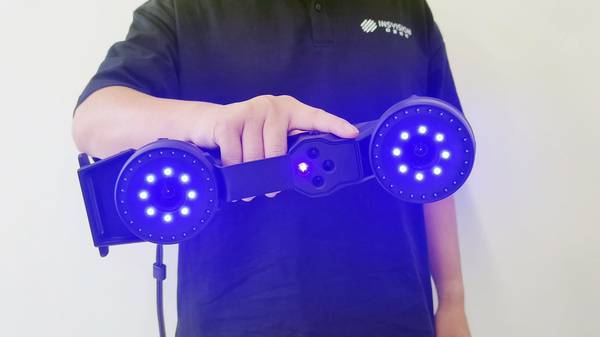
Why “3D Modelleme Cihazı” Is a Trap for Industrial Buyers
Search for “3D modeling device” and you’ll wade through hobbyist scanners, educational tools, and prototyping gadgets. These consumer-grade units deliver impressive visuals for their price point. They collapse under industrial demands.
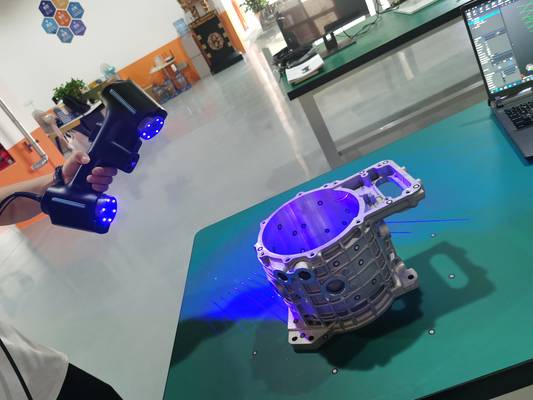
Metrology-grade accuracy, repeatability under thermal stress, and calibration stability—these aren’t marketing add-ons. They’re baseline requirements for production environments. A $2,000 desktop scanner might capture a coffee mug beautifully. It won’t deliver the point cloud precision your robotic welding cell demands or the traceable measurements your quality system requires.
INSVISION engineers industrial 3D camera systems, not modeling toys. Our hardware feeds high-fidelity spatial data directly into automated inspection and robot guidance workflows. The distinction matters: one category produces pretty pictures; the other protects your automation investment and keeps production lines moving.
Consumer vs. Industrial 3D Scanning Capabilities
| Feature | Consumer-Grade Devices | Industrial-Grade (AlphaScan) |
|---|---|---|
| Accuracy & Repeatability | Suitable for visual models only | Metrology-grade, meets automotive/aerospace standards |
| Environmental Tolerance | Fails under thermal stress, vibration, EMI | Withstands shop-floor conditions including coolant mist and metal dust |
| Integration | No native support for automation workflows | Direct output to robot controllers and MES (Siemens, Rockwell, etc.) |
Eliminate Measurement Lag: Real-Time Quality Control on the Line
Coordinate measuring machines (CMMs) excel in climate-controlled labs. By the time a part reaches that lab, you’ve already produced dozens—sometimes hundreds—of non-conforming units. Scrap piles grow. Rework schedules balloon. The financial damage compounds hourly.
Handheld metrology systems rewrite this equation. INSVISION AlphaScan captures complex geometries directly at the production station, delivering immediate feedback to operators. No line stoppage. No batch quarantine. No waiting for lab results.
The portability doesn’t compromise precision. AlphaScan maintains repeatability specifications that satisfy automotive and aerospace standards while operating in ambient shop-floor conditions. Manufacturers embedding this capability upstream catch deviations where they originate, not downstream where they cost exponentially more.
Benefits of In-Line Metrology with AlphaScan
- □ Immediate operator feedback without halting production
- □ Compliance with automotive and aerospace repeatability standards
- □ Detection of deviations at origin, reducing downstream costs
Digital Twins for Complex Geometry: From Reverse Engineering to Failure Analysis
Legacy pump housings. Obsolete casting patterns. Discontinued spare parts with no remaining drawings. Traditional measurement methods—calipers, gauges, even fixed CMMs—struggle with organic surfaces and compound curves. Technicians improvise. Documentation gaps persist. Lead times stretch.
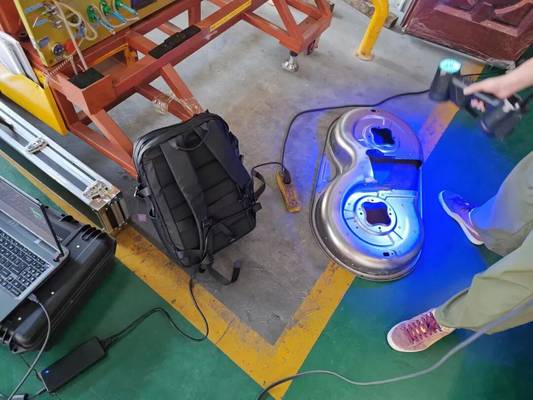
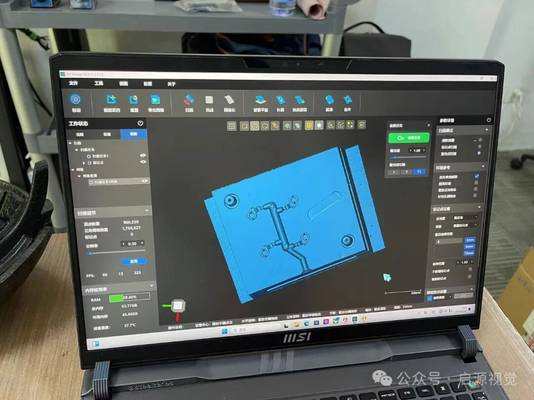
Professional-grade 3D modeling devices transform these scenarios. AlphaScan captures freeform surfaces at micron-level resolution, generating dense point clouds that convert directly into CAD-ready meshes. Maintenance teams collect this data in situ, eliminating the logistical burden of transporting heavy components to inspection facilities.
The applications extend across the asset lifecycle: reverse engineering obsolete components, validating supplier castings, analyzing wear patterns in failed parts. INSVISION systems remove manual measurement error from these workflows while compressing engineering cycles from weeks to days.
Steps to Implement Digital Twin Workflows
- Capture freeform surfaces in situ using AlphaScan at micron-level resolution
- Convert dense point clouds into CAD-ready meshes
- Apply digital twin data across asset lifecycle: reverse engineering, supplier validation, failure analysis
Robot Integration: Building Automation That Actually Works
Robot guidance demands more than “good enough” vision data. Sub-millimeter positioning errors in bin picking or seam tracking propagate into defective welds, dropped parts, and damaged tooling. When your 3D modeling device underperforms, the entire automation cell underperforms with it.
INSVISION’s Norwegian engineering heritage reflects deep specialization in industrial machine vision. AlphaScan integrates natively into robotic cells, outputting structured point clouds that robot controllers process without intermediary conversion. The hardware withstands electromagnetic interference, vibration, and temperature cycling that consumer scanners cannot tolerate.
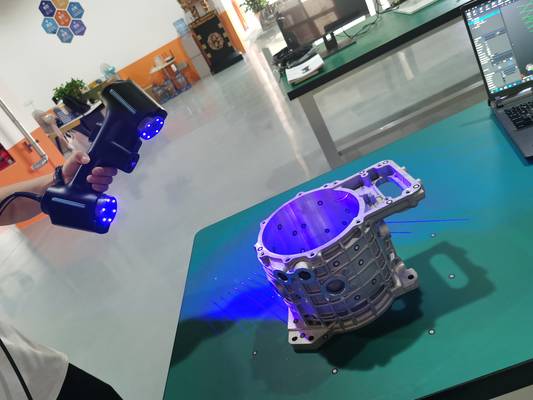
This robustness protects automation capital. Manufacturers deploying AlphaScan as their vision foundation adapt to evolving robotic technologies without replacing core sensing infrastructure. The upgrade path preserves initial investment rather than forcing wholesale replacement.
True Cost of Ownership: Why Cheap Devices Drain Budgets
Entry-level scanners advertise attractive purchase prices. Hidden costs accumulate rapidly in industrial deployment.
Calibration drift requiring weekly recalibration. Plastic housings cracking under shop-floor handling. Software licenses that don’t integrate with your quality management system. Support queues staffed by generalists who’ve never visited a foundry.
AlphaScan carries higher acquisition cost. It earns that back through operational reliability. IP-rated enclosures survive coolant mist and metal dust. Certified accuracy remains stable across annual calibration intervals. Enterprise software integrates with Siemens, Rockwell, and custom MES architectures without middleware workarounds.
Total cost of ownership calculations favor industrial-grade equipment within 18-24 months for typical deployment scenarios. The return accelerates when accounting for avoided downtime, eliminated rework, and sustained automation performance.
Hidden Costs: Consumer vs. Industrial Scanners
| Cost Factor | Consumer-Grade Scanners | AlphaScan (Industrial) |
|---|---|---|
| Calibration | Weekly recalibration due to drift | Stable accuracy over annual intervals |
| Durability | Plastic housings crack under shop-floor use | IP-rated enclosures resist coolant and dust |
| Software Integration | No QMS/MES compatibility; requires middleware | Native integration with Siemens, Rockwell, custom MES |
| Support | Generalists unfamiliar with industrial environments | Industrial-experienced engineering support |
Making the Decision
Procurement teams evaluating 3D modelleme cihazı should demand: traceable accuracy specifications, environmental durability ratings, integration documentation, and referenceable industrial deployments. Consumer products fail these criteria consistently.
the series designs exclusively for production environments. The AlphaScan series represents engineering investment in metrology-grade performance that industrial operations actually require—not the performance that sells well in online marketplaces.