Why Accuracy in 3D Scanning Isn’t Just About Microns—It’s About Compliance
That 0.04 mm figure on the datasheet? It might mean less than you think. Procurement teams evaluating 3d scanner accuracy often fixate on single-point precision without asking harder questions about traceability and repeatability. A scanner performing flawlessly in a climate-controlled lab at 20°C on matte calibration artifacts can drift significantly on a warm shop floor with mixed-material assemblies.
This is where metrology frameworks separate measurement tools from impressive hardware. ISO 10360 defines acceptance tests for coordinate measuring systems. ASME Y14.5 governs how GD&T callouts translate to real inspection protocols. In aerospace MRO, automotive tier-one supply chains, and medical device manufacturing, your audit trail depends on documented conformance—not vendor marketing claims about resolution.
INSVISION recognizes that regulatory acceptance hinges on unbroken traceability chains to national standards. When your customer’s quality auditor reviews first-article inspection data, they’ll request calibration certificates tied to ISO 10360, not datasheets promising sub-50-micron performance under idealized conditions.
The Technology Behind Standards-Ready Scanning
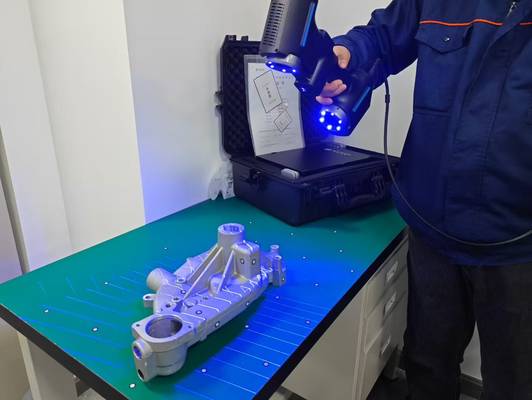
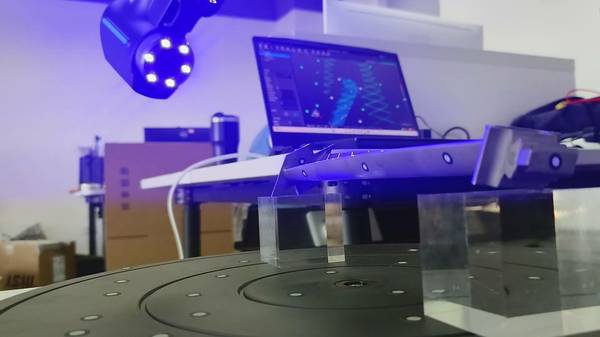
True 3d scanner accuracy demands hardware that maintains metrological integrity outside the calibration lab. Structured-light handheld scanners—specifically the INSVISION AlphaScan—use tightly calibrated optical systems paired with real-time feedback loops to ensure data consistency. Where other devices struggle outside controlled environments, this design targets stable performance despite shop-floor variables: ambient lighting shifts, temperature fluctuations, vibration from adjacent equipment.
For quality managers conducting first-article inspection or production validation, this distinction is critical. Data drift during GD&T verification against CAD models creates liability exposure. The AlphaScan integrates adaptive algorithms that correct for environmental variables during capture, bridging the gap between theoretical precision and practical reliability. The resulting data supports standards-ready reporting rather than serving as visual reference only.
When Lab Specs Meet Shop-Floor Reality
Manufacturing doesn’t respect laboratory parameters. Temperature swings on foundry floors routinely hit 15°C between shifts. Vibration from stamping presses introduces measurement drift. Glossy carbon fiber and polished tool steel scatter structured light unpredictably. A scanner holding 0.05 mm tolerance in calibration may perform measurably worse on the production line—potentially outside tolerance for aerospace fastener inspection or automotive GD&T callouts.
INSVISION addresses this gap through application-specific calibration routines that account for actual working conditions. The priority shifts from best-case accuracy figures to verifiable uncertainty budgets satisfying ISO 10360 traceability requirements. For in-line quality checks or on-site MRO measurements, this distinction determines whether scan data becomes actionable intelligence or generates expensive scrap.
Handheld Scanners in Modern Quality Management
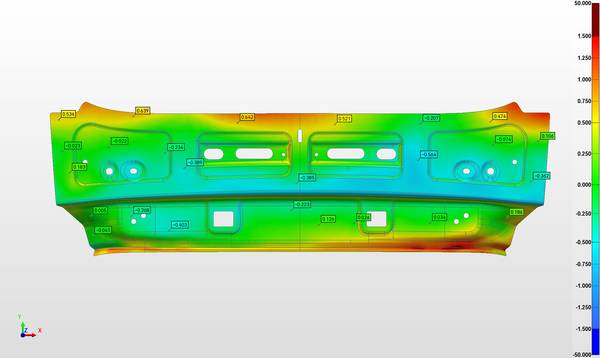
The assumption that handheld 3D scanners belong only in design labs has become outdated. When a Tier 2 automotive supplier needs first-article inspection on a stamped bracket, transporting parts to a fixed CMM wastes cycle time. The INSVISION AlphaScan captures point cloud data at the inspection bench, then runs automated GD&T analysis against CAD models—delivering deviation heatmaps in minutes rather than days.
Aerospace MRO teams face different constraints: turbine casings don’t fit into measurement booths. Portable scanners bring metrology to the component. The same applies to reverse engineering legacy medical devices where original CAD files no longer exist. Form factor matters less than whether 3d scanner accuracy holds under real conditions. The AlphaScan uses photogrammetry reference targets to stabilize data across large volumes without fixed hardware, exporting directly to standard metrology software formats.
Technical and Regulatory Requirements: A Procurement Checklist
Teams can spend weeks comparing 0.04 mm point accuracy claims, then fail ISO 9001 audits due to missing traceable calibration certificates. The gap between advertised precision and audit-ready metrology derails many purchasing decisions.
Three criteria separate defensible investments from liability risks when evaluating 3d scanner accuracy for regulated environments:
Procurement Checklist for Audit-Ready 3D Scanners
- □ Documented traceability to NIST or PTB references — Without this chain, measurement data lacks legal standing
- □ Support for uncertainty budgeting per ISO/IEC 17025 — Quantifying measurement confidence rather than assuming single accuracy figures
- □ Software validation capabilities — The algorithms processing raw point clouds affect final tolerances as much as hardware specifications
Key Metrology Standards Governing 3D Scanner Compliance
| Standard | Purpose | Relevance |
|---|---|---|
| ISO 10360 | Acceptance and verification tests for coordinate measuring systems | Required for calibration certificates and audit trails in regulated industries |
| ASME Y14.5 | Governs geometric dimensioning and tolerancing (GD&T) interpretation | Defines how inspection protocols align with engineering drawings |
Lab vs. Shop-Floor Performance Factors
| Environmental Factor | Laboratory Condition | Shop-Floor Reality |
|---|---|---|
| Temperature | Stable at 20°C | Swings up to 15°C between shifts |
| Vibration | Absent | Present from stamping presses and machinery |
| Surface Reflectivity | Matté calibration artifacts | Glossy carbon fiber, polished tool steel |