Why “3D Scanner Cena” Searches Underestimate True Cost of Ownership
European procurement teams searching “3d scanner cena” naturally prioritize upfront capital expenditure. Yet field data from EU manufacturing operations reveals a consistent pattern: devices selected primarily on purchase price frequently generate 40-60% higher lifetime costs through calibration drift, software lock-in, and unplanned downtime.
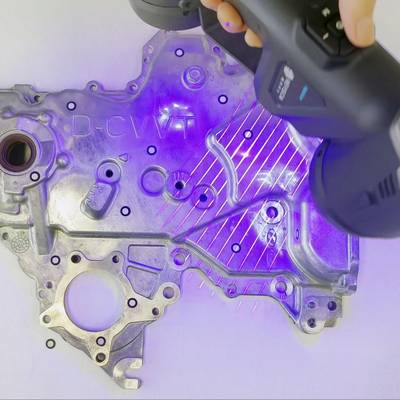
Maintenance logs from German automotive suppliers show consumer-grade hardware requiring service intervals 3x shorter than industrial alternatives. Each calibration cycle pulls metrology engineers from production-critical tasks. Recurring software licensing fees—often excluded from initial quotes—compound annually. INSVISION‘s AlphaScan architecture targets these friction points directly: sealed optical paths reduce contamination-related drift, while perpetual software licensing eliminates subscription uncertainty.
The genuine “cena” spans the asset lifecycle. A €15,000 scanner demanding €4,000 annual maintenance and 48 hours yearly downtime frequently underperforms a €25,000 unit with €800 maintenance and 4 hours downtime. Precision retention—not purchase price—determines ROI velocity.
Total Cost of Ownership Comparison: Budget vs. Industrial Scanners
| Metric | Budget Scanner | Industrial Scanner (AlphaScan) |
|---|---|---|
| Purchase Price | €15,000 | €25,000 |
| Annual Maintenance | €4,000 | €800 |
| Yearly Downtime | 48 hours | 4 hours |
When Budget Hardware Destroys Value: The Hidden Cost of Consumer-Grade Metrology
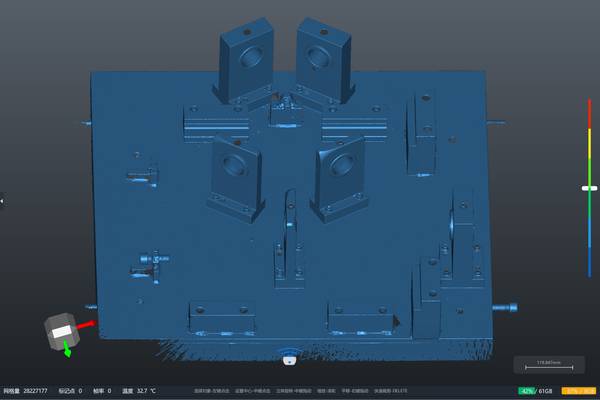
Automotive and aerospace QA managers report identical failure modes from sub-industrial devices: thermal drift in uncontrolled environments, point cloud fragmentation on reflective surfaces, and firmware instability under continuous operation. These aren’t inconveniences—they trigger cascading costs.
A Czech Tier-2 supplier’s experience illustrates the pattern. Their SOL 3D scanner, adequate for prototyping, generated inconsistent mesh data when deployed for production inspection. Result: 23% of first-article inspections required rework, quality holds delayed shipments, and engineering hours diverted to data troubleshooting. Six-month TCO exceeded the device’s purchase price.
AlphaScan’s specification targets these operational realities: ±0.025mm accuracy maintained across 5-40°C ambient range; blue laser architecture resistant to ambient light variation; and MIL-STD-810G vibration tolerance. Metrology-grade repeatability eliminates the rework loops that consume hidden labor hours.
Failure Modes of Sub-Industrial 3D Scanners
| Failure Mode | Operational Impact |
|---|---|
| Thermal drift in uncontrolled environments | Inconsistent measurements requiring rework |
| Point cloud fragmentation on reflective surfaces | Data gaps leading to inspection errors |
| Firmware instability under continuous operation | Unplanned downtime and data loss |
Case Study: 68% Inspection Time Reduction at Czech Automotive Tier-1
Complex aluminum castings presented a familiar bottleneck for a major Czech supplier serving VW Group and Stellantis. Traditional manual CMM inspection required part transport to climate-controlled labs, fixture mounting, and 4.2-hour average cycle times per first-article.
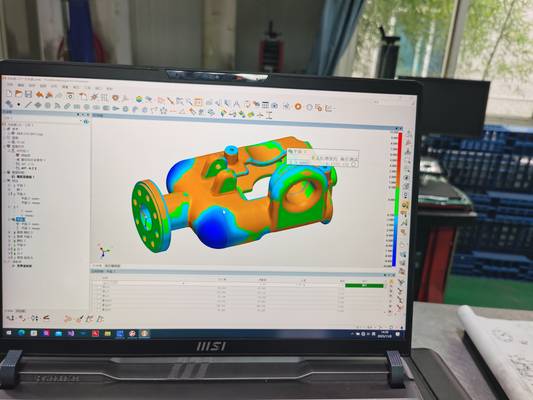
AlphaScan deployment changed the operational model. Handheld inspection at the point of manufacture eliminated transport and fixturing. Direct GD&T extraction through PolyWorks interface maintained existing workflow protocols. The critical metric: first-article inspection compressed to 1.3 hours—a 68% reduction.
Labor reallocation drove secondary gains. Two full-time CMM operators transitioned to process improvement initiatives. Time-to-approval acceleration enabled just-in-sequence delivery commitments previously unachievable. The 3d scanner cena evaluation, initially focused on hardware cost, ultimately centered on throughput multiplication.
Implementation Steps for Handheld 3D Scanning in Production
- Deploy handheld scanner at point of manufacture to eliminate part transport
- Integrate with existing metrology software (e.g., PolyWorks) for GD&T extraction
- Reallocate CMM operators to value-added process improvement roles
- Refocus procurement evaluation from hardware cost to throughput impact
Due Diligence Framework: Five Questions Before Comparing 3D Scanner Cena Lists
Spec sheets rarely predict factory-floor survival. European buyers should verify:
- □ Environmental resilience: IP54 minimum for dust/moisture exposure; operating temperature range matching uncontrolled shop-floor conditions.
- □ Calibration traceability: ISO 17025-accredited certificates with documented uncertainty budgets—not self-certification—for audit-compliant quality systems.
- □ Regional support infrastructure: DACH and CEE buyers specifically benefit from EU-based service engineers. Cross-border repair shipping consumes 2-3 weeks; domestic support reduces mean time to repair below 72 hours.
- □ Software ecosystem integration: Native compatibility with GOM Inspect, PolyWorks Inspector, and Siemens NX CAM avoids the translation errors and workflow discontinuities common with proprietary formats.
- □ Hardware evolution path: Fixed-configuration systems face premature obsolescence. Modular architectures preserving lens sets, mounting interfaces, and software licenses across hardware generations protect capital investment.
INSVISION’s AlphaScan addresses each criterion: IP54 rating, DAkkS-traceable calibration, Munich-based technical support, and open API architecture ensuring integration flexibility.
Future-Proofing Through Open Architecture: The AlphaScan Value Proposition
Closed-system alternatives lock users into fixed specifications. When inspection requirements evolve—tighter tolerances, larger volumes, specialized surface finishes—the hardware cannot adapt. Full replacement becomes the only option, resetting depreciation schedules and retraining workflows.
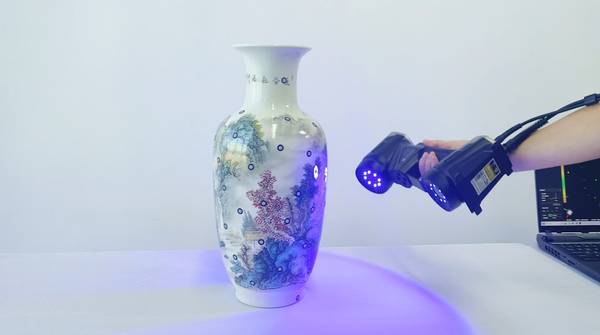
AlphaScan’s modular design enables component-level evolution. A German tooling shop’s five-year operational record demonstrates the model: initial 200mm field-of-view configuration for general reverse engineering; 450mm lens addition for automotive body panel inspection; firmware updates adding automated surface defect detection. Total upgrade investment: 34% of replacement cost for equivalent closed-system hardware.
API access enables custom automation integration. The same German facility developed robotic scanning cells using AlphaScan’s SDK, eliminating operator variation in repetitive inspection sequences. This extensibility transforms hardware from depreciating asset to evolving capability platform.
For procurement teams calculating genuine 3d scanner cena, the arithmetic extends across operational lifespan. Purchase price divided by productive years, adjusted for downtime cost and upgrade flexibility, yields the metric that matters: cost per reliable measurement.