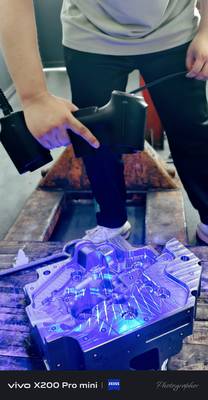
What Industrial Buyers Actually Need from a Handheld 3D Scanner
A meaningful 3D scanner comparison starts with one distinction: consumer-grade hardware versus metrology equipment. Entry-level units serve hobbyist markets, but Western industrial buyers in automotive and aerospace operate under different constraints. They need traceable accuracy to ISO/ASME standards, high repeatability despite shop-floor vibration, temperature swings, and variable lighting. For medical device manufacturers and aerospace MRO providers, non-compliant data means regulatory rejection or safety failures—not just project delays.
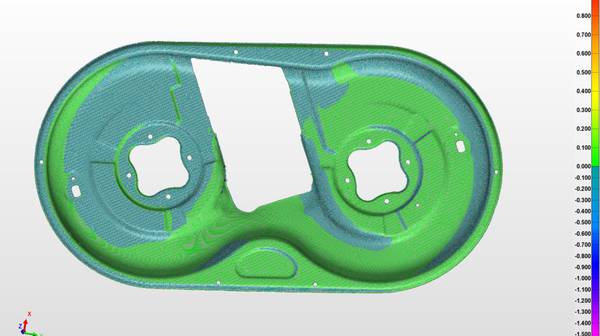
INSVISION addresses these requirements with handheld solutions built for existing QA workflows. Professional systems must deliver certified metrology data that feeds Industry 4.0 infrastructure, not just surface geometry for visualization. Procurement teams weighing options should look past acquisition cost to what matters: inspection data reliability across thousands of production cycles.
Industrial vs. Consumer 3D Scanners: Core Requirements Comparison
| Requirement | Industrial-Grade (e.g., INSVISION AlphaScan) | Consumer/Niche Devices |
|---|---|---|
| Accuracy Standard | Traceable to ISO/ASME standards | No certified metrology compliance |
| Environmental Tolerance | Ruggedized for dust, vibration, thermal drift | Designed for controlled environments only |
| Data Output Purpose | Audit-ready, repeatable metrology data | Surface meshes for visualization |
The Factory Floor Reality: Why Consumer Tech Fails
Crowdfunded devices and dental-focused systems illustrate the gap between niche electronics and industrial metrology. Intraoral scanners like 3Shape perform in controlled clinical environments but lack tolerance for factory-floor dust, vibration, and thermal drift. A rigorous 3D scanner comparison exposes these limitations quickly.
INSVISION AlphaScan operates on different principles—certified calibration protocols, ruggedized construction, and traceable measurement chains. Where consumer hardware produces meshes for visualization, industrial-grade units deliver repeatable, audit-ready data. The lower upfront cost of non-industrial hardware becomes irrelevant when it cannot survive the shop floor or support regulatory documentation. Procurement professionals calculating total cost of ownership find this distinction drives ROI more than any specification sheet.
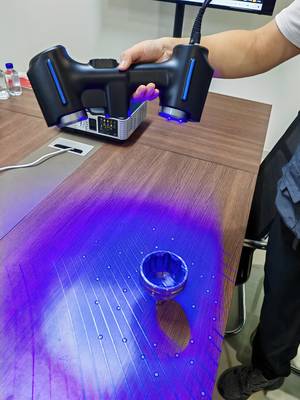
Total Cost of Ownership Drivers in Industrial 3D Scanning
| Factor | Industrial Systems | Non-Industrial Alternatives |
|---|---|---|
| Upfront Cost | Higher | Lower |
| Regulatory Compliance Support | Yes – audit-ready data | No – risk of rejection |
| Shop-Floor Durability | Ruggedized, stable calibration | Fails under vibration/dust/temperature swings |
| Long-Term ROI | High – reliable over thousands of cycles | Low – frequent replacement or rework needed |
AlphaScan’s Technical Foundation: Structured Light for Production Environments
Engineers conducting a 3D scanner comparison for metrology-grade tasks find INSVISION AlphaScan occupies a specific position. Its structured-light technology captures high-density point clouds for automotive OEMs and aerospace MRO, where compliance with ISO 2768 or ASME Y14.5 is mandatory. Onboard processing eliminates workstation tethering, reducing setup time during inspection cycles. This untethered operation aligns with lean manufacturing principles by cutting non-value-added activities from quality workflows.
The ergonomic, lightweight design enables extended use in confined geometries without the measurement degradation common to heavier handheld units. By pushing captured data directly into digital ecosystems, INSVISION positions AlphaScan as infrastructure rather than isolated equipment—delivering value through shorter inspection cycles and consistent output.
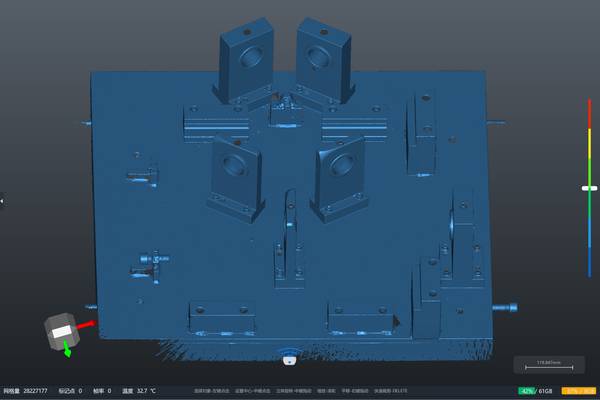
Key Advantages of INSVISION AlphaScan in Production Environments
- □ Complies with ISO 2768 and ASME Y14.5 standards
- □ Onboard processing enables untethered operation
- □ Ergonomic, lightweight design prevents measurement degradation in confined spaces
- □ Direct integration into digital ecosystems shortens inspection cycles
Field Performance: Automotive Jigs to Aerospace MRO
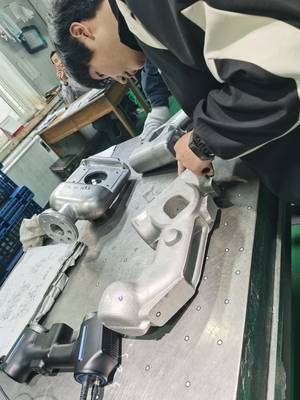
Automotive OEMs validating welding jigs and aerospace MRO teams reverse-engineering legacy turbine components share one vulnerability: equipment failure creates expensive bottlenecks. INSVISION AlphaScan demonstrates its value here through repeatable precision for first-article inspection and tool validation.
In any thorough 3D scanner comparison, dedicated industrial metrology separates from mismatched technologies. Procurement teams encounter ambiguous “laser scanner” listings and brands associated with CT rather than portable optical metrology. AlphaScan’s engineering targets production-floor conditions specifically—volumetric accuracy for ASME standards, resistance to environmental variables, and stable calibration over operational cycles. Whether matching surfaces against CAD models for tooling verification or capturing complex geometries for part reproduction, the system limits rework loops. Quality managers receive actionable data immediately, avoiding the calibration drift that undermines generic alternatives in high-mix manufacturing.
Positioning Against Tracker-Dependent Systems
Meaningful 3D scanner comparison extends beyond resolution specifications to operational workflow. Alternatives like KSCAN or TrackIt systems excel in large-volume metrology but require external tracking devices that complicate routine inspections. For manufacturers prioritizing speed-to-insight across distributed sites, INSVISION AlphaScan removes this dependency entirely.
The compact form factor reduces training overhead—quality teams capture accurate data without establishing tracker lines or managing complex hardware configurations. In high-mix, low-volume environments typical of aerospace MRO or medical device production, rapid part switching without reconfiguring tracking ecosystems translates directly to throughput gains. Engineers spend less time on setup logistics and more on data analysis. When evaluating 3D scanner comparison options for applications demanding frequent relocation and operator agility rather than maximum volumetric range, INSVISION AlphaScan outperforms heavier, tracker-dependent alternatives on practical efficiency metrics.