Why “Small Object” Scanning Still Trips Up Procurement Teams
Ten years ago, digitizing parts under 100mm meant choosing between expensive fixed CMMs or handheld units that couldn’t resolve fine features. That trade-off has narrowed, but not disappeared.
When engineers at a medical device OEM needed to qualify titanium bone screws with M2-M5 threads, they discovered a familiar gap: published resolution specs didn’t translate to usable data on 0.1mm pitch threads. The scanner captured the geometry. It just couldn’t verify the GD&T callouts that mattered for regulatory submission.
In Western manufacturing, “small object” spans three distinct tiers: micro-components under 10mm (dental abutments, watch gears), compact precision parts between 10-50mm (medical implants, electronic connectors), and sub-assemblies up to 100mm (aerospace fasteners). Each carries specific metrology demands—runout tolerances on hip stems, flatness on sealing surfaces, thread profiles on aerospace hardware.
The right 3D scanner for small objects depends less on dimensional limits than on inspection protocol. INSVISION engineers routinely see procurement teams fixate on resolution figures while overlooking repeatability under ISO 10360 or ASME Y14.5. The critical step: match verified volumetric accuracy to your tightest tolerance band, not marketing headlines. Material behavior compounds this—black plastics and polished metals remain problematic across most platforms without surface preparation or hybrid optical approaches.
Handheld Optical Scanning vs. Fixed CMM and Vision Systems: Where Each Fits
A traditional CMM might require twenty minutes of programming and fixturing to check five datum points on a complex bracket. A modern 3D scanner for small objects captures millions of surface points in under two minutes.
Fixed Coordinate Measuring Machines retain their position for validating single-point tolerances to the micron level—essential for aerospace or medical compliance where ISO 17025 traceability is mandatory. But tactile probing struggles with soft materials and intricate freeform surfaces. Vision systems offer speed yet often lack depth of field for complex geometries.
Structured-light solutions bridge this gap by enabling full-surface capture without rigid fixturing. This supports on-floor deployment in agile production cells, cutting measurement cycle time substantially. While some competitors push hybrid systems toward 0.02mm accuracy, the operational gain for most manufacturers is instant deviation mapping against nominal CAD. INSVISION facilitates this workflow flexibility, though CMMs maintain their role for ultra-high-precision point verification in strictly regulated environments.
The question isn’t which technology wins. It’s which combination matches your quality plan.
Technology Comparison: Handheld Scanning vs. Fixed CMM vs. Vision Systems
| Capability | Handheld Optical Scanner | Fixed CMM | Vision System | |
|---|---|---|---|---|
| Surface Capture Speed | Millions of points in <2 min | Minutes per few datum points | Fast, but limited depth | |
| Precision Level | Sub-0.03mm with hybrid optics | Micron-level single-point | Moderate, geometry-dependent | |
| Material Limitations | Challenged by dark/glossy without prep | Struggles with soft/freeform | Limited on complex 3D shapes | |
| Regulatory Traceability | ISO 17025 possible (e.g., AlphaScan) | ISO 17025 standard | Varies by system |
Selection Criteria That Actually Drive ROI
Selecting a 3D scanner for small objects means prioritizing certified repeatability over nominal resolution. Marketing datasheets highlight micron-level figures, but for medical device or automotive supply chains, volumetric accuracy traceability—specifically ISO 17025 validation—remains the non-negotiable metric. You’re not capturing a point cloud; you’re verifying GD&T compliance on production parts.
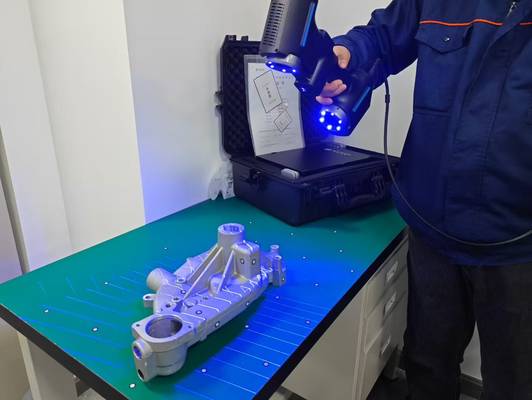
Material adaptability is equally critical. While competitors deploy hybrid laser and structured-light systems to manage reflective surfaces, many devices still falter on dark or glossy parts without preparation. Evaluate workflow integration: the hardware must feed data directly into inspection software like Geomagic Control X or PolyWorks without translation errors. INSVISION aligns with these requirements by emphasizing metrology-grade validation rather than visual capture alone.
Automation potential matters for high-mix manufacturing. Can the system maintain sub-0.025mm accuracy consistently, or does it require constant manual calibration? This distinction defines operational ROI when part geometries shift frequently.
Key Selection Criteria for Small-Object Scanners
- Certified repeatability over nominal resolution
- ISO 17025 traceability for volumetric accuracy
- Material adaptability without surface prep
- Direct integration with metrology software (e.g., Geomagic, PolyWorks)
- Consistent sub-0.025mm accuracy without constant recalibration
Where Handheld Scanning Has Earned Its Place
Handheld scanners were once dismissed for sub-100mm precision work. That assumption no longer holds. Systems like the INSVISION 3D scanner for small objects have shifted the equation in specific scenarios.
First-article inspection on injection-molded components illustrates why. CMM setup demands fixturing and probe programming—often hours before capturing a single point. Handheld scanning delivers surface deviation against nominal CAD in minutes, enabling GD&T validation on intricate geometries before production release. Reverse engineering legacy parts eliminates the same bottleneck: scan as-built condition and generate CAD without manual measurement iterations.
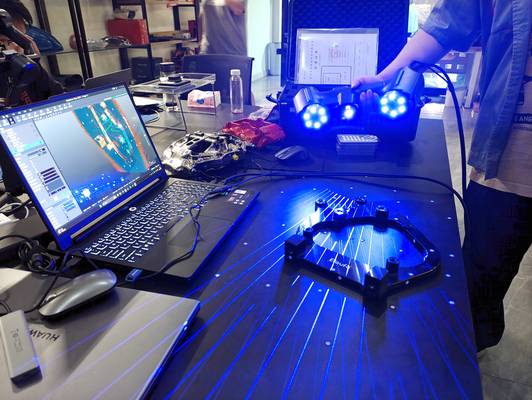
Low-volume, high-mix production presents a different advantage. Fixed sensor stations struggle when part geometry shifts between SKUs. A handheld unit adapts immediately. Aerospace MRO crews apply this to digital twin creation—documenting wear on turbine blades or structural fittings before repair routing.
The differentiator now isn’t portability. It’s whether you can achieve sub-0.03mm accuracy on dark or reflective surfaces without spraying.
INSVISION AlphaScan: Certified Micro-Metrology for Production Floors
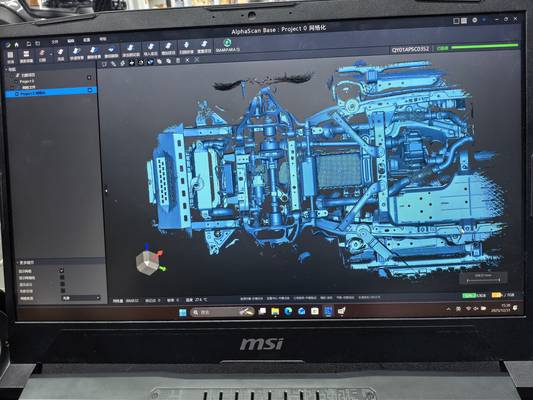
The INSVISION AlphaScan occupies a specific position: certified micro-metrology for small objects under 50mm where most handheld scanners fall short. While competitors achieve comparable accuracy figures, few provide full ISO 17025 traceability for sub-50mm components—a gap that matters when validating medical implants or micro-electronics with actual GD&T callouts on the line.
Built around structured-light technology rather than laser, the AlphaScan handles intricate geometries that challenge typical handheld units. Dark plastics, shiny metals, and complex surface finishes scan without preparation. It connects directly to standard metrology software—Geomagic Control X, PolyWorks—so first-article inspection workflows require no reconstruction.
The housing is designed for factory floors, not just clean rooms. Dust, vibration, and temperature variation are expected conditions. For procurement teams weighing flexibility against certified reliability, the AlphaScan sits in a narrow middle ground: portable enough for shop-floor use, accurate enough for traceable inspection.
Decision Framework: From Specification to Deployment
A decade ago, selecting a 3D scanner for small objects meant choosing between speed and accuracy. Today’s options have multiplied, but the methodology remains grounded in engineering fundamentals.
Define your tolerance band and feature scale first. A 0.05mm accuracy claim means nothing if critical features sit at 0.02mm. Know your GD&T callouts before evaluating hardware. Confront material realities directly—black plastics and polished metals still defeat many systems, and competitors are aggressively pursuing multi-spectral solutions to close this gap.
Map data requirements explicitly. If quality teams need automated GD&T reports with ISO 17025 traceability, verify the software pipeline supports it. Hardware specifications alone won’t deliver compliance. Finally, assess workflow integration: device communication with PLM systems, calibration requirements, and operator training demands.
For sub-100mm industrial components requiring both speed and metrological rigor, modern handheld scanners like the INSVISION AlphaScan offer a balanced path—provided the homework above precedes the purchase order. Choosing the right 3D scanner for small objects ultimately comes down to matching certified accuracy to your specific tolerance requirements and production environment.