Why “Genauigkeit” Belongs in Your Operations Manual, Not Your Marketing Deck
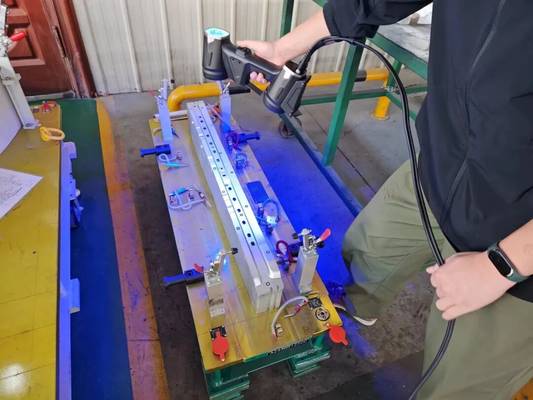
For procurement teams in automotive and aerospace, 3D scanner genauigkeit (accuracy) functions as a direct proxy for production risk. Marketing materials love to trumpet theoretical performance under laboratory conditions—perfect temperature, zero vibration, pristine calibration. Manufacturing floors offer none of these luxuries.
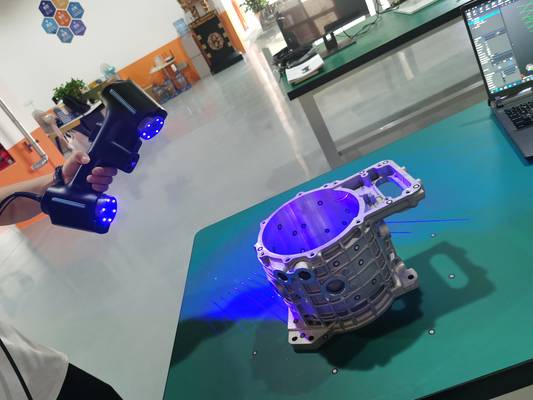
The gap between datasheet promise and shop-floor reality carries measurable consequences. In precision tooling, a 50-micron deviation on a critical mating surface can cascade into assembly failures, warranty claims, or regulatory non-compliance. The financial exposure isn’t hypothetical: undetected dimensional drift in injection molds routinely generates €40,000–€60,000 monthly losses from scrap and rework, based on documented cases across German automotive suppliers.
Professional buyers have learned to distrust unverified specifications. Traceable metrology standards—specifically VDI/VDE 2634 for optical 3D scanning—provide the only reliable framework for performance validation. These protocols test volumetric accuracy under realistic conditions, not idealized scenarios. At INSVISION, we’ve built our specification process around certified precision because quality control decisions demand data you can defend to auditors and customers alike.
The Hidden Production Tax of Sub-Standard Scanning
Low-accuracy 3D scanning imposes costs that rarely appear in capital expenditure spreadsheets. The mechanism is straightforward: imprecise point clouds propagate errors through downstream processes, generating mismatched assemblies, rejected tooling, and emergency engineering changes.
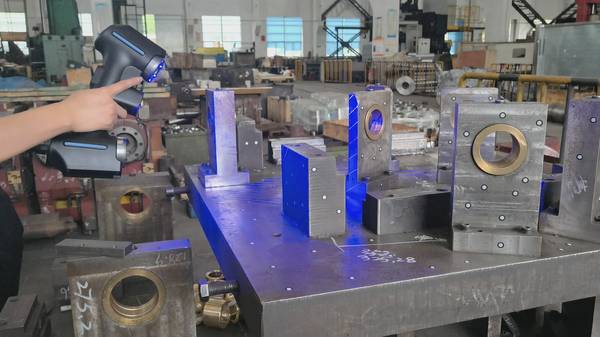
Consider the documented case of a Bavarian moldmaker operating with entry-level scanning hardware. Surface warpage on critical cooling channels went undetected during incoming inspection, producing defective parts that only failed during customer assembly. Monthly losses stabilized at €48,000 before implementation of a metrology-grade handheld system capable of resolving true surface geometry. The payback period: under four months.
This pattern repeats across industries. Consumer-grade equipment—adequate for visualization or rough reverse engineering—lacks the stability and traceability required for production validation. When scan uncertainty forces 100% hard-gauge verification or triggers false-positive rejections, the operational friction consumes any apparent hardware savings. Reliable metrology isn’t a premium option; it’s infrastructure that protects margin.
What Actually Determines Scanner Performance on Your Floor
Datasheet specifications describe potential, not predictability. True 3D scanner genauigkeit emerges from how systems manage the environmental insults of active manufacturing: thermal cycling from adjacent processes, vibration transmitted through concrete floors, electromagnetic interference from welding equipment.
Key Engineering Factors for Professional 3D Scanners
- □ Calibration architecture: Self-monitoring reference frames that detect and compensate for thermal drift in real time
- □ Tracking robustness: Optical or inertial systems maintaining sub-pixel positional certainty despite operator motion and ambient light variation
- □ Algorithmic compensation: Software pipelines that identify and filter outlier measurements without suppressing legitimate geometric features
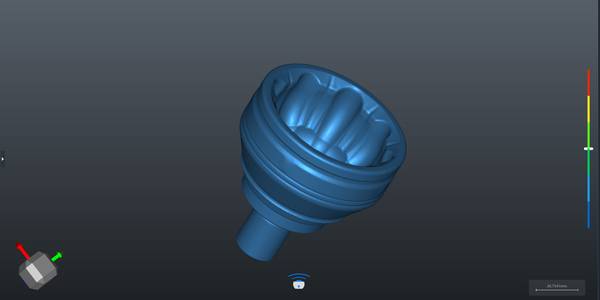
Handheld scanners face the sternest test here. Without the structural stability of fixed CMMs, they must derive precision entirely from intelligent sensor fusion. INSVISION’s approach prioritizes dynamic error correction—systems that continuously validate their own positional certainty and flag conditions that threaten measurement integrity. The result: trustworthy data in environments where consumer equipment produces decorative point clouds.
Case Application: When Shop-Floor Mobility Replaces CMM Bottlenecks
Fixed coordinate measuring machines deliver exceptional precision, but they impose logistical constraints that erode throughput. Large automotive fixtures require disassembly and transport to climate-controlled metrology labs. Turbine blades need custom fixturing and programming before first measurement. Each queue adds days to validation cycles.
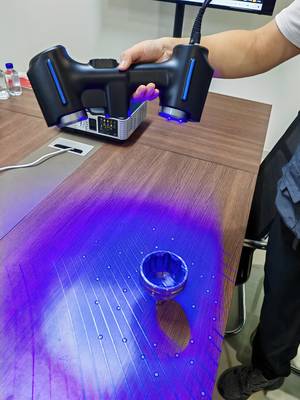
The AlphaScan from INSVISION addresses this friction point directly. Certified to ±0.025 mm volumetric accuracy per VDI/VDE 2634 Part 3, the system relocates CMM-grade measurement to the production line. Automotive tooling validation proceeds without fixture removal; blade inspection captures complex airfoil geometry without dedicated CMM programming.
Operational Benefits of Mobile Metrology Implementation
- Eliminating transport and queue time compresses inspection cycles from days to hours
- Measurement capacity scales with production demand rather than lab capacity
- For high-mix, low-volume production, metrology overhead converts from fixed to variable cost aligned with actual throughput
Right-Sizing Accuracy: Matching Specification to Application
Not every measurement task demands the tightest available tolerance. Procurement teams routinely over-specify 3D scanner genauigkeit, acquiring metrology-grade systems for applications where standard industrial accuracy suffices. The capital misallocation is significant: the price differential between accuracy tiers often exceeds 200%, with no operational benefit for the overspecification.
Application-appropriate selection requires honest assessment of actual tolerance requirements:
Accuracy Requirements by Application
| Application | Typical Accuracy Requirement | Risk of Overspecification |
|---|---|---|
| Legacy part reverse engineering | ±0.1 mm | High—surface capture priority over dimensional precision |
| Casting and forging inspection | ±0.05 mm | Moderate—process variation exceeds scanner uncertainty |
| GD&T validation, precision components | ±0.02 mm | Low—tolerance stack-up demands measurement certainty |
| Tooling qualification, medical devices | ±0.01 mm | None—regulatory and performance requirements justify premium |
INSVISION’s Tiered Product Approach
| System Capability | Process Alignment | Outcome |
|---|---|---|
| Aligned with actual tolerance requirements | Avoids unnecessary metrology-grade acquisition | Prevents capital misallocation exceeding 200% |
| Measurement uncertainty as negligible contributor | Matched to total process variation | Ensures operational efficiency without overspending |
the series’s product architecture supports this tiered approach. Rather than forcing all applications toward maximum specification, we align system capability with process requirements. The objective isn’t selling the most expensive scanner—it’s ensuring measurement uncertainty remains a negligible contributor to total process variation.
The Procurement Imperative
Industrial 3D scanning has matured beyond novelty into critical quality infrastructure. As this transition completes, the evaluation criteria have sharpened. Datasheet specifications provide starting points; certified performance under realistic conditions determines actual value.
For decision-makers, the essential questions have shifted: Does this system maintain accuracy in my environment? Can I trace measurements to recognized standards? Will the data stand up to customer audit and regulatory scrutiny?
3D scanner genauigkeit, properly understood, is neither abstract engineering virtue nor marketing differentiator. It is a contractual guarantee—between supplier and manufacturer, between manufacturer and end customer—that physical reality matches design intent. Equipment selections that respect this reality protect operational margin. Those that don’t simply defer costs into production failures and customer claims.