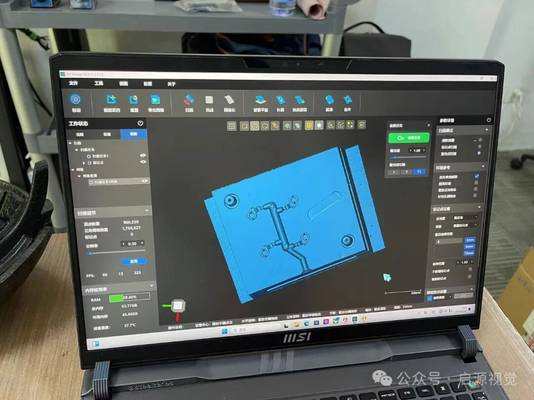
Hidden Costs Beyond Initial 3D Scanner Harga
| Cost Factor | Description |
|---|---|
| Acquisition Cost | Represents only 15–20% of total ownership expenses |
| Integration Delays | Time lost during system setup and compatibility resolution |
| Calibration Downtime | Operational pauses required for maintaining measurement accuracy |
| Measurement Uncertainty | Cascading costs from errors leading to rework or scrap |
Beyond the Price Tag: What “3D Scanner Harga” Actually Means for Precision Manufacturers
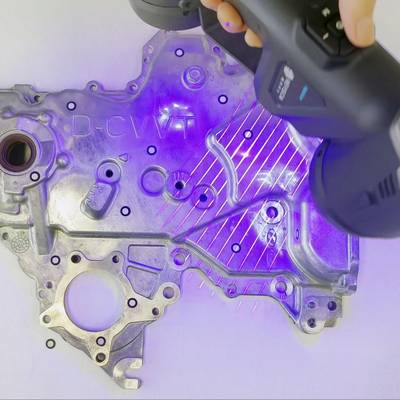
The search for “3d scanner harga” rarely ends with the lowest quote. Veteran procurement teams in aerospace, automotive, and energy sectors know that acquisition cost represents roughly 15-20% of total ownership expenses. The remaining burden falls on integration delays, calibration downtime, and the cascading costs of measurement uncertainty.
INSVISION engineers its systems to compress these hidden liabilities. The Alpha-Projector exemplifies this approach: its binocular vision architecture achieves 0.25mm positioning accuracy while replacing manual scribing with laser-projected guidance derived directly from native CAD files. When workpieces shift during assembly—a common occurrence in large-component manufacturing—the system’s dynamic tracking recalculates projection paths in real time without operator intervention. This eliminates the misalignment errors that typically trigger expensive rework cycles.
Key Software Advantages for Interoperability
- □ PTB certification ensures traceability to international measurement standards
- □ Native compatibility with CATIA CPD removes data translation friction
- □ Native compatibility with FiberSIM streamlines composites workflows
- □ Reduces dependency on specialized integration contractors
The software layer proves equally critical. PTB certification ensures traceability to international measurement standards, while native compatibility with CATIA CPD and FiberSIM removes the data translation friction that plagues mixed-vendor environments. For manufacturers evaluating 3d scanner harga across multiple suppliers, this interoperability translates to weeks shaved off deployment timelines and reduced dependency on specialized integration contractors.
Why Measurement Errors Cost More Than the Hardware: AlphaScan in Production Environments
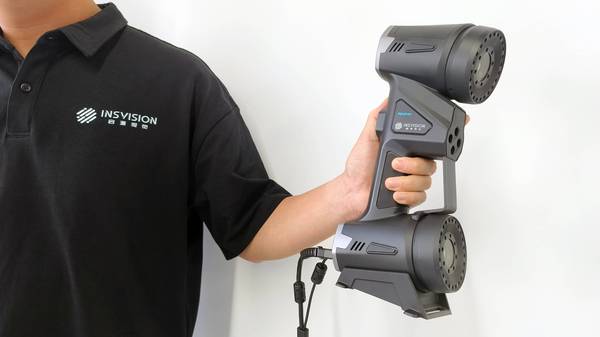
Composite layup operations in aerospace and prototype validation in automotive share a common vulnerability: manual measurement protocols introduce deviation rates that compound across production stages. A single misaligned ply in a carbon fiber component can compromise structural integrity, triggering scrap costs that dwarf the original inspection equipment investment.
The AlphaScan handheld system addresses this through programmatic guidance—projecting step-by-step visual instructions that remove operator discretion from critical sequences. The PTB-certified software backbone supports multi-source point cloud alignment and integrated GD&T analysis, ensuring that dimensional reporting meets customer audit requirements without secondary processing.
Workflow Acceleration Through AlphaScan Interface
- Technicians navigate directly from 2D drawings or 3D models
- Logically sequenced workflows guide users through critical steps
- Training intervals reduce from weeks to days
The interface design reflects field-tested ergonomics rather than engineering abstraction. Technicians navigate directly from 2D drawings or 3D models through logically sequenced workflows, reducing training intervals from weeks to days. When procurement teams weigh 3d scanner harga against operational impact, this acceleration of workforce readiness represents recoverable value that spreadsheet comparisons typically miss.
Closing the Digital-Physical Gap: Alpha-Projector’s Impact on Assembly Throughput
Physical templates and manual marking remain entrenched in wind turbine manufacturing and aircraft assembly—not from preference, but from lack of viable alternatives. These methods carry inherent latency: template fabrication, storage logistics, and the inevitable rework when human interpretation diverges from design intent.
The Alpha-Projector replaces this infrastructure with direct laser projection of CAD-derived contours. The 0.25mm accuracy specification applies under dynamic conditions; the vision system continuously monitors workpiece position and adjusts the projected path to maintain registration. This capability proves particularly valuable in large-structure assembly, where thermal expansion and handling tolerances routinely defeat static positioning methods.
the series Operational Gains
| Metric | Improvement |
|---|---|
| Assembly Cycle Time | 40%+ reduction from workpiece positioning through final verification |
| Physical Template Inventory | Eliminated entirely |
| First-Pass Assembly Defect Rate | Near-zero |
Field deployments demonstrate 40%+ reduction in assembly cycle times, measured from workpiece positioning through final verification. The elimination of physical template inventory and the near-zero defect rate on first-pass assembly compound these gains. For manufacturers comparing 3d scanner harga across inspection-only devices, this operational transformation redefines the evaluation framework entirely.
Unattended Metrology: AlphaAutoScan-400 in High-Volume Quality Control
Labor availability constraints have shifted automation from efficiency preference to operational necessity. The AlphaAutoScan-400 integrates into production lines for continuous scanning without operator presence, addressing inspection bottlenecks that currently throttle output in many facilities.
The system’s PTB-certified software environment includes embedded GD&T engines that execute automated pass/fail determination against specified tolerances. This shifts skilled metrologists from repetitive data acquisition to analytical and process-improvement functions—precisely the redeployment that addresses both throughput and retention challenges.
Training requirements remain minimal despite the technical sophistication. The interface abstracts complex point cloud processing and alignment algorithms into task-specific workflows accessible to production staff. When 3d scanner harga evaluations extend to five-year operational projections, the AlphaAutoScan-400’s combination of labor efficiency and measurement consistency typically demonstrates payback periods under eighteen months.
Evaluating Total Investment: A Framework for “3D Scanner Harga” Decisions
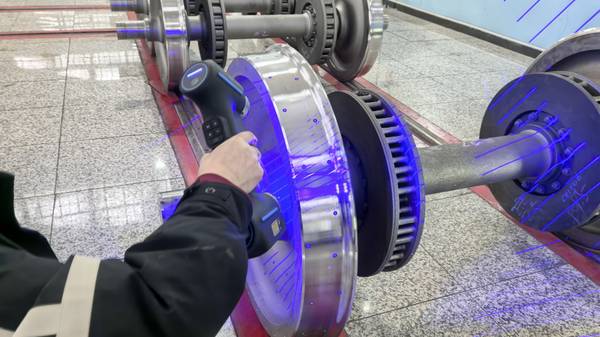
Procurement teams searching 3d scanner harga encounter a fragmented market: consumer-grade devices with industrial aspirations, modular systems requiring extensive customization, and vertically integrated platforms with corresponding price premiums. Discerning the appropriate category requires mapping specific operational requirements against capability matrices.
Fragmented solutions—often attractive on initial quotation—frequently incur integration costs that exceed the hardware differential. Data format incompatibilities between scanning hardware and downstream engineering systems (particularly specialized composites packages like FiberSIM) generate manual translation workflows that erode productivity gains.
INSVISION’s architecture prioritizes ecosystem coherence over feature accumulation. The 0.25mm binocular vision specification, dynamic tracking compensation, and PTB-certified metrology software form an integrated stack rather than assembled components. This design philosophy extends to the programmatic guidance systems that replace error-prone manual procedures across multiple product lines, including the AlphaScan handheld scanner, AlphaVista blue light scanner, and X-Track optical tracking system.
For manufacturers transitioning from template-based or manual measurement methods, this integration depth determines whether digital transformation accelerates production or creates parallel complexity. The appropriate 3d scanner harga evaluation weights these implementation factors alongside hardware specifications—recognizing that the cheapest qualified device rarely delivers the lowest total cost of ownership.