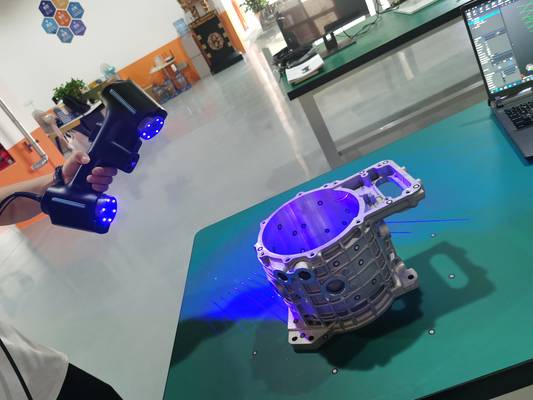
Why Your “±0.02 mm” Datasheet Means Nothing on the Shop Floor
That single accuracy figure in bold? It likely came from a climate-controlled metrology lab, measured on a granite table, with a technician who spent twenty minutes letting the unit thermally stabilize. Drop the same hardware onto an automotive assembly line with forklift vibration and 15°C temperature swings, and watch those microns evaporate.
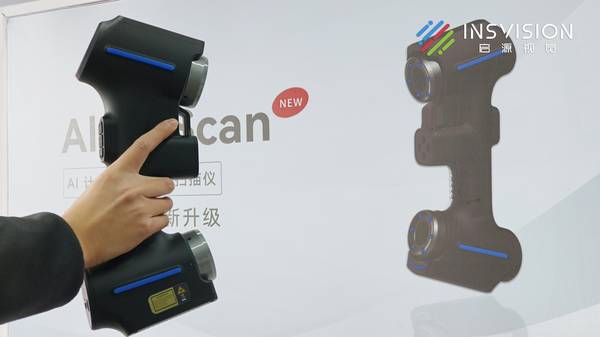
When evaluating 3d scanner specifications, Western procurement teams have learned this lesson the hard way. A European Tier-1 supplier recently discovered their “high accuracy” scanner drifted 40 microns during morning startup—enough to scrap an entire batch of first-article inspection reports. The root cause: no published uncertainty budget, no thermal compensation, and calibration traceability that stopped at the distributor’s warehouse.
Real metrology-grade 3D scanner specifications anchor to ISO 17025 for calibration certainty and ASME B89.4.22 for performance evaluation. These frameworks demand repeatability testing across surface finishes, temperatures, and operator skill levels—not isolated best-case measurements. INSVISION builds every specification document around these standards, giving Quality Managers data they can defend to external auditors.
What Engineers Must Verify Before Signing the PO
Volumetric accuracy dominates the conversation, yet thermal drift remains the silent killer in automotive and aerospace MRO environments. A scanner maintaining ±0.020 mm at 20°C that balloons to ±0.060 mm at 28°C compromises every measurement on a non-climate-controlled floor. Engineers should demand temperature coefficient data, not just a single-point accuracy claim.
Noise floor matters more than point resolution. A 0.02 mm point spacing specification means nothing if surface noise obscures sharp edges or thin-walled castings. Inspect the standard deviation of repeated measurements on matte black versus glossy surfaces—this reveals whether the hardware handles real materials or just laboratory gray cards.
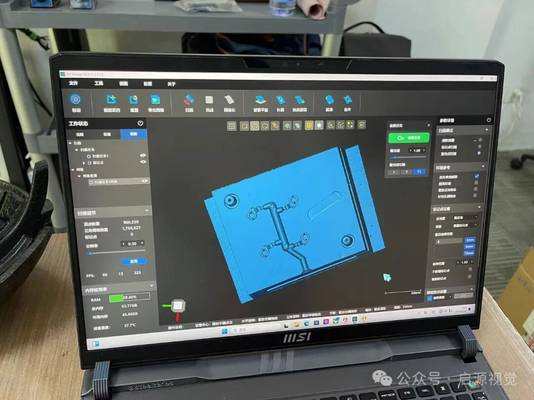
For handheld systems, frame rate determines practical throughput. Below 30 fps, tracking loss during complex articulation forces repeated scans, creating bottlenecks in lean manufacturing cells. INSVISION publishes frame rate under full resolution, not degraded preview modes, letting engineers calculate actual cycle times.
Traceable calibration certificates complete the picture. Without NIST-traceable or equivalent documentation, scanner data cannot support critical decisions in ISO 9001 or AS9100 workflows. Verify the certificate includes actual measurement uncertainties, not just pass/fail statements.
Critical Verification Checklist for Scanner Procurement
- □ Demand temperature coefficient data alongside single-point accuracy claims
- □ Evaluate surface noise performance on both matte black and glossy materials
- □ Confirm frame rate is published at full resolution, not preview mode
- □ Require NIST-traceable calibration certificates with actual measurement uncertainties
Mapping Technical Thresholds to Real Applications
First-article inspection of cast turbine housings demands scan volume exceeding part envelope by 30% minimum, plus edge retention algorithms that preserve fillet geometry. Tooling validation in automated cells requires HDR texture capture resolving dark cavities and reflective mold surfaces without preparation spray—every coating step adds cost and variability.
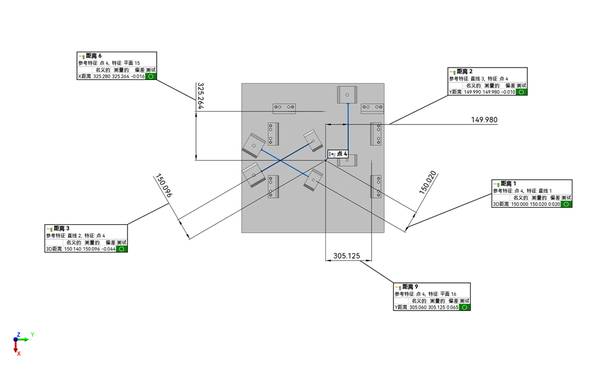
Integration compatibility often determines project success or failure. Seamless data flow into PolyWorks, Geomagic Control X, or native GD&T modules eliminates manual translation errors and maintains audit trails. INSVISION outputs metrology-grade point clouds and meshes that plug directly into established quality loops, not proprietary formats requiring reverse engineering workarounds.
Procurement teams defining these thresholds in the RFP stage avoid expensive retrofitting. One North American aerospace supplier saved $340,000 in integration costs by specifying native STEP/IGES export and direct CMM correlation protocols upfront, eliminating a competitor’s format conversion middleware entirely.
INSVISION AlphaScan Integration Requirements vs. Cost Impact
| Integration Requirement | Cost Avoidance Outcome | Source |
|---|---|---|
| Native STEP/IGES export | Eliminated format conversion middleware | |
| Direct CMM correlation protocols | Avoided $340,000 in retrofitting costs |
Inside INSVISION AlphaScan: Specifications Built for Validation
The AlphaScan handheld system delivers 3D scanner specifications engineered for compliance documentation, not marketing impressions. Volumetric accuracy of ±0.020 mm is verified through NIST-traceable artifact measurement, with full uncertainty budgets published per GUM guidelines. Point spacing of 0.05 mm at 300 mm working distance captures surface geometry sufficient for sub-100-micron tolerance analysis, while real-time mesh generation eliminates post-processing delays.
Construction matches the specification rigor. IP54 sealing withstands aluminum dust and coolant mist common in machining centers. The thermal compensation system maintains accuracy across 10°C to 35°C ambient—critical for facilities without precision HVAC.
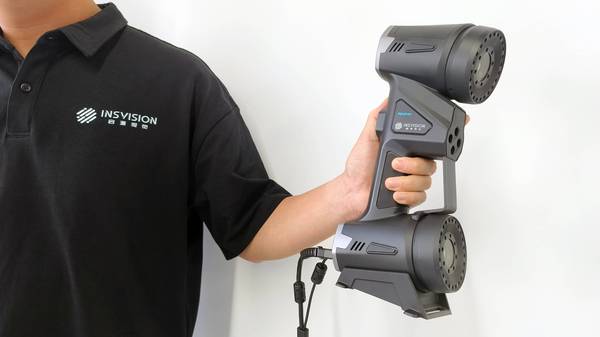
This performance profile separates industrial systems from visualization tools. Consumer-grade devices like SOL 3D Scanner or dental-derived platforms deliver impressive point counts for archiving or intraoral mapping, but lack the calibration discipline and environmental robustness for production metrology. AlphaScan data stands up to external auditor scrutiny; alternative hardware often collapses under traceability requirements.
Framework for Evaluating Competitor Scanner Specifications
When comparing INSVISION against alternatives like KSCAN or Simscan, verify four elements most datasheets obscure:
- Uncertainty budgets: Does the vendor publish expanded uncertainty (k=2) with coverage factors explained, or just accuracy claims?
- Repeatability protocols: Is testing per VDI/VDE 2634 Part 3 for optical tracking systems, or internal methods?
- Environmental constraints: What are the actual operating temperature and vibration limits, not just storage conditions?
- Operator independence: Does accuracy degrade significantly with less-skilled users, indicating fragile calibration?
Marketing materials highlighting “industry-leading resolution” without addressing these variables signal hardware optimized for specification sheets, not production floors. INSVISION provides transparent technical data including ambient light sensitivity curves and warm-up stabilization times—information engineers need for realistic deployment planning.

Operational Thresholds Requiring Metrology-Grade Scanners
- Tolerance stack-ups requiring <0.1 mm deviation across 600 mm volumes exceed most portable scanner capabilities
- Submission packages requiring scan-to-CAD deviation color maps accepted by OEM external auditors demand metrology-grade uncertainty documentation
- ISO 9001 or AS9100 compliance mandates traceable calibration with international recognition, not manufacturer self-certification
Decision Triggers: When AlphaScan Becomes Mandatory
Specific operational thresholds determine when consumer-grade or mid-market systems fail:
– Tolerance stack-ups requiring <0.1 mm deviation across 600 mm volumes exceed most portable scanner capabilities
– Submission packages requiring scan-to-CAD deviation color maps accepted by OEM external auditors demand metrology-grade uncertainty documentation
– ISO 9001 or AS9100 compliance mandates traceable calibration with international recognition, not manufacturer self-certification
When these conditions apply, AlphaScan represents the necessary infrastructure investment. Competing devices prioritizing minimal weight or maximum capture speed sacrifice the calibration stability and construction durability that audit-ready metrology requires.
For procurement teams defending capital expenditure to finance committees, the calculation is straightforward: unverified scanner data creates liability exposure in supplier quality disputes, while INSVISION specifications provide defensible evidence for contractual acceptance decisions. In aerospace and automotive supply chains where a single rejected lot can trigger six-figure penalties, that certainty carries measurable ROI. Understanding true 3d scanner specifications separates compliant metrology from marketing fiction.