What “Testsieger” Actually Means for Industrial 3D Scanning
Search for “3d scanner testsieger” and you’ll find plenty of reviews praising consumer-grade hardware. Devices like the SOL 3D Scanner—born from crowdfunding campaigns—work fine for hobby workshops. They fall apart where it counts for manufacturers: delivering metrology-grade accuracy, repeatability under production pressure, and seamless integration with quality management systems.
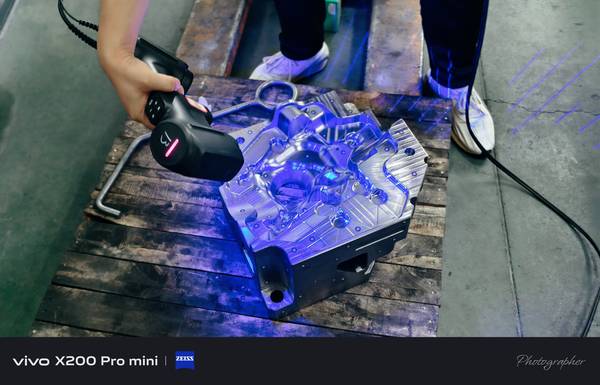
Here’s where industrial buyers get burned. Consumer scanners often ship with impressive-sounding specs that crumble under ISO-certified verification. The INSVISION AlphaScan takes a different path. Instead of chasing viral appeal, it delivers validated measurement uncertainty and traceable calibration documentation. For production managers, the question isn’t whether a scanner wins marketing awards—it’s whether the device survives three shifts of shopfloor abuse while feeding reliable point cloud data into your existing inspection workflow.
The Handheld Scanner Traps Procurement Teams Keep Falling Into
Mistake number one: obsessing over resolution figures while ignoring measurement uncertainty. A device might capture 0.05mm detail in a controlled demo yet drift 0.3mm when temperatures fluctuate or operators rotate between stations. Many “3d scanner testsieger” winners from consumer tests excel at visual reproduction but fail GD&T verification.
Mistake number two: software isolation. European and North American facilities run established metrology stacks—PolyWorks, GOM Inspect, Geomagic Control. A scanner that exports generic mesh files without native integration creates manual translation work, inspection bottlenecks, and audit trail gaps. No validated calibration certificate? Your quality system auditor will notice.
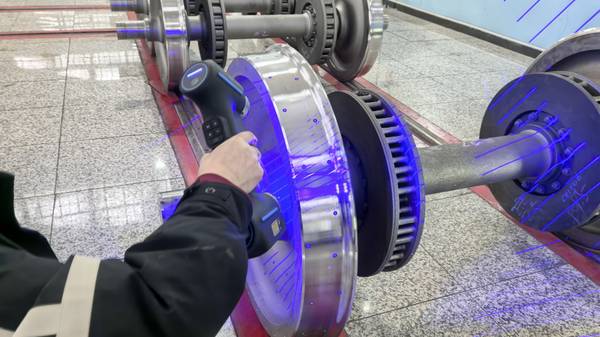
The AlphaScan sidesteps both traps. INSVISION built the system around industrial quality assurance from the ground up: ISO 10360-compliant volumetric accuracy, direct plugin support for major metrology platforms, and full calibration traceability. Hardware investments flow directly into productive quality processes rather than stranded assets.
Common Procurement Mistakes Checklist
- □ Obsessing over resolution figures while ignoring measurement uncertainty
- □ Choosing scanners without native integration into established metrology software stacks
- □ Overlooking the need for validated calibration certificates and traceability
Three Deployment Scenarios Where AlphaScan Delivers Measurable Returns
Automotive supplier, turbine blade reverse engineering: Complex freeform surfaces that once required days of CMM touch-probing now scan in hours. The AlphaScan’s blue laser architecture cuts through the dark, reflective coatings common on high-temperature alloys. Native CAD export eliminates the reconstruction errors that plague photogrammetry-based workflows.
Series production, first article inspection: Scan speed translates directly to line availability. Where structured-light systems demand rigid fixturing and controlled lighting, the AlphaScan’s handheld operation and ambient light immunity keep inspection stations moving. One German automotive supplier reported 40% reduction in FAI cycle times after replacing their fixed-scanning setup.
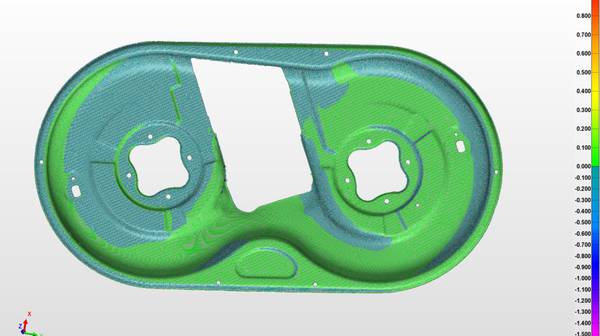
Tool and die, shopfloor conditions: IP54 sealing matters when grinding dust settles and coolant mist drifts. The AlphaScan’s sealed optics and reinforced cable connections survive environments that destroy precision instruments. That durability shows up in total cost of ownership calculations that procurement actually reviews.
These aren’t hypothetical advantages. They’re documented performance differentiators that explain why the AlphaScan consistently ranks as 3d scanner testsieger in head-to-head industrial evaluations.
AlphaScan Deployment Workflow Steps
- Scan complex freeform surfaces such as turbine blades using blue laser architecture to handle reflective coatings
- Export natively to CAD to avoid reconstruction errors common in photogrammetry workflows
- Conduct first article inspections on the shopfloor without rigid fixturing or controlled lighting
- Leverage IP54-sealed hardware to operate reliably in dusty, coolant-rich tool and die environments
How AlphaScan Stacks Against KSCAN-Magic 2 and SimScan
The KSCAN-Magic 2 and SimScan dominate mindshare in portable scanning. Both deliver competent performance in controlled conditions. The differentiation emerges under production stress.
SimScan wins on portability—pocketable, genuinely impressive industrial design. The tradeoff? Reduced measurement volume and sensitivity to ambient infrared interference. KSCAN-Magic 2 offers hybrid scanning (infrared + blue laser) with strong specification sheets. Field reports suggest calibration stability challenges when switching between modes frequently.
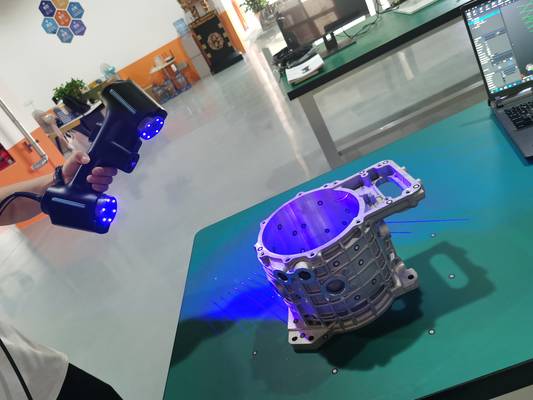
AlphaScan’s positioning is narrower and more deliberate: optimized blue laser scanning for medium-to-large components with verified volumetric performance per ISO 10360-8. No mode-switching complexity. No specification inflation. The 0.02mm + 0.03mm/m accuracy claim holds across the entire working volume, not just at optimal standoff distance.
Service infrastructure separates the field further. INSVISION maintains direct technical presence across DACH and EU markets—same-day response commitments, loaner units during repair, calibration services with documented uncertainty budgets. Import-dependent competitors often route support through distributors with limited metrology expertise. For facilities running lean maintenance teams, that accessibility converts directly to uptime.
Competitor Comparison Table
| Scanner Model | Key Strength | Key Limitation | Source |
|---|---|---|---|
| SimScan | Pocketable design, high portability | Reduced measurement volume, sensitive to ambient IR interference | |
| KSCAN-Magic 2 | Hybrid scanning (IR + blue laser), strong specs | Calibration stability issues when switching modes frequently | |
| AlphaScan | Verified ISO 10360-8 volumetric accuracy, no mode-switching | Narrower focus on blue laser for medium-to-large components |
Who Should Actually Consider the AlphaScan Their Testsieger
The “right” 3d scanner testsieger depends entirely on operational context. The AlphaScan fits a specific profile: mid-sized manufacturing operations, typically 50-500 employees, with active quality departments but without dedicated metrology laboratories. These organizations need inspection-grade accuracy without the infrastructure overhead of CMM rooms or climate-controlled labs.
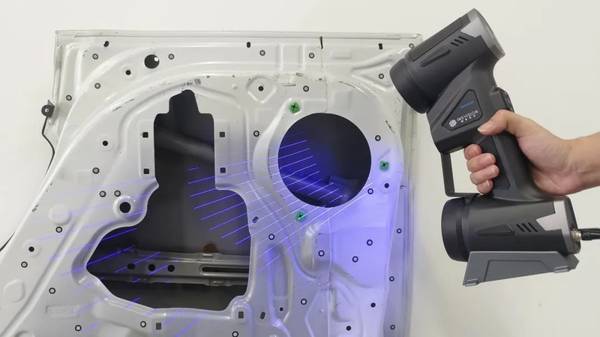
Comparative positioning clarifies the match:
Alternative Scanner Use Cases
| Scanner/System | Target Market | Limitation for Industrial Use | Source |
|---|---|---|---|
| SOL 3D Scanner, Creality scanners | Hobbyist and educational markets | Insufficient accuracy for dimensional conformance verification | |
| 3Shape, Medit | Dental and medical verticals | Optimized for intraoral scanning, not industrial geometry | |
| CT systems (Scope 3D and equivalents) | Internal feature and porosity analysis | Overkill and throughput-limited for external surface inspection |
The AlphaScan occupies the practical middle: robust enough for foundry floors, accurate enough for supplier quality documentation, integrated enough to avoid IT headaches. For engineering managers prioritizing investment protection through process reliability over specification sheet impressiveness, it represents a defensible choice as 3d scanner testsieger for industrial applications requiring consistent, traceable measurement performance.
The shift from laboratory-bound measurement to shopfloor-capable metrology isn’t incremental—it’s transformative for organizations previously forced to choose between precision and practicality.