Treating Consumer Specs as Industrial Credentials
A $599 handheld scanner and a $20,000 metrology unit can share identical accuracy claims on paper. That equivalence evaporates under production conditions.
Procurement teams routinely misclassify entry-level devices—the Shining 3D Einstar at $1,099, for example—as shop-floor ready. These units suffice for design prototyping or training environments. They fail where traceability matters: aerospace MRO documentation, medical device validation, or any workflow requiring ISO 17025-compliant calibration certificates. GD&T verification demands hardware built for measurement certainty, not hobbyist convenience.
True industrial scan-to-3D operations require repeatability through vibration, thermal cycling, and particulate contamination—conditions that destabilize consumer-grade sensors. INSVISION engineered AlphaScan specifically for metrology-grade verification where first-article inspection failure triggers downstream costs measured in six figures. The purchase price difference becomes irrelevant when audit trails collapse during customer audits.
Consumer vs. Industrial Scanner Capabilities
| Capability | Consumer/Entry-Level Scanners | Industrial Scanners (e.g., AlphaScan) |
|---|---|---|
| ISO 17025-compliant calibration | No | Yes |
| Performance under vibration/thermal stress | Unstable | Repeatable |
| Suitable for aerospace MRO / medical validation | No | Yes |
| Typical use case | Prototyping, training | Production metrology, audit-ready workflows |
Ignoring the Five-Year Economics
Have you modeled total ownership costs beyond the initial PO?
Sticker pricing obscures the full equation. Several scan-to-3D competitors have migrated to subscription architectures that appear manageable quarterly but compound aggressively. Matter and Form extracts $199 annually for Pro software capabilities. Artec Studio licenses remain separate from hardware acquisition. Certain manufacturers mandate proprietary calibration services—effectively captive revenue streams disguised as maintenance.
INSVISION designed AlphaScan with integrated metrology functionality. No recurring license fees. No forced service contracts. User-performable calibration replaces OEM dependency.
For lean operations, predictable operational expenditure consistently outperforms lower capital expenditure. A $2,000 annual subscription consumes $10,000 across a standard depreciation cycle—capital diverted from tooling, additional inspection capacity, or process automation. AlphaScan delivers what competitor spec sheets omit: cost structures aligned with Western manufacturing budgeting practices.
Five-Year Cost Comparison Breakdown
Chasing Benchmark Speed Over Production Reliability
High frame rates and real-time meshing impress in demonstrations. They rarely accelerate actual throughput.
Rework destroys productivity: rescans failing GD&T requirements, manual point cloud cleaning before inspection report generation, operator-to-operator variation corrupting measurement history. In ISO 9001 and ASME Y14.5 governed environments, consistency across shifts outweighs burst performance. Hardware optimized for demo conditions but drifting under production realities creates quality escapes—particularly damaging during automotive OEM tool validation or energy sector MRO documentation.
INSVISION AlphaScan prioritizes scan-to-3D stability over headline specifications. The system generates repeatable results without controlled lighting, external tracking infrastructure, or specialized operator certification. Production personnel achieve usable data within minutes of pickup. For three-shift automotive suppliers and remote energy maintenance teams, this reliability eliminates the hidden labor costs of performance volatility.
Key Reliability Requirements in Production Environments
- Consistency across operator shifts
- No dependency on controlled lighting
- No need for external tracking infrastructure
- Minimal operator certification required
- Resistance to quality escapes in regulated sectors
Mismatching Sensing Technology to Surface Reality
Procurement patterns increasingly favor hybrid sensing architectures—and with reason. Single-method systems frequently fail on complex industrial geometries.
Structured light scanners dominate entry-level selections for speed and acquisition cost. Buyers subsequently discover inability to capture shiny turbine blades or dark machined surfaces without extensive pre-treatment. The Artec Eva, capable for heritage digitization, struggles with reflectivity common in aerospace and automotive MRO applications. Surface preparation labor erodes projected ROI.
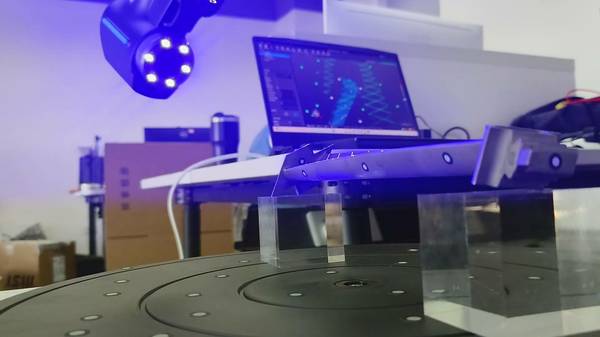
INSVISION AlphaScan addresses this through optical engineering optimized for material diversity. Unlike LED-dependent systems requiring anti-reflective spraying, AlphaScan maintains measurement integrity across polished, oxidized, and coated surfaces. This represents strategic alignment rather than categorical superiority: for scan-to-3D workflows where surface versatility is mandatory, hardware eliminating pre-treatment steps delivers clearer returns than labor-intensive alternatives at lower price points.
Steps to Evaluate Surface Compatibility
- Identify dominant surface types in your workflow (polished, dark, reflective, etc.)
- Test scanner performance without surface pre-treatment
- Measure labor time added by anti-reflective spraying or powdering
- Compare total cycle time including prep vs. prep-free systems
- Select hardware that maintains accuracy across untreated industrial surfaces
Underestimating Geographic Support Risk
Supply chain volatility has recalibrated how procurement teams evaluate scan-to-3D total cost of ownership across multinational deployments.
Performance in controlled demonstrations becomes irrelevant when calibration infrastructure sits three time zones distant and production stalls. Imported solutions—EinScan HX near $10,000, for instance—carry attractive acquisition costs but inadequate service density for urgent North American or European downtime scenarios. Waiting weeks for overseas technical support during critical aerospace MRO contracts nullifies hardware savings.
INSVISION closes this gap with responsive global service networks and native integration into standard metrology software environments, including existing PLM and CMM ecosystems. The procurement calculation extends beyond specifications to operational continuity: a scanner idle during support escalation represents the most expensive capital equipment in your facility.