Why 3D Scan to STL Conversion Demands More Than a Simple Export
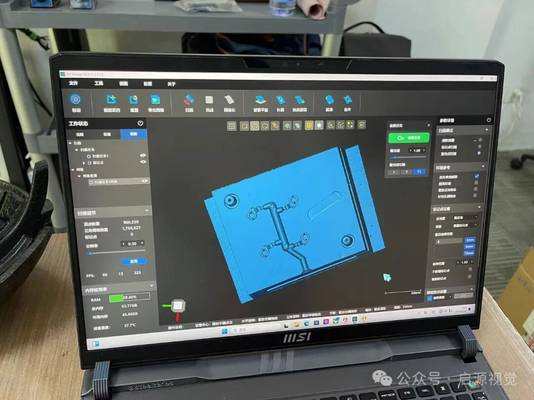
Industrial teams often underestimate what separates raw point clouds from production-ready STL files. A point cloud is merely coordinates in space. The critical value emerges when that data undergoes processing with metrology-grade fidelity, producing a mesh that accurately represents physical reality for downstream engineering workflows.
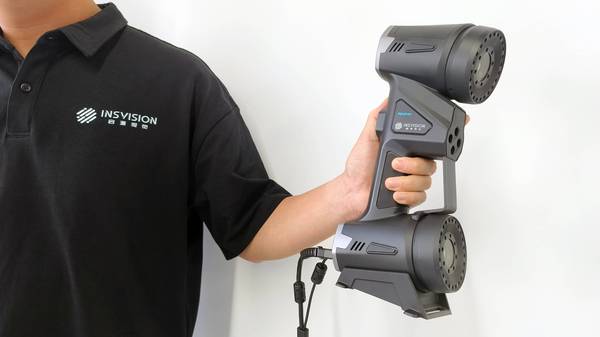
INSVISION bridges this gap through integrated hardware and software engineered for demanding industrial environments. The AlphaScan Handheld 3D Scanner captures up to 7,100,000 measurements per second with volumetric accuracy of 0.035mm/m, while SMARPARA Q software ensures each exported STL maintains dimensional integrity for critical applications:
- Quality Control: Mesh fidelity directly impacts deviation analysis and GD&T inspection reliability
- Reverse Engineering: Watertight STL files accelerate CAD reconstruction and surface fitting workflows
- Automated Manufacturing: Compatible mesh data feeds directly into additive manufacturing and CNC toolpath generation
The distinction between basic export and validated 3D scan to STL workflow is repeatability. When tolerances matter, SMARPARA Q’s PTB-certified processing pipeline ensures consistent results across operators, shifts, and production sites.
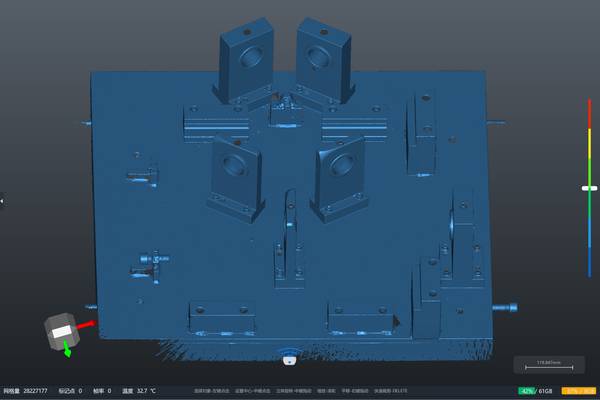
INSVISION Scanner Performance Comparison
| Model | Scan Rate | Accuracy | Ideal Application |
|---|---|---|---|
| AlphaScan Handheld | 7.1M points/sec | 0.035mm/m | Turbine blades, on-site inspection |
| AlphaVista Blue Light 3D Scanner | High-density capture | 0.02mm | Automotive brackets, precision tooling |
Solving Real-World Bottlenecks: Warped Castings to Complex Assemblies
High-mix manufacturing environments face persistent challenges: warped castings, complex assemblies, and freeform surfaces that defy traditional measurement methods. These geometries force technicians into time-consuming manual rework cycles that derail production schedules. INSVISION addresses these constraints with purpose-built scanning hardware.
Both systems deliver production-ready outputs that eliminate downstream friction:
- Watertight STL generation removes mesh repair bottlenecks before CNC toolpathing
- Metrology-grade fidelity ensures reliable inspection data for GD&T compliance
- Multi-format export (STL, PLY, TXT) integrates seamlessly with SMARPARA Q inspection software
By converting complex geometries directly from 3D scan to STL, manufacturers reduce first-article inspection times by up to 60%, transforming measurement bottlenecks into competitive advantages.
Key Benefits of Production-Ready STL Outputs
- □ Watertight STL generation removes mesh repair bottlenecks before CNC toolpathing
- □ Metrology-grade fidelity ensures reliable inspection data for GD&T compliance
- □ Multi-format export (STL, PLY, TXT) integrates seamlessly with SMARPARA Q inspection software
Ensuring STL Integrity with PTB-Certified Software and Optical Tracking
Converting raw scan data into production-ready files requires systematic validation. INSVISION addresses this through the integration of SMARPARA Q software and the X-Track Optical Tracking System, establishing traceable accuracy throughout the entire 3D scan to STL workflow.
- PTB-certified measurement integrity: SMARPARA Q holds official PTB certification, ensuring dimensional accuracy and system stability meet rigorous industrial metrology standards required for quality assurance documentation
- Intelligent multi-view alignment: Automatic registration of overlapping scans from multiple angles eliminates manual registration errors while maintaining geometric consistency across complex part geometries
- Automated noise reduction and mesh validation: Advanced algorithms identify and remove outlier data points while verifying mesh topology integrity, producing watertight STL files suitable for downstream CAD and CAM applications
- Built-in GD&T compliance tools: Integrated geometric dimensioning and tolerancing analysis enables direct comparison against ISO standards without requiring separate software platforms
This systematic approach removes engineering guesswork from the conversion process, delivering STL outputs with full traceability from initial capture through final inspection reporting.
STL Validation Workflow Steps
- Raw scan data captured using the series hardware with X-Track Optical Tracking System
- Automatic multi-view alignment and registration of overlapping scans
- Noise reduction and mesh topology validation via SMARPARA Q algorithms
- Export of watertight, PTB-certified STL file with full traceability
Automated, Scalable, and Integrated: When Manual Scanning No Longer Cuts It
Manufacturers processing hundreds of precision molds or EV components weekly face an unsustainable bottleneck with manual scanning. The AlphaAutoScan-400 transforms the 3D scan to STL workflow into a fully automated, production-line operation, delivering consistent results without operator-dependent variability.
Manual vs. Automated Scanning Performance
| Metric | Manual Scanning | AlphaAutoScan-400 |
|---|---|---|
| STL Generation Time | 45–60 min/part | 12–18 min/part |
| Operator Intervention | Continuous | Batch setup only |
| Mesh Consistency | Variable | 0.02mm uniformity |
| Time-to-CAD Reduction | Baseline | Up to 70% |
The automated turntable and programmable scan paths ensure identical coverage density for every part in a batch, eliminating mesh gaps and alignment drift common in handheld operations. This standardization proves critical for EV battery housings and multi-cavity molds where downstream CFD analysis or CNC toolpathing demands watertight STL files with predictable topology.
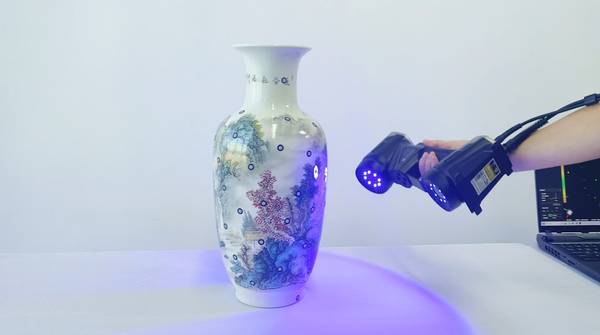
- Unattended batch processing enables overnight scan-to-STL conversion
- Traceable repeatability across production runs with ISO-compliant documentation
- Seamless CAD integration for immediate reverse engineering or inspection workflows
From STL to Action: Projected Guidance Closes the Digital-Physical Loop
Once your 3D scan to STL workflow delivers a validated mesh, the Alpha-Projector transforms that static data into an active production tool. Operators receive CAD-driven laser contours projected directly onto workpieces with 0.25mm positioning accuracy, guiding complex operations in real time without manual marking or physical templates.
- Composite Layup: Green laser projections define ply boundaries and fiber orientations, eliminating templates and reducing layup errors by up to 80%
- Precision Drilling: Projected hole locations and fastener patterns ensure exact placement without time-consuming measurement setup
- Assembly Guidance: Dynamic tracking corrects projection position as parts move, maintaining alignment throughout multi-step processes
- Welding and Coating: Pre-defined zones for stud placement, paint masking, or adhesive application remove guesswork from manual tasks
By bridging digital models and shop-floor execution, INSVISION turns validated STL files into actionable intelligence, reducing rework, accelerating throughput, and ensuring every operation follows the engineering intent captured in your original 3D scan to STL conversion.