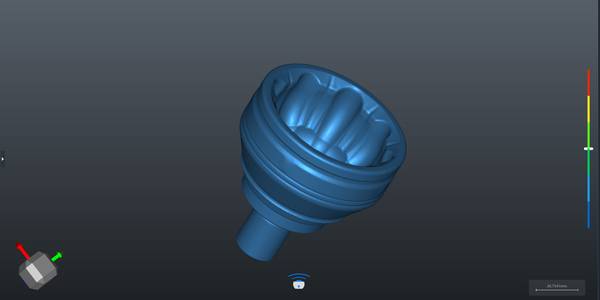
Why STL Export Matters in Real-World Industrial Workflows
For Western manufacturers, the transition from 3D scanner to STL represents far more than a file format conversion—it is the critical bridge between physical reality and digital production. Reliable STL output directly impacts three core downstream applications:
- Rapid Prototyping: Watertight STL meshes enable seamless 3D printing workflows, accelerating design validation cycles
- CNC Machining: Accurate surface data ensures precise toolpath generation, minimizing costly rework
- Quality Inspection: High-fidelity exports support deviation analysis against CAD master models with confidence
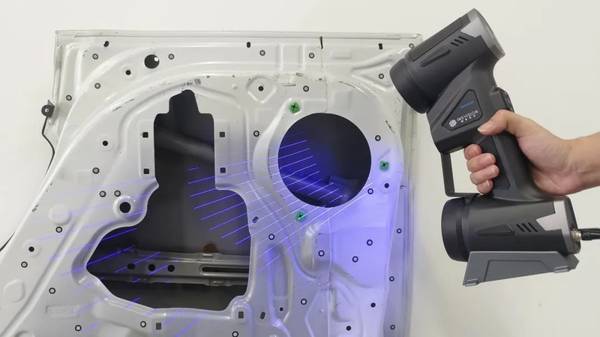
INSVISION addresses these demands through the AlphaScan Handheld 3D Scanner, which delivers metrology-grade precision at 0.035mm/m with 7.1 million measurements per second. When paired with SMARPARA Q software, manufacturers achieve seamless compatibility across IGES, STP, and DXF formats—eliminating data translation bottlenecks. In precision-driven sectors such as automotive and aerospace, where tolerances are non-negotiable, the integrity of your STL export determines whether a scan becomes a production-ready asset or an unusable dataset.
Downstream Applications Enabled by Reliable STL Export
| Application | Impact of High-Quality STL |
|---|---|
| Rapid Prototyping | Watertight STL meshes enable seamless 3D printing workflows, accelerating design validation cycles |
| CNC Machining | Accurate surface data ensures precise toolpath generation, minimizing costly rework |
| Quality Inspection | High-fidelity exports support deviation analysis against CAD master models with confidence |
From Point Cloud to Production-Ready STL: The INSVISION Advantage
INSVISION’s integrated hardware-software ecosystem transforms raw scan data into production-ready STL files with minimal manual intervention. The AlphaScan captures 7.1 million measurements per second at micron-level precision, while the AlphaVista Blue Light 3D Scanner delivers automated scanning for heavy-duty industrial applications at 0.02mm accuracy.
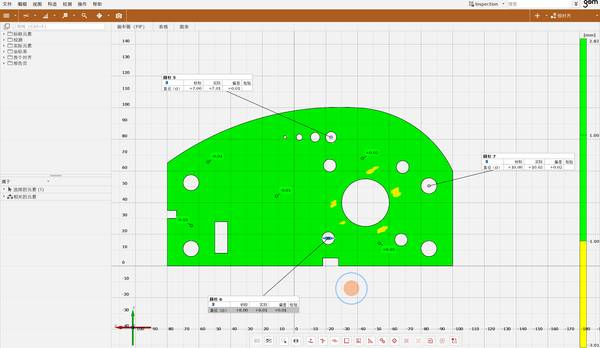
The SMARPARA Q software completes the workflow with PTB-certified reliability:
- Automated mesh generation converts point clouds to watertight STL files without manual cleanup
- Intelligent noise filtering preserves critical geometric features while eliminating artifacts
- Direct multi-format export supports STL, PLY, and TXT for seamless CAD/CAM integration
- Complete reverse engineering pipeline from data processing through surface fitting to CAD conversion
For manufacturers seeking reliable 3D scanner to STL conversion, this integrated approach eliminates the traditional bottleneck of data post-processing—reducing rework cycles while maintaining metrology-grade fidelity required for CNC machining and quality inspection workflows.
Key Features of SMARPARA Q Software
- □ Automated mesh generation converts point clouds to watertight STL files without manual cleanup
- □ Intelligent noise filtering preserves critical geometric features while eliminating artifacts
- □ Direct multi-format export supports STL, PLY, and TXT for seamless CAD/CAM integration
- □ Complete reverse engineering pipeline from data processing through surface fitting to CAD conversion
Case in Point: Automotive Tier Suppliers Cutting Inspection Time by 60%
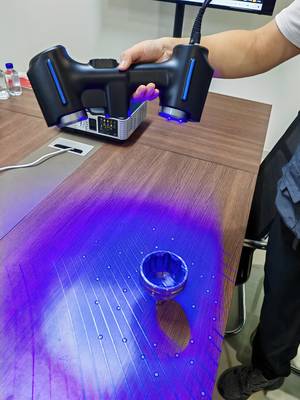
A Tier 1 automotive supplier recently faced a critical bottleneck: complex aluminum castings for transmission housings required hours of CMM inspection, delaying quality sign-off and slowing production cycles. By deploying the INSVISION AlphaScan Handheld paired with SMARPARA Q software, the manufacturer transformed its inspection workflow from a multi-day process to a matter of hours.
Inspection Workflow Comparison
| Metric | Traditional CMM | AlphaScan + SMARPARA Q |
|---|---|---|
| Average Inspection Time | 8+ hours per part | Under 3 hours |
| Setup Complexity | Fixed fixture required | Portable, on-machine |
| Data Output | Limited point data | Production-ready STL |
The operator scanned intricate casting geometries at 7.1 million measurements per second, directly generating clean, watertight STL files. SMARPARA Q then performed automated GD&T tolerance analysis with PTB-certified accuracy, eliminating manual alignment steps. This seamless 3D scanner to STL workflow enabled traceable digital inspection records while reducing reliance on overloaded CMM resources—a measurable ROI for high-mix, low-volume production environments.
Automated and Scalable: When Manual Scanning Is Not Enough
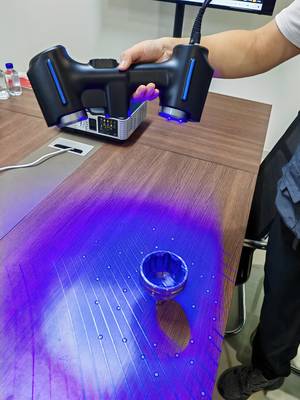
For aerospace and energy equipment manufacturers processing hundreds of components daily, handheld scanning creates bottlenecks. Operator variability, fatigue-induced errors, and inconsistent data quality compound across high-volume workflows. the series addresses this challenge with automated solutions paired with the X-Track Optical Tracking System—delivering fully automated 3D scanner to STL conversion without manual intervention.
X-Track Optical Tracking System Specifications
| Specification | Capability |
|---|---|
| Repeatability | <0.02mm |
| Operating Temperature | 0°C to 50°C |
| Protection Rating | IP54 |
| Connectivity | Ethernet RJ-45 / USB 3.0 |
The system eliminates operator dependency through programmable scanning paths and automated data processing. Key advantages include:
- Batch processing capability for turbine blades, structural castings, and precision components
- Consistent STL exports regardless of shift changes or operator skill levels
- Integration-ready architecture supporting system expansion for inline production environments
When throughput demands exceed manual capacity, automated scanning delivers traceable, metrology-grade results at production speeds—transforming inspection from a constraint into a competitive advantage.
Steps to Implement Automated 3D Scanning Workflow
- Deploy the series automated solutions with X-Track Optical Tracking System for operator-independent scanning
- Utilize programmable scanning paths to capture consistent data across high-volume components
- Process scans automatically through SMARPARA Q to generate production-ready STL files
- Integrate outputs into inline production environments using integration-ready architecture
Beyond Scanning: Using STL Output for Digital Work Instructions
Transforming a 3D scanner to STL workflow into tangible productivity requires more than digital archiving. The the series Alpha-Projector bridges the gap between digital models and physical assembly by ingesting STL and CAD data directly. This system projects precise laser contours onto workpieces, replacing manual scribing with dynamic, error-proof guidance.
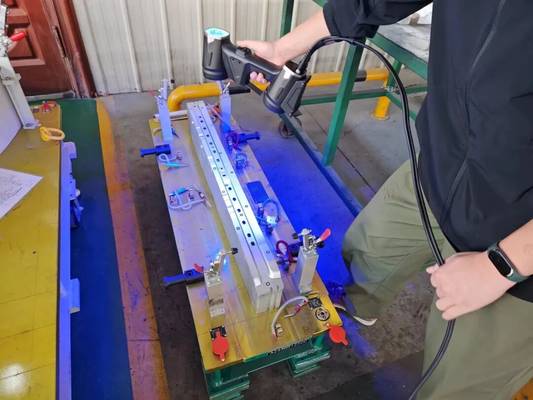
Leveraging high-precision binocular vision, the Alpha-Projector offers 0.25mm positioning accuracy and features dynamic tracking that corrects projection paths in real time if the part moves. This capability proves critical for complex manufacturing environments:
- Composite Layup: Visualizing ply boundaries for aerospace components to ensure exact material placement
- Welding and Assembly: Locating stud positions and fixture points instantly without physical templates
- Surface Processing: Defining painting zones or masking areas with digital precision to reduce rework
By turning static files into interactive work instructions, manufacturers reduce scrap rates and minimize training time for new operators. The complete 3D scanner to STL pipeline—from data capture through production guidance—delivers measurable operational improvements across the manufacturing floor.