Eliminating Costly Rework in Automotive Prototyping
In automotive prototyping, dimensional inaccuracies in clay and foam models propagate downstream, triggering expensive tooling modifications and compressed production timelines. The AlphaScan Handheld 3D Scanner from INSVISION addresses this challenge by enabling precise digital capture of complex prototype geometries directly on the shop floor.
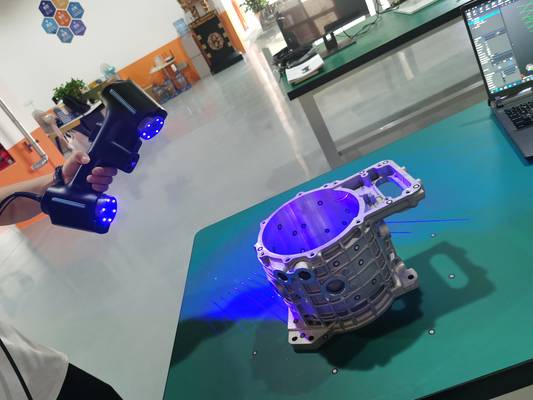
Unlike traditional CMM methods requiring controlled environments, this advanced scanner laser system delivers reliable measurements in real-world manufacturing conditions:
- Non-contact capture of delicate clay and foam surfaces without surface damage
- Portable operation eliminates time-consuming transfers to metrology labs
- High-density point clouds preserve intricate design details for accurate CAD comparison
- Seamless software integration accelerates physical-to-digital workflows
Performance Impact Summary
| Performance Metric | Result |
|---|---|
| Design iteration cycles | Reduced by up to 40% |
| Downstream rework costs | Minimized by 60-75% |
| Prototype digitization time | From 4-6 hours to 8-12 minutes |
Engineering teams validate dimensional accuracy early in development, identifying and correcting deviations before they cascade into costly production changes. This protects project timelines and profit margins while accelerating time-to-market.
Achieving Micron-Level Precision in Aerospace Component Inspection
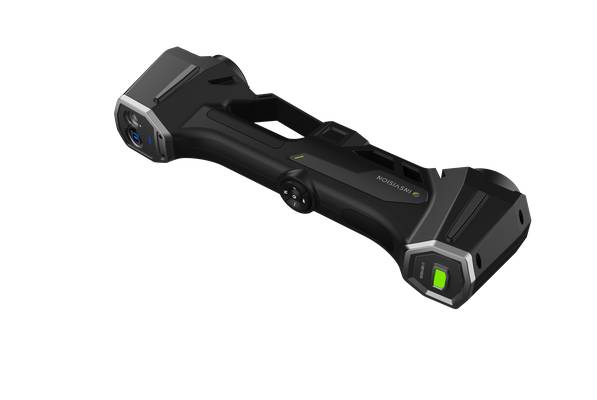
In aerospace manufacturing, tolerance deviations compromise flight safety and regulatory compliance. INSVISION addresses this with the AlphaVista Blue Light 3D Scanner paired with the X-Track Optical Tracking System, enabling manufacturers to capture micron-level measurements on complex geometries including turbine blades and composite aerostructures.
Traditional CMM methods demand climate-controlled labs and lengthy setup times. This integrated scanner laser solution brings precision directly to the production floor:
- Real-time optical tracking maintains accuracy across large work envelopes without physical targets
- Blue light technology filters ambient interference for reliable data capture in typical shop environments
- Full traceability supports AS9100 audit requirements with documented measurement workflows
- Non-contact inspection protects delicate composite surfaces from damage during quality checks
Aerospace Workflow Checklist
- □ Real-time optical tracking maintains accuracy across large work envelopes without physical targets
- □ Blue light technology filters ambient interference for reliable data capture in typical shop environments
- □ Full traceability supports AS9100 audit requirements with documented measurement workflows
- □ Non-contact inspection protects delicate composite surfaces from damage during quality checks
Aerospace suppliers facing tight delivery windows eliminate the bottleneck of sending parts to metrology labs. Quality teams verify first articles and perform in-process inspections without disrupting production flow, reducing lead times by 30-50% while maintaining documentation rigor auditors demand.
Automating Quality Control for High-Volume Manufacturing
Manufacturers producing thousands of castings or machined parts daily cannot rely on spot checks. The AlphaAutoScan-400 Automated 3D Scanning System from INSVISION enables 100% inline inspection by integrating directly into existing production lines. This automated solution eliminates manual measurement bottlenecks while ensuring every part meets specification before leaving the facility.
Unlike manual scanner laser setups requiring operator intervention, the AlphaAutoScan-400 operates autonomously across all shifts:
- Seamless line integration maintains production throughput without slowing cycle times
- Automated defect detection identifies dimensional deviations, surface flaws, and feature omissions in real time
- Reduced labor costs replace manual inspection stations with unattended scanning routines
- Immediate pass/fail reporting routes nonconforming parts before shipping
Implementation Steps for Inline Inspection
- Integrate AlphaAutoScan-400 directly into existing production lines to enable 100% inline inspection
- Configure automated defect detection to identify dimensional deviations, surface flaws, and feature omissions in real time
- Deploy immediate pass/fail reporting to route nonconforming parts before shipping
- Replace manual inspection stations with unattended scanning routines to reduce labor costs
Catching defects at the source avoids compounding costs of customer returns, warranty claims, and damaged supplier relationships. Quality control transforms from cost center to competitive advantage.
Accelerating Reverse Engineering for Legacy Part Replacement
When OEMs discontinue critical components, maintenance teams face extended downtime without CAD documentation. INSVISION pairs structured light projection with advanced scanner laser technology, enabling rapid digitization of physical legacy components directly on the shop floor.
- Rapid tooling updates: Capture complete surface geometry of worn dies and molds to generate accurate repair toolpaths without manual measurements
- Spare part fabrication: Convert physical parts into production-ready CAD models for CNC machining or additive manufacturing
- Digital twin creation: Establish baseline documentation for aging equipment to support predictive maintenance strategies
This integrated workflow compresses reverse engineering timelines from 3-4 weeks to 2-3 days, eliminating dependency on external service bureaus. Manufacturing teams build comprehensive digital archives of critical legacy assets, ensuring long-term equipment support regardless of original supplier availability.
Choosing the Right the series Scanner Laser for Your Workflow
Selecting the optimal scanner laser solution requires systematic evaluation of operational constraints. Engineers should assess four critical dimensions before investing:
Scanner Selection Comparison
| Criteria | Handheld (AlphaScan) | Stationary/Automated (AlphaVista/X-Track) |
|---|---|---|
| Part complexity | Large, irregular geometries | Repetitive, high-precision components |
| Throughput requirement | Low to medium volume (10-100 parts/day) | High-volume production (1,000+ parts/day) |
| Operating environment | Flexible shop floor, varying conditions | Controlled stations with optical tracking |
| Accuracy specification | Up to 0.030 mm | Up to 0.010 mm with traceability |
| Operator dependency | Trained technician required | Minimal manual intervention |
Additional selection factors include:
- Part size and accessibility: Handheld systems excel scanning large assemblies or hard-to-reach features; automated cells suit compact, consistently positioned parts
- Accuracy versus speed trade-offs: Determine whether micron-level precision justifies longer cycle times or rapid pass/fail inspection better serves production targets
- Integration complexity: Factor existing MES infrastructure when deploying automated solutions to maximize ROI within 18-24 months
Matching scanner laser capabilities to specific production bottlenecks ensures capital investments translate directly into measurable efficiency gains and quality improvements.