Why Standard 3D Scanners Fail on Small, Complex Parts
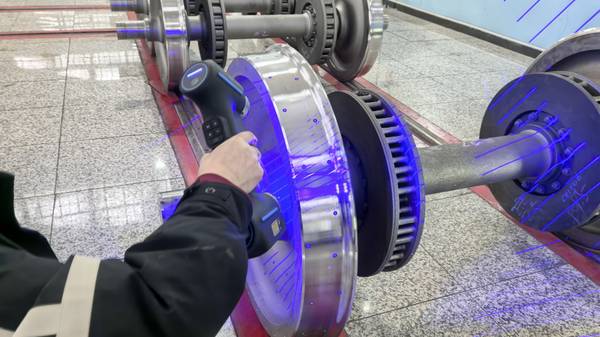
Western manufacturers encounter critical limitations when deploying off-the-shelf scanning systems for small, intricate components. A professional 3d scanner for small objects must capture fine details on precision gears, medical implants, and electronic housings—requirements that standard equipment routinely fails to meet.
Common Failure Modes of Standard 3D Scanners
- □ Insufficient resolution: Many scanners lack optical precision for micro-scale features, producing blurred or missing data on intricate geometries.
- □ Vibration sensitivity: Shop-floor vibrations destabilize standard scanners, compromising accuracy during extended scans.
- □ Poor edge capture: Sharp corners and thin walls round or disappear due to inadequate sensor sensitivity.
- □ Environmental limitations: Consumer-grade units demand controlled lighting and temperature, making them impractical for production floors.
INSVISION engineers industrial-grade systems specifically for demanding manufacturing environments. With 0.02mm-level accuracy and robust construction, professional equipment maintains consistent performance across variable shop-floor conditions where alternatives underperform.
AlphaScan Handheld vs. AlphaVista Blue Light: Matching Technology to Application
Manufacturers selecting a 3d scanner for small objects face distinct operational requirements. INSVISION offers two engineered approaches:
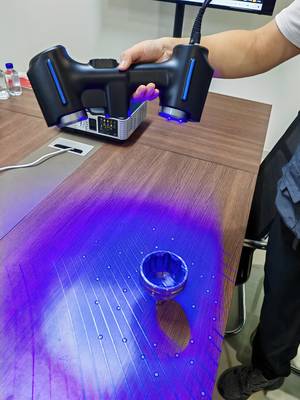
The AlphaScan Handheld 3D Scanner delivers portability at 9.5kg with 520nm laser technology and 0.02mm accuracy. Automotive suppliers deploy it directly on assembly lines for sensor housing inspection, with USB 3.0 and Ethernet interfaces ensuring seamless metrology infrastructure integration.
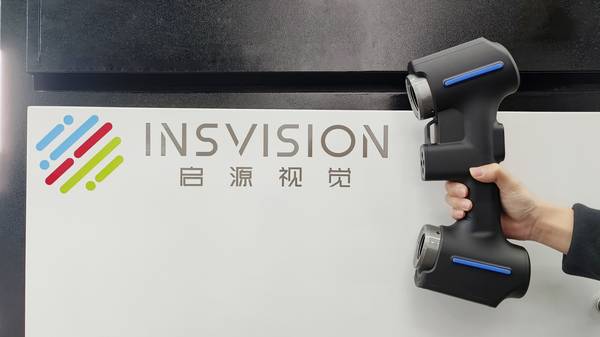
The AlphaVista Blue Light 3D Scanner employs structured blue light technology engineered for challenging reflective surfaces found in aerospace brackets and polished medical components. Its IP54 rating and 0°C to 50°C operating range withstand harsh conditions where standard scanners fail.
Scanner Comparison: AlphaScan Handheld vs. AlphaVista Blue Light
| Specification | AlphaScan Handheld | AlphaVista Blue Light |
|---|---|---|
| Technology | 520nm Laser | Structured Blue Light |
| Accuracy | 0.02mm | 0.02mm |
| Weight/Form Factor | 9.5kg Portable | Fixed Installation |
| Optimal Application | Complex geometries, line-side inspection | Reflective surfaces, controlled environments |
| Environmental Rating | Industrial-grade | IP54 |
Both systems integrate with SMARPARA Q software for PTB-certified inspection workflows, supporting IGES, STP, and DXF formats for immediate CAD comparison and GD&T analysis.
Automated Quality Control: From Scan to PTB-Certified Report
The bottleneck in small object metrology often lies in data processing, not capture. INSVISION pairs AlphaScan or AlphaVista systems with SMARPARA Q software, creating a direct path from scan to audit-ready documentation.
Workflow Implementation Steps
- Deploy AlphaScan or AlphaVista system for high-accuracy scan capture.
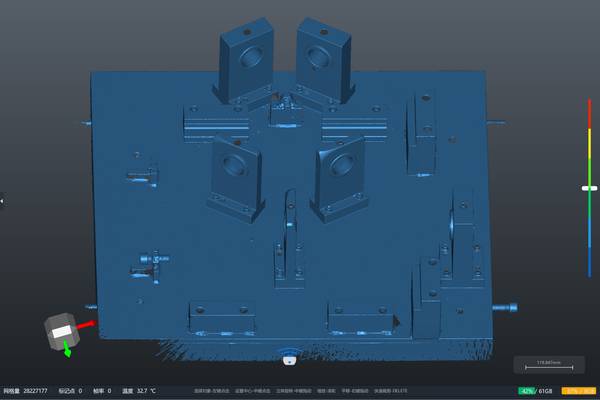
- Process scan data using SMARPARA Q with PTB-certified accuracy and automated alignment modes.
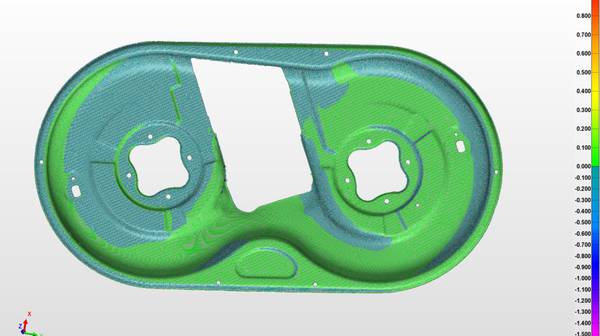
- Generate one-click reports featuring color deviation maps and GD&T tolerance analysis.
- Export results in IGES, STP, DXF, or DWG for seamless CAD integration and audit compliance.
Integrated workflow capabilities:
- PTB-certified accuracy ensuring measurement traceability for regulatory compliance
- Automated alignment with auto, datum, and RPS-based positioning modes
- One-click report generation featuring color deviation maps and complete GD&T tolerance analysis
- Multi-format compatibility supporting IGES, STP, DXF, and DWG for seamless integration
A Tier 2 automotive supplier implemented this system for first-article inspection of precision transmission components:
Quality Control Impact Metrics
| Metric | Before Implementation | After Implementation |
|---|---|---|
| First-Article Inspection Time | 8 hours | 2.4 hours (70% reduction) |
| Report Generation | Manual, 2+ hours | Automated, under 15 minutes |
| ISO/TS 16949 Compliance | Documentation gaps | Full traceability achieved |
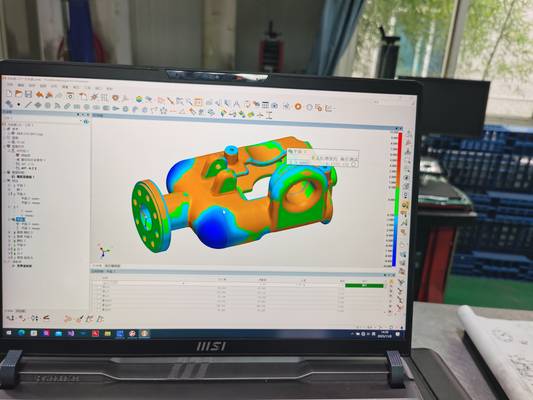
Color deviation maps and comprehensive GD&T analysis enabled instant identification of dimensional variations with complete audit trails. Small batch inspection no longer demands disproportionate time investment, redirecting quality teams toward process improvement.
Dynamic Laser Projection for Manual Assembly and Rework
Low-volume, high-mix production retains unavoidable manual operations. The Alpha-Projector transforms these processes by projecting CAD-derived laser contours directly onto workpieces, eliminating marking errors that generate scrap.
- Dynamic tracking: Real-time position correction maintains 0.25mm projection accuracy when workpieces shift
- CAD-native workflows: FiberSIM and CATIA CPD compatibility projects drill locations, weld points, and layup boundaries without manual marking
- Error prevention: Programmed sequences flag missed steps or out-of-tolerance placements before scrap occurs
| Application | Manual Method | Alpha-Projector Implementation |
|---|---|---|
| Composite battery tray drilling | 15 minutes marking plus verification | 2 minutes direct guidance |
| Chassis weld point location | High rework rate | First-time-right placement |
| Operator training duration | 2–3 weeks | 2–3 days |
For Western factories facing skilled labor shortages, this technology bridges capability gaps—enabling junior technicians to execute complex assembly and rework with reduced scrap and training overhead.
Scalable Metrology Architecture: From Prototype to Production
INSVISION’s modular approach extends a single 3d scanner for small objects investment across enterprise operations. The ecosystem scales from prototype validation to full production automation, protecting capital expenditure while adapting to evolving demands.
| Growth Stage | the series Solution | Typical Application |
|---|---|---|
| Prototyping | AlphaScan Handheld | Precision mold validation, first-article inspection |
| Process Scaling | X-Track Optical Tracking System | Large-scale tracking, multi-station workflows |
| Full Automation | AlphaAutoScan with SMARPARA Q | Lights-out EV component inspection |
Data continuity persists throughout scaling. All the series hardware operates within CAD-native workflows using IGES, STP, DXF, and DWG formats, eliminating translation errors when transitioning from handheld development scanning to automated production cells.
- Unified software backbone: SMARPARA Q delivers PTB-certified inspection across all hardware configurations
- Modular expansion: Add X-Track Optical Tracking System for large parts without operator retraining or data system migration
- Cross-industry validation: Deployed in automotive, aerospace, energy, and heavy machinery sectors
Manufacturers investing in a 3d scanner for small objects gain more than point-cloud acquisition—they secure a scalable metrology platform that grows with operational requirements while maintaining measurement integrity across every expansion phase.