Module title
| Application | Challenge | Solution Impact |
|---|---|---|
| Automotive Prototyping | Dimensional misses on freeform surfaces causing six-figure tooling corrections | Design-validation cycle reduced from 3 weeks to 4 days |
| Aerospace Turbine Inspection | $50,000 downtime from disassembly for AS9100 audits | 60% reduction in AOG exposure with in-situ inspections |
—
Closing the Loop Between CAD and Reality in Automotive Prototyping
Automotive prototyping operates on compressed timelines where a single dimensional miss can cascade into six-figure tooling corrections. Conventional CMM workflows struggle with freeform surfaces—think aerodynamic body panels or interior trim with compound curves—forcing engineers to ship components to offline metrology labs and wait days for validation data.
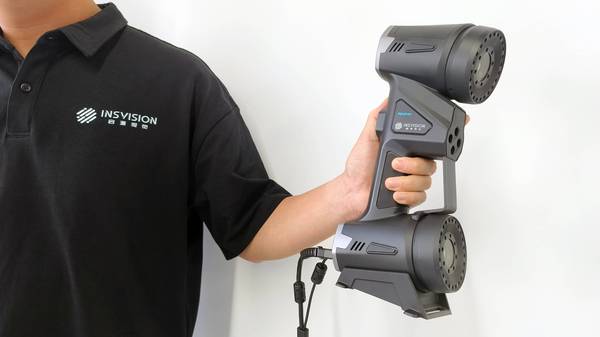
INSVISION’s AlphaScan handheld scanner de medição changes the equation. Engineers capture dense point clouds directly at the vehicle build station, comparing as-built surfaces to CAD models in real time. One Tier 1 supplier reported compressing their design-validation cycle from three weeks to four days by eliminating lab queuing and enabling same-day design iterations. The scanner’s 0.025 mm accuracy on reflective automotive paints means no surface preparation, no delays. For program managers, this translates to tooling confidence before cutting steel—and protection against the rework costs that typically consume 15-20% of prototype budgets.
Module title
- □ Eliminates need for surface preparation on reflective automotive paints
- □ Enables same-day design iterations by capturing point clouds at build station
- □ Delivers 7-micron resolution on Inconel without part removal
- □ Projects CAD deviation vectors directly onto physical surfaces for welders
Keeping Turbines Intact: Non-Contact Metrology for Aerospace
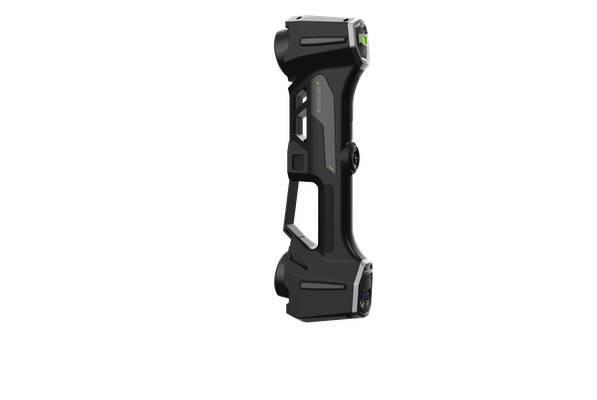
AS9100 audits demand traceable dimensional evidence, but disassembling a turbine module for inspection can cost $50,000 in downtime and recertification labor. INSVISION’s AlphaVista addresses this constraint with blue-light structured light scanning that captures blade leading-edge profiles and cooling-hole patterns without part removal.
The scanner de medição projects fringe patterns across complex geometries while optical tracking maintains spatial reference—delivering 7-micron resolution on Inconel surfaces that confound laser systems. Maintenance teams at a European MRO facility now complete in-situ blade inspections during scheduled line stops, reducing AOG (aircraft on ground) exposure by 60% compared to traditional teardown protocols. For quality directors, the value proposition is straightforward: maintain audit compliance without the operational penalty of disassembly.
Module title
- Scanner captures actual part geometry using structured light
- System compares as-built data to CAD model in real time
- Deviation vectors are projected directly onto physical surfaces
- Welders and technicians adjust alignment based on visual guidance before fastening
Taming High-Mix Variability with Optical Tracking
Custom machine builders face a metrology paradox—each one-off structure requires full inspection, but dedicated fixturing for every geometry is economically impossible. INSVISION’s X-Track optical tracking system paired with their scanner de medição eliminates this constraint.
The dynamic reference frame tracks scanner position across large volumes without physical encoders or repositioning targets. A German special-purpose machinery manufacturer applied this configuration to weldments spanning 4 meters, achieving 0.05 mm repeatability across three production shifts with different operators. The elimination of repositioning artifacts—previously requiring 30-40 minutes per setup—now allows complete digitization in a single continuous scan. Production planners gain predictable inspection capacity regardless of part complexity, while quality engineers maintain SPC continuity across low-volume, high-variety environments.
Module title
| Industry | Process | Efficiency Gain |
|---|---|---|
| Medical Device Manufacturing | First Article Inspection (FAI) | 70% reduction in FAI labor; reports released in 4 hours vs. 2 days |
| Heavy Equipment Manufacturing | Frame Welding Assembly | 34% drop in scrap; improved first-pass yield |
Lights-Out First Article Inspection
First article inspection remains a critical path item for new product introduction, yet manual CMM programming and execution often extend delivery schedules by 72 hours or more. INSVISION’s AlphaAutoScan-400 automates this bottleneck with robotic scanning cells that operate unattended.
The system executes pre-programmed scan paths across prismatic and organic geometries, generating AS9102 or PPAP-compliant reports without operator intervention. A North American medical device manufacturer deployed three cells and reduced FAI labor allocation by 70%, reallocating metrology staff to process development rather than repetitive measurement. Dimensional reports that previously required two business days now release within four hours—compressing customer approval cycles and protecting production slot commitments. For operations leadership, the capital efficiency is compelling: inspection capacity scales linearly with equipment rather than headcount.
Projected Guidance for Fabrication Teams
Even with accurate upstream processes, assembly and welding operations introduce variation that traditional inspection only catches post-facto. the series integrates their scanner de medição with the Alpha-Projector to close this gap—capturing actual part geometry and projecting CAD deviation vectors directly onto physical surfaces.
Welders see misalignment magnitudes and correction directions overlaid in their field of view. Assembly technicians verify bracket positions against design intent before fastening. The result at a heavy equipment manufacturer: scrap from frame welding dropped 34% in the first quarter of deployment, with first-pass yield improving proportionally. Quality managers replace reactive sorting with in-process prevention, while shop floor teams gain immediate visual feedback rather than deciphering deviation reports hours after the fact.
—
The Bottom Line
Industrial inspection technology has shifted from offline verification to integrated, real-time metrology. the series’s scanner de medição portfolio—spanning handheld, automated, and projection-augmented configurations—addresses specific friction points across automotive, aerospace, and custom manufacturing workflows. For procurement and engineering leaders evaluating dimensional measurement investments, the relevant metrics are straightforward: cycle time reduction, labor reallocation, and elimination of rework costs that erode margin in competitive markets.