Catching Defects Before They Become Disasters
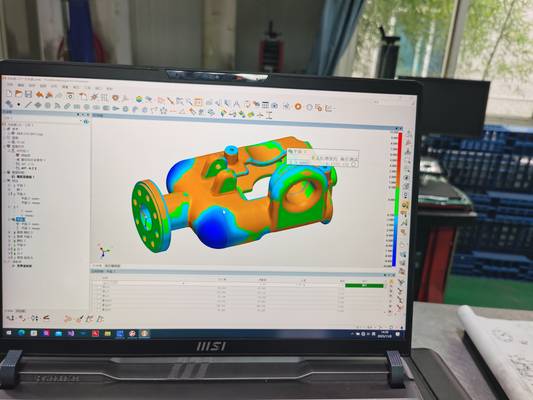
A single dimensional error in an aerospace component can trigger $50,000+ in scrap, rework, and schedule penalties—often discovered only when parts reach the customer. INSVISION eliminates this exposure by embedding metrology-grade 3D scans directly into production workflows.
Real-Time Quality Validation Capabilities
| Feature | Description |
|---|---|
| Hardware | AlphaScan handheld and AlphaVista blue-light systems |
| Software Certification | PTB-certified |
| Analysis Method | Built-in GD&T analysis against native CAD models |
| Quality Approach | Predictive rather than reactive |
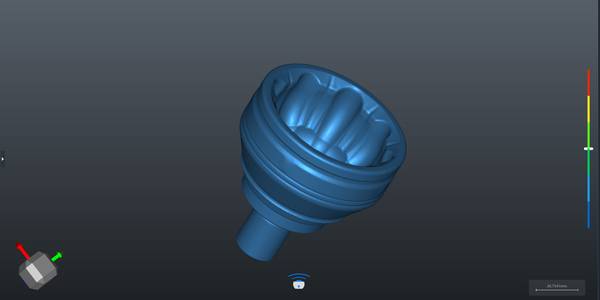
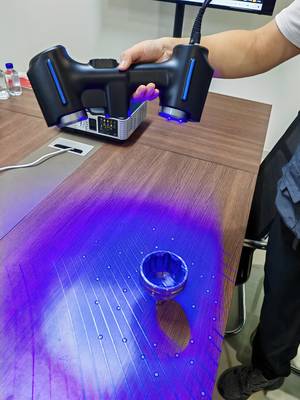
Using the AlphaScan handheld and AlphaVista blue-light systems, quality teams perform real-time validation on the shop floor. PTB-certified software aligns multi-source scan data against native CAD models, flagging out-of-tolerance features through built-in GD&T analysis before parts ship. The shift is fundamental: quality control becomes predictive rather than reactive, protecting both margins and delivery commitments in precision-dependent supply chains.
Replacing Physical Templates with Laser Precision
Composite layups and wiring harness assembly traditionally rely on time-consuming physical templates prone to human error. The Alpha-Projector eliminates this bottleneck entirely.
Laser Projection System Benefits
- □ Projects green laser contours directly onto workpieces with 0.25mm positioning accuracy
- □ Uses high-precision binocular machine vision for guidance
- □ Integrates natively with CATIA and FiberSIM for dynamic digital templates
- □ Automatically corrects projection alignment if the workpiece shifts
- □ Reduces labor time by 30–40% while improving first-time-right assembly rates
The system projects green laser contours directly onto workpieces with 0.25mm positioning accuracy, guided by high-precision binocular machine vision. Native integration with CATIA and FiberSIM creates a digital template that moves with the part—dynamic tracking automatically corrects projection alignment if the workpiece shifts during operation. Manufacturers typically reduce labor time 30-40% while achieving first-time-right assembly rates previously unattainable with manual layout methods.
Running Lights-Out Inspection at Scale
Expanding quality capacity conventionally means hiring skilled metrologists—if you can find them. INSVISION’s X-Track optical tracking paired with the AlphaAutoScan-400 removes this constraint entirely.
Automated Inspection Workflow Steps
- X-Track optical tracking pairs with AlphaAutoScan-400 for operator-free inspection
- CAD-driven task creation defines inspection parameters
- Real-time dynamic tracking compensates for part movement during scanning
- Metrology-grade 3D scans are delivered consistently across all shifts
The system executes fully automated inspection of large components—turbine blades, EV battery trays, structural castings—without operator presence. CAD-driven task creation and real-time dynamic tracking compensate for part movement automatically, delivering consistent metrology-grade 3D scans across all shifts. Same throughput. Same precision. No headcount increase.
Connecting Physical Reality to Digital Intent
The gap between as-designed and as-built remains manufacturing’s persistent source of inefficiency. INSVISION closes it through software architecture built specifically for industrial 3D scan workflows.
Digital Integration Features
| Capability | Impact |
|---|---|
| Automatic alignment of raw point clouds with native CAD geometry | Eliminates manual alignment errors |
| Multi-source data fusion | Ensures consistency across scanner types and sessions |
| Deviation reports in CATIA CPD and FiberSIM-compatible formats | Eliminates manual translation errors, accelerates root-cause analysis |
| Actionable data delivery within hours | Compresses iteration cycle and reduces time-to-correction |
Raw point clouds align automatically with native CAD geometry. Multi-source data fusion ensures consistency across scanner types and measurement sessions. Deviation reports generate directly in CATIA CPD and FiberSIM-compatible formats, eliminating manual translation errors that delay root-cause analysis. Engineering receives actionable data within hours, not days—compressing the iteration cycle and reducing time-to-correction for production deviations.
Building Interoperability Into Digital Infrastructure
3D scan data too often becomes a siloed asset—inaccessible to PLM systems, incompatible with downstream engineering tools, locked behind proprietary formats. INSVISION architects around this problem.
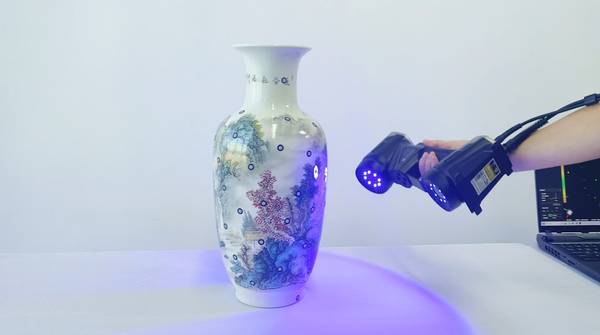
Native support for CATIA CPD, FiberSIM, STEP, and IGES enables direct embedding into existing PLM and MES pipelines. PTB-certified algorithms ensure measurement integrity travels with the data. Whether driving laser projection tasks, feeding reverse engineering workflows, or populating digital twins, the information remains fluid across departments and software ecosystems.
The result: 3D scans function as infrastructure, not isolated inspections—scaling with production demands rather than constraining them.