Impact of Manual Layout Errors
| Issue | Consequence |
|---|---|
| Physical templates warp | Misalignment propagates through entire assemblies |
| Chalk lines smudge | Triggers downstream rework consuming 15-20% of production budgets |
INSVISION Digital Workflow Components
| Component | Function |
|---|---|
| AlphaScan 3D handscanner | Captures geometry directly from native CATIA and FiberSIM files |
| Alpha-Projector laser projection system | Projects guidance with 0.25mm accuracy for composite layup and structural assembly |
Benefits of INSVISION’s Dynamic Tracking
- □ Automatically recalibrates projection path when workpiece is bumped or thermal expansion occurs
- □ Prevents progression to next step until current feature is within tolerance
- □ Maintains laser guidance locked to actual part position, not theoretical coordinates
First Article Inspection (FAI) Workflow with INSVISION
- PTB-certified metrology software runs on acquisition hardware for integrated measurement and analysis
- Point clouds align to CAD references immediately without exporting to external packages
- GD&T callouts evaluate against actual geometry in real time
- Deviation heatmaps flag out-of-spec features before the part leaves the station
- Digital thread documentation is generated automatically, satisfying AS9100 and ISO 9001 auditors
From Chalk Lines to Laser Precision: Digitizing Complex Assembly Layouts
Aerospace and automotive manufacturers still lose millions annually to layout errors traced back to manual marking methods. Physical templates warp. Chalk lines smudge. Misalignment propagates through entire assemblies, triggering downstream rework that can consume 15-20% of production budgets.
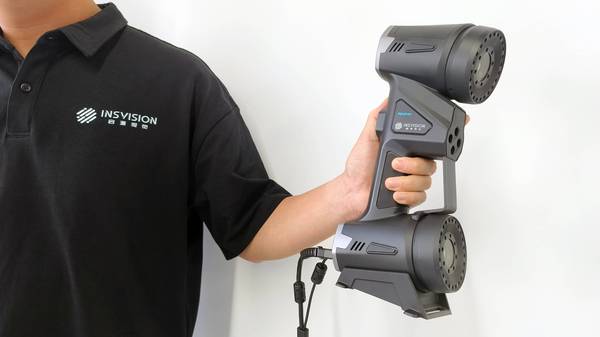
INSVISION replaces this analog vulnerability with a digital workflow anchored by the AlphaScan 3D handscanner and Alpha-Projector laser projection system. The setup pulls geometry directly from native CATIA and FiberSIM files, eliminating format conversion errors that plague hybrid workflows. High-precision binocular vision locks projection accuracy to 0.25mm—tight enough for most composite layup and structural assembly applications.
Where this gets interesting is the dynamic tracking layer. When a technician bumps the workpiece or thermal expansion shifts a fixture, the system recalibrates the projection path automatically. No restart. No re-teaching. The laser guidance stays locked to actual part position, not theoretical coordinates. Operators hit first-time-right placement because the system won’t let them proceed to the next step until the current feature registers within tolerance.
The operational math is straightforward: eliminate physical tooling costs, compress setup cycles from hours to minutes, and remove the scrap rates tied to manual layout variability.
—
Shrinking First Article Inspection from Days to Hours
First Article Inspection (FAI) remains a notorious chokepoint. Quality engineers spend 40-60% of inspection time on documentation alone—transcribing measurements, building reports, chasing traceability across disconnected systems.
the series’s 3D handscanner ecosystem attacks this friction directly. PTB-certified metrology software runs on the acquisition hardware, so measurement and analysis happen in one environment. Point clouds align to CAD references immediately. GD&T callouts evaluate against actual geometry without exporting to external packages. Deviation heatmaps generate in real time, flagging out-of-spec features before the part leaves the station.
The certification matters for regulated industries. PTB validation means measurement uncertainty is quantified and traceable, satisfying AS9100 and ISO 9001 auditors without supplemental paperwork. Manufacturers running this workflow report inspection cycle reductions of 60-70%, with complete digital thread documentation generated automatically.
Training curves flatten because the interface follows metrology logic rather than forcing users through software gymnastics. Precise, data-driven validation becomes standard procedure—not a specialized skill reserved for quality lab personnel.
—
Breaking the Format Conversion Bottleneck
Data handoffs between engineering and production still destroy productivity. A CATIA CPD file converted for inspection use loses design intent. Surface definitions degrade. FiberSIM ply data requires manual reconstruction. Each translation introduces latency and error risk.
the series’s 3D handscanner operates natively across these formats. Complex composite definitions, laminate sequences, and structural interfaces import directly into the measurement environment. The same dataset flows from design through reverse engineering, tooling fabrication, and final assembly verification without intermediate processing.
Multi-source data alignment handles the reality of industrial workflows—merging scan data with CMM points, photogrammetry, and CAD references into unified coordinate systems. Built-in deviation analysis tools evaluate against design specifications immediately, rather than exporting to standalone packages.
This interoperability isn’t convenience. It’s the difference between digital transformation investments that deliver ROI and those that accumulate shelfware. Engineering and production teams finally reference identical geometry, eliminating the “which version is correct” disputes that delay decisions.
—
Metrology-Grade Accuracy Without the Metrology Lab
Traditional CMMs demand thermal stability, vibration isolation, and rigid fixturing that simply don’t exist on active production floors. Photogrammetry requires controlled lighting and static conditions. Both force manufacturers to choose between measurement confidence and operational practicality.
the series’s optical tracking technology—exemplified by the X-Track optical tracking system—rejects this compromise. The system monitors reference targets continuously, adjusting scan frame positions in real time when vibration, thermal drift, or accidental contact shifts the workpiece. Technicians scan large unstable structures, weldments, or assemblies in-process without constructing elaborate holding fixtures.
The 0.25mm positioning consistency holds across these conditions because the tracking loop corrects faster than environmental disturbances propagate. Measurement uncertainty stays quantified and traceable without requiring controlled-environment infrastructure.
For manufacturers, this means bringing metrology-grade validation to the point of production rather than transporting parts to isolated quality labs. Cycle times compress. Throughput increases. And the capital expense of dedicated inspection facilities gets reallocated.
—
One Platform: From Legacy Reverse Engineering to Production Scaling
High-mix, low-volume manufacturers face a tooling paradox. Hard gauges and physical templates amortize poorly across short runs, yet digital alternatives often require mass-production volumes to justify implementation costs.
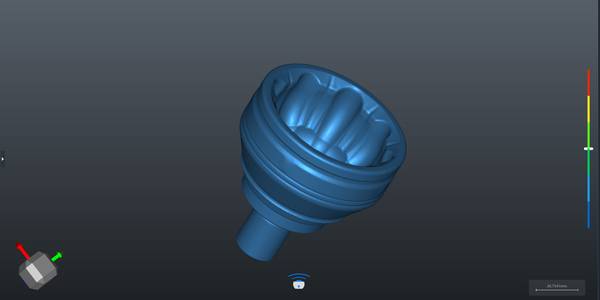
the series’s 3D handscanner architecture collapses this tradeoff. The same AlphaScan hardware that captures legacy part geometry for reverse engineering transitions directly to Alpha-Projector guided assembly once the digital model is validated. PTB-certified software handles both workflows, with integrated GD&T tools ensuring dimensional integrity from scan to final placement.
The the series’s green laser contours project at 0.25mm accuracy, with dynamic tracking maintaining alignment if the workpiece moves during assembly. Technicians follow visual guidance that updates automatically—no manual marking, no template storage, no tooling changeover between variants.
This flexibility proves particularly valuable for aftermarket aerospace components, specialized automotive builds, and industrial equipment refurbishment. Manufacturers eliminate hard tooling capital for products that may never see a second production run, while maintaining the precision and traceability that regulated industries demand.
The ROI calculation shifts from “how many units to amortize this gauge” to “how quickly can we reconfigure for the next variant.” In markets where product lifecycles compress and customization expands, that operational agility becomes competitive differentiation. With the series’s 3D handscanner technology, manufacturers achieve first-time-right assembly while dramatically reducing costly rework across aerospace, automotive, and industrial applications.