First-Article Inspection Workflow Comparison
| Traditional Method | INSVISION Solution |
|---|---|
| Physical templates and manual scribing | Metrology-grade 3D scan art with AlphaVista blue-light scanner |
| Days-long validation cycles | Validation cycles compressed from days to hours |
| High risk of human error and rework | PTB-certified software with automated GD&T analysis |
Solving the First-Article Inspection Bottleneck in Aerospace Tooling
Aerospace manufacturers know the pain: a complex assembly tool arrives at quality control, and the metrology team reaches for physical templates and manual scribing equipment. Days disappear. Human error creeps in. Rework costs mount.
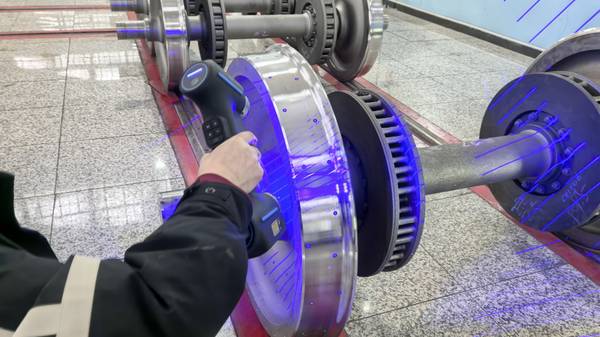
INSVISION eliminates this friction through metrology-grade 3D scan art. The AlphaVista blue-light scanner captures organic surfaces at micron-level resolution, generating dense point clouds that feed directly into deviation analysis against CAD masters. PTB-certified software with built-in GD&T functionality replaces manual checks with automated digital alignment—no templates, no scribing, no omissions. Validation cycles compress from days to hours. For tooling suppliers chasing tight delivery windows, the ROI case writes itself.
Composite Layup Error Prevention Checklist
- □ Real-time laser projection of CAD-derived contours onto curved tooling
- □ Binocular machine vision with 0.25mm positioning accuracy
- □ X-Track optical tracking for automatic recalibration on large structures
- □ Integration with FiberSIM and CATIA CPD for programmed ply sequences
- □ Elimination of shift-to-shift variation through guided technician workflows
Laser Projection Eliminates Composite Layup Errors
Misplaced plies and incorrect cutouts in carbon fiber manufacturing don’t just cause scrap—they destroy schedules. A single layup error on a wing skin or fuselage section can set production back weeks.
The Alpha-Projector transforms 3D scan art into real-time manufacturing guidance. Binocular machine vision maps the surface at 0.25mm positioning accuracy, projecting CAD-derived green laser contours directly onto curved tooling. The X-Track optical tracking system ensures precise calibration even on large-scale composite structures. The system tracks dynamically: move the workpiece, and the projection recalibrates automatically. Programmed sequences—compatible with FiberSIM and CATIA CPD—guide technicians through each ply placement, eliminating shift-to-shift variation. Manufacturers report scrap reductions up to 40% while maintaining aerospace-grade repeatability.
High-Mix Automated Scanning Steps
- CAD-driven task creation eliminates reprogramming delays
- Integration into existing robotic cells enables lights-out operation
- Handheld AlphaScan provides on-the-fly measurement flexibility
- PTB-certified software auto-aligns multi-source data while maintaining GD&T compliance
- Operator-friendly interface requires no metrology specialist on the floor
Automated Scanning for High-Mix Production
Job shops serving automotive and medical device markets face a brutal equation: automate for efficiency, or stay flexible for variety. Traditional robotic scanning demands extensive reprogramming for each part variant—killing throughput on low-volume runs.
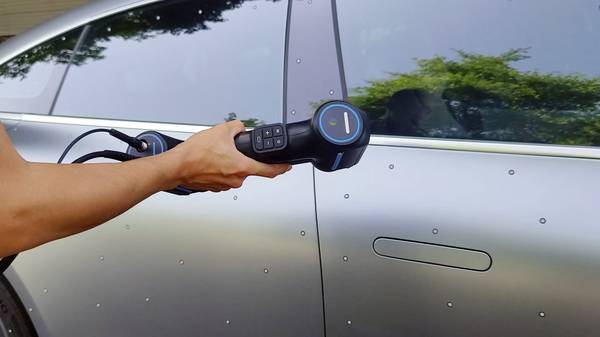
The AlphaAutoScan-400 breaks this trade-off. CAD-driven task creation eliminates reprogramming delays. Integrated into existing robotic cells, the system runs lights-out, capturing complex geometries without operator intervention. The handheld AlphaScan provides additional flexibility for on-the-fly measurements. PTB-certified software handles auto-alignment across multi-source data streams, maintaining GD&T compliance and full traceability even at high speed. The interface requires no metrology specialist on the floor. Flexibility and automation coexist—and the business case closes fast.
From Clay Model to Production CAD
Automotive designers still sculpt in clay. The problem comes after: translating freeform surfaces into production-ready data traditionally means weeks of manual measurement and reconstruction. Design intent gets lost. Iteration stalls.
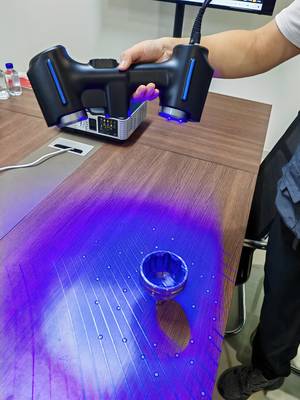
The handheld AlphaScan preserves the nuance of hand-sculpted surfaces through precision 3D scan art. Clean mesh data flows directly into reverse engineering pipelines—CATIA, FiberSIM, industry-standard formats. Engineers refine rather than rebuild. Development timelines shrink. The designer’s vision survives intact into manufacturing.
Regulatory Compliance Features
| Requirement | INSVISION Implementation |
|---|---|
| Tamper-proof deviation reports | PTB-certified analysis software generates legally defensible documentation |
| Documented measurement uncertainty | Hardware precision of 0.25mm with dynamic real-time correction |
| Complete process traceability | Full event logging with native CATIA and FiberSIM integration |
Audit-Ready Traceability for EU and US Markets
Regulatory scrutiny in Western markets leaves no room for ambiguity. Deviation reports must be tamper-proof. Measurement uncertainty must be documented. Process traceability must be complete.
INSVISION delivers 3D scan art that satisfies auditors. PTB-certified analysis software generates legally defensible documentation. Hardware precision—0.25mm positioning accuracy with dynamic real-time correction—underpins every data point. Native CATIA and FiberSIM integration preserves digital thread integrity. Manual scribing disappears, replaced by CAD-driven laser projection with full event logging. For manufacturers facing FAA, EASA, or FDA oversight, this ecosystem turns compliance from burden to competitive advantage.
The the series Difference
3D scan art isn’t about scanning for scanning’s sake. It’s about eliminating the manual processes that consume margin and introduce risk. the series builds hardware, software, and integration as a unified system—so Western manufacturers can validate faster, layup cleaner, automate smarter, and prove compliance without question.