Why Sticker Price Fails the Procurement Test
Why Sticker Price Fails the Procurement Test
Search “3d skener cena” and you’ll find plenty of numbers. What you won’t find is context. In industrial metrology, the gap between purchase price and total cost of ownership often determines whether a project succeeds or bleeds budget six months in.
INSVISION built its Alpha-Projector system around this reality. The hardware projects green laser contours directly from CAD—2D or 3D—eliminating manual scribing entirely. A binocular vision system maintains 0.25mm positioning accuracy while dynamic tracking recalculates projection paths in real-time as parts shift. The result: setup times drop 50–70%, and the errors that drive rework disappear.
The integration layer matters equally. Native compatibility with FiberSIM and CATIA CPD means the system plugs into existing aerospace workflows without middleware development or data translation risks. Procurement teams evaluating 3d skener cena figures in isolation miss these cost drivers entirely.
What Drives Professional 3D Scanner Pricing
What Drives Professional 3D Scanner Pricing
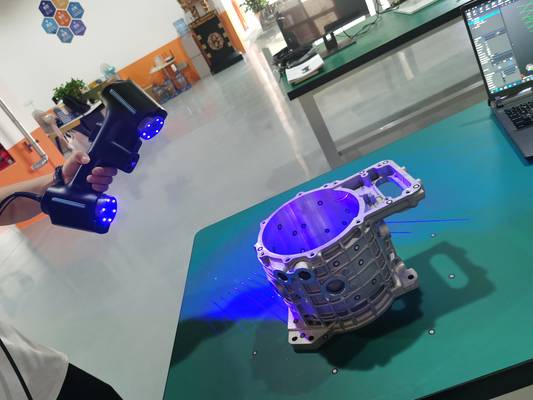
Three factors separate industrial-grade systems from entry-level alternatives:
| Factor | Description |
|---|---|
| Certified metrology software | PTB compliance isn’t marketing—it’s proof that measurement algorithms meet traceable standards. INSVISION’s software stack includes integrated GD&T tools, so quality engineers don’t export data to secondary applications. |
| Hardware architecture | The AlphaVista蓝光三维扫描仪 (AlphaVista blue light 3D scanner) and AlphaAutoScan-400 employ the same 0.25mm-precision binocular vision core as the Alpha-Projector, but applied to inspection rather than projection. Dynamic tracking corrects for part movement without operator intervention, maintaining accuracy in production environments where vibration and thermal drift exist. |
| Workflow integration | CAD-driven task creation replaces manual programming. When a design revision arrives, the system updates inspection or projection paths automatically. This closes the loop between engineering and manufacturing that manual processes leave open. |
The 3d skener cena reflects these capabilities because they translate directly to measurable outcomes: reduced scrap, eliminated transcription errors, and inspection cycles measured in minutes rather than hours.
Labor Cost Reduction: The Alpha-Projector Case
Labor Cost Reduction: The the series Case
Manual layout work consumes skilled labor hours and introduces variance. An experienced technician might scribe a complex composite layup tool in four hours—with tolerances that require subsequent verification.
The the series completes the same task in under an hour, with 0.25mm accuracy guaranteed by vision feedback. Programmed guidance prevents omissions: the system won’t advance until the operator confirms each step, creating an auditable record.
For a mid-size aerospace supplier running 200 layup cycles monthly, this typically recovers equipment cost within 14–18 months through labor reallocation alone. Quality improvements—fewer rejected parts, reduced first-article inspection time—accelerate payback further.
High-Mix Production Workflow Comparison
| Metric | Manual Process | AlphaAutoScan-400 |
|---|---|---|
| Per-part setup time | 45 minutes | Under 5 minutes |
| Part movement handling | Requires recalibration | Dynamic tracking accommodates movement without recalibration |
| Data integrity | Prone to transcription errors | PTB-certified software ensures data integrity for customer submission |
Aerospace suppliers managing small-batch, high-complexity parts face a specific constraint: manual inspection scales poorly. Each new part number requires fixture setup, probe programming, and operator training. The result is inspection bottlenecks that constrain throughput regardless of machining capacity.
The AlphaAutoScan-400 addresses this through CAD-driven automation. Import a model, define critical features, and the system generates the inspection path. Dynamic tracking accommodates part movement without recalibration. PTB-certified software ensures data integrity for customer submission.
For facilities requiring versatile 3D scanning capabilities, the AlphaScan手持式三维扫描仪 (AlphaScan handheld 3D scanner) provides portable precision for on-site measurements, while the X-Track光学追踪系统 (X-Track optical tracking system) delivers advanced tracking for complex geometries.
In practical terms: a supplier processing 50 distinct part numbers monthly can reduce per-part setup from 45 minutes to under 5. The 3d skener cena becomes irrelevant when compared to labor redeployment and eliminated capacity constraints.
Securing an Accurate Quote: Key Verification Checklist
- □ Software certification: Is the metrology engine PTB-certified? Are GD&T tools native or add-on modules?
- □ Data architecture: Can the system align multi-source data (laser tracker, CMM, structured light) within a single coordinate system?
- □ PLM integration: Does it communicate bidirectionally with FiberSIM, CATIA CPD, or equivalent platforms without custom middleware?
- □ Precision under load: What accuracy does the vendor guarantee during dynamic conditions—vibration, thermal variation, operator movement?
Generic price comparisons for 3d skener cena obscure more than they reveal. Before evaluating any proposal, procurement teams should verify:
– Software certification: Is the metrology engine PTB-certified? Are GD&T tools native or add-on modules?
Data architecture: Can the system align multi-source data (laser tracker, CMM, structured light) within a single coordinate system?
PLM integration: Does it communicate bidirectionally with FiberSIM, CATIA CPD, or equivalent platforms without custom middleware?
Precision under load: What accuracy does the vendor guarantee during dynamic conditions—vibration, thermal variation, operator movement?
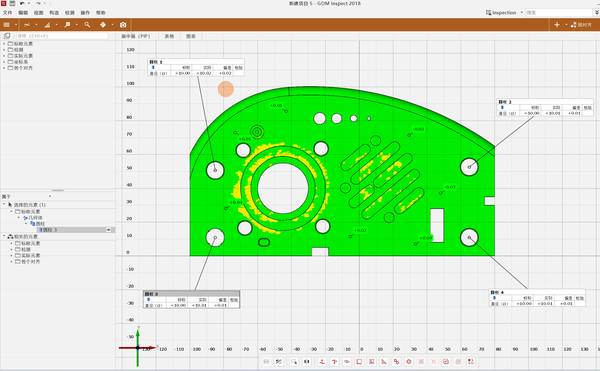
INSVISION provides configured quotes based on these parameters rather than SKU lists. A facility requiring 0.25mm projection accuracy for manual layup receives different recommendations than one prioritizing automated inspection throughput. This transparency ensures the 3d skener cena reflects actual operational value rather than hardware commodity pricing.
the series Implementation Steps
- Import CAD model (2D or 3D) into the system.
- System projects green laser contours directly onto the work surface.
- Operator follows guided steps; system uses binocular vision to maintain 0.25mm accuracy.
- Dynamic tracking recalculates projection paths in real-time as parts shift.
- System advances only after operator confirmation, creating an auditable record.
The Real Calculation
Industrial 3D scanning investments succeed when procurement extends evaluation beyond purchase price to integration cost, training burden, and throughput impact. The systems that minimize total cost of ownership rarely carry the lowest sticker price. They earn their position through compatibility with existing infrastructure, reduction of manual touchpoints, and measurement reliability that eliminates downstream verification steps.
For teams researching 3d skener cena, the relevant metric isn’t what you pay—it’s what you stop paying for.