Key Benefits of INSVISION’s In-Process Verification
| Benefit | Description |
|---|---|
| Eliminates rework loops | Shift from reactive quality control to in-process verification prevents cascading errors. |
| Protects delivery schedules | Early detection of deviations avoids production delays. |
| Reduces material waste | Transforms scrap from an accepted cost into a preventable exception. |
Catching Dimensional Drift Before It Costs You
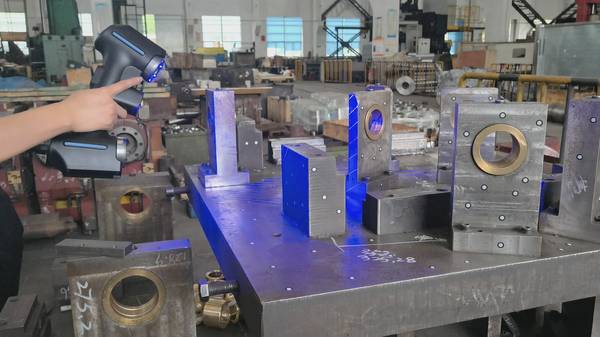
A single undetected deviation in an aerospace bracket or automotive chassis can cascade into weeks of rework and six-figure scrap bills. INSVISION’s AlphaScan and AlphaVista handheld 3D scanning tools deploy directly on the shop floor to intercept these issues at the source—before components ever reach assembly.
These systems run on PTB-certified metrology software with native GD&T analysis and multi-source point cloud alignment. Technicians compare scan data against original CATIA or FiberSIM models in real time, flagging out-of-tolerance features while the part still sits on the fixture. The shift from reactive quality control to in-process verification eliminates rework loops, protects delivery schedules, and transforms material waste from an accepted cost into a preventable exception.
Challenges in Manual Layout Work
- □ Scribed lines wander.
- □ Templates wear over time.
- □ Training new operators to read complex drawings consumes weeks of productive capacity.
—
From Manual Scribing to Laser-Guided Precision
Manual layout work remains a persistent source of error in complex fabrication. Scribed lines wander. Templates wear. Training new operators to read complex drawings consumes weeks of productive capacity.
INSVISION’s Alpha-Projector replaces this uncertainty with CAD-driven green laser projection. High-precision binocular machine vision positions 3D contours onto workpieces with 0.25mm accuracy—guiding technicians through drilling, welding, and assembly without interpretation gaps. Dynamic tracking automatically recalibrates projection if the workpiece shifts, maintaining precision through real-world shop floor conditions.
The payoff extends beyond accuracy. Digital work instructions flatten the learning curve for new hires and eliminate the omissions that plague manual processes. Complex assemblies become repeatable, error-proof operations with measurable throughput gains.
AlphaAutoScan-400 Workflow Steps
- Operators load 2D or 3D models to generate scan paths automatically—no programming expertise required.
- Binocular vision positioning maintains 0.25mm accuracy with dynamic tracking that corrects for part movement during measurement.
- Built-in GD&T tools execute deviation analysis against design intent for first-article inspection and in-process verification.
—
Automating Quality Across High-Mix, Low-Volume Production
Contract manufacturers face a brutal equation: maintain aerospace-grade tolerances across constantly changing part families without choking throughput. Manual inspection cannot solve this. Neither can fixed gauging built for single-part production.
The AlphaAutoScan-400 addresses the gap through automated, CAD-driven inspection routines. Operators load 2D or 3D models to generate scan paths automatically—no programming expertise required. Binocular vision positioning maintains 0.25mm accuracy with dynamic tracking that corrects for part movement during measurement.
Built-in GD&T tools execute deviation analysis against design intent, supporting both first-article inspection and in-process verification. The result scales quality control capacity without proportional labor increases, preserving margins in environments where setup time traditionally dominates cycle time.
INSVISION Software Interoperability Features
| Feature | Impact |
|---|---|
| Native CATIA CPD and FiberSIM support | Eliminates translation errors and preserves metadata. |
| Direct scan data integration | Enables immediate GD&T analysis and deviation reporting for engineering teams. |
| Accelerated design validation | Reduces prototype iterations and narrows the “as designed” vs. “as built” gap. |
—
Closing the Design-to-Production Feedback Loop
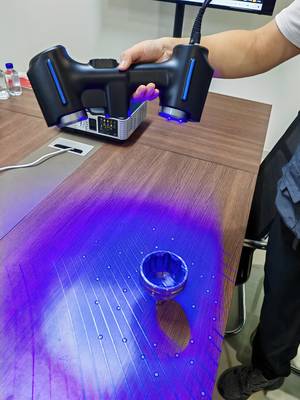
Metrology data too often dies on the shop floor—trapped in proprietary formats or disconnected from engineering workflows. the series’s software ecosystem breaks these silos by supporting native CATIA CPD and FiberSIM formats without translation errors or lost metadata.
Scan data flows directly into GD&T analysis and multi-source alignment, generating deviation reports that engineering teams act on immediately. Design validation accelerates. Prototype iterations shrink. The gap between “as designed” and “as built” narrows from a chronic problem to a managed, measurable variance.
—
Protecting Infrastructure Investments While Modernizing Metrology
Retrofitting advanced 3D scanning tools into established production lines rarely justifies ripping out functioning PLM and MES infrastructure. the series prioritizes interoperability—supporting industry-standard formats and modular hardware adoption that scales incrementally.
The X-Track dynamic tracking system exemplifies this approach. Manufacturers add precision positioning capabilities without overhauling existing fixtures or material handling systems. PTB-certified software ensures measurement reliability across mixed hardware environments. High-precision binocular vision maintains 0.25mm accuracy even when workpieces move during processing, dynamically correcting projection positions without operator intervention.
This incremental modernization path lets engineering teams capture metrology-grade precision, reduce scrap rates, and prevent downstream errors—without disrupting the operational balance that keeps factories running. By integrating advanced 3D scanning tools into existing workflows, manufacturers can achieve measurable quality improvements while protecting their infrastructure investments.