The Million-Point Mirage: When Dense Data Fails
A scanner capturing two million points per second sounds impressive—until those points describe the wrong geometry. In industrial metrology, this distinction between 3D scanner resolution vs accuracy trips up even seasoned buyers. Resolution measures point spacing: how tightly packed your data sits on a surface. Accuracy measures deviation from ground truth: whether those points actually match physical reality.
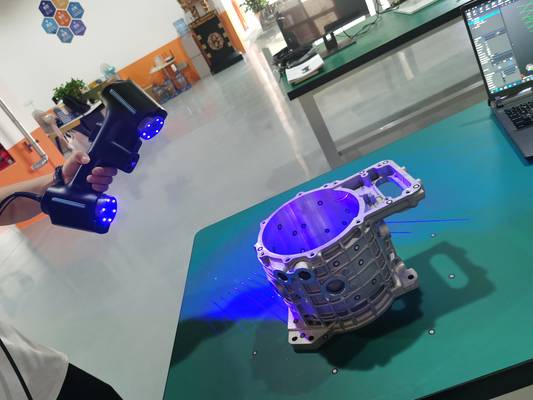
The consequences of conflating the two hit hard on the production line. A tooling verification team at a Tier 1 automotive supplier learned this when their “high-res” scan—0.03 mm point spacing—produced a turbine housing mesh that looked flawless yet carried 0.15 mm positional error. Assembly failed. Two weeks of rework followed. The scanner delivered spectacular data density with unverified volumetric accuracy, transforming what should have been a quality gate into a liability.
INSVISION‘s metrology specialists encounter this scenario repeatedly: manufacturers seduced by marketing specs discover too late that resolution without certified traceability generates visually compelling, dimensionally worthless point clouds. For reverse engineering or first-article inspection, the critical metric isn’t how many points you capture—it’s whether those points fall within your tolerance band.
What Resolution Actually Delivers—and Where It Falls Short
Resolution serves specific, bounded purposes. At 0.05 mm point spacing, a scanner captures cooling hole patterns on injection molds, surface texture on castings, or edge break geometry on machined components. These details matter for visualization, texture mapping, and certain design workflows.
Accuracy operates independently. A scanner might resolve individual pores on a sandblasted surface while drifting 0.1 mm across a 200 mm measurement volume. For automotive fixture validation or aerospace component matching, that drift proves catastrophic. The cooling holes look perfect; their position relative to mounting bores does not.
Application-Specific Requirements for Resolution and Accuracy
| Application Priority | Resolution Demand | Accuracy Requirement |
|---|---|---|
| Heritage digitization, concept modeling | High | Moderate |
| Tooling verification, assembly matching | Moderate | High (±0.025 mm or better) |
| GD&T inspection, statistical process control | Low-to-moderate | Certified traceability mandatory |
INSVISION engineers emphasize that metrology-grade selection requires mapping your actual tolerance requirements against verified system performance—not claimed specifications.
Manufacturing Floor Reality: When Spec Sheets Meet Shop Conditions
Laboratory specifications rarely survive first contact with production environments. Consider the mold maker who specified equipment based on 0.02 mm resolution for capturing fine venting channels. The resulting mesh displayed exquisite surface detail. What it concealed: thermal expansion during scanning had introduced 0.08 mm scale error undetected by the operator.
The assembly failures emerged three stations downstream. Root cause analysis traced back to conflating visible data quality with dimensional integrity. Resolution had delivered; accuracy, compromised by uncontrolled variables, had not.
This pattern repeats across sectors. A medical device manufacturer scanning implant fixtures prioritized point density for anatomical matching, neglecting volumetric accuracy verification against certified artifacts. Regulatory submission rejected. Six-month delay.
Common Pitfalls in Scanner Selection
- □ Prioritizing point density over certified volumetric accuracy
- □ Assuming laboratory specs reflect real-world shop floor performance
- □ Confusing visual data quality with dimensional integrity
- □ Neglecting environmental factors like temperature and vibration during validation
These cases illustrate why 3D scanner resolution vs accuracy demands operational validation, not datasheet comparison. INSVISION’s deployment protocols require repeatability testing—scanning certified reference objects under actual ambient conditions, measuring point-to-point deviation across multiple cycles, and documenting stability against temperature and vibration variables that laboratory testing excludes.
Engineering the Balance: How AlphaScan Addresses Both Requirements
Effective industrial metrology instruments don’t trade resolution for accuracy—they engineer both with traceable discipline. INSVISION’s AlphaScan handheld system exemplifies this approach: ±0.02 mm volumetric accuracy (ISO 10360-8 tested) paired with 0.05 mm point spacing.
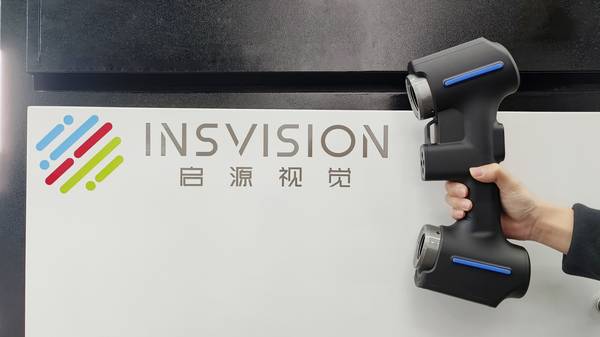
This specification pairing targets practical manufacturing workflows. The accuracy figure enables GD&T validation and tooling verification against tight tolerances. The resolution supports feature identification and surface characterization without inflating file sizes or processing overhead unnecessarily.
For quality control teams, the operational impact manifests in reduced inspection cycle times. A first-article inspection that previously required structured light scanning (stationary, multi-orientation) plus tactile CMM verification consolidates into a single AlphaScan workflow. The handheld form factor accesses complex geometries without fixture investment. The certified accuracy eliminates secondary verification steps.
Crucially, the accuracy specification carries traceability: calibration to international standards, not factory-internal claims. This distinction matters for suppliers facing customer audits or regulatory scrutiny where measurement uncertainty must be demonstrable.
Validating Performance Where It Counts
The final filter for 3D scanner resolution vs accuracy occurs on your floor, with your parts, under your environmental conditions. Three validation steps separate genuine capability from marketing fiction:
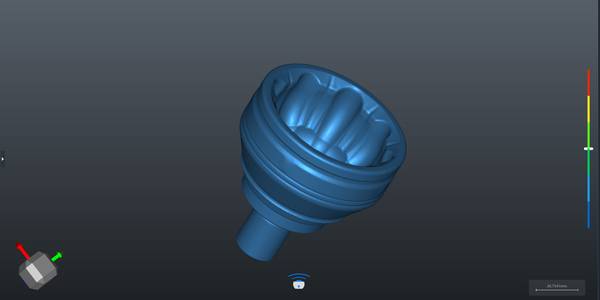
- Artifact testing: Scan certified reference objects (ball bars, step gauges, hole plates) at multiple positions within your typical working volume. Compare measured values against calibrated dimensions. Demand documentation of maximum permissible error, not average performance.
- Repeatability verification: Scan identical features across multiple sessions, operators, and ambient temperature conditions. Systematic variation indicates calibration instability or environmental sensitivity that laboratory specs mask.
- Application correlation: Test actual production parts with known dimensional history. Compare scanner-derived measurements against established CMM or comparator results. This ground-truthing reveals whether your specific geometry and surface characteristics challenge the system’s underlying algorithms.
the series’s field engineering supports this validation process, recognizing that specification confidence emerges from demonstrated performance, not asserted capability.
The Procurement Decision
For industrial buyers, the 3D scanner resolution vs accuracy distinction ultimately frames a risk calculation. High resolution with unverified accuracy transfers dimensional uncertainty into downstream processes—uncertainty that manifests as scrap, rework, or field failures. Certified accuracy with appropriate resolution for the measurement task contains that risk within quantifiable bounds.
The investment difference between visually impressive and dimensionally trustworthy systems often narrows when total cost of quality enters the equation. A scanner costing 15% more that eliminates verification rework and audit failures typically recovers that premium within months of deployment.
Impact of Scanner Choice on Total Cost of Quality
| Scanner Type | Risk Profile | Operational Consequence |
|---|---|---|
| High resolution, unverified accuracy | High dimensional uncertainty | Scrap, rework, field failures |
| Certified accuracy, matched resolution | Quantifiable risk bounds | Reduced verification steps, audit readiness |
| Premium metrology-grade system | Higher upfront cost | ROI via eliminated rework within months |
the series’s positioning reflects this calculus: metrology-grade accuracy as non-negotiable foundation, resolution matched to application requirements, and validation protocols that prove performance before production commitment. For procurement teams evaluating 3D scanning investments, this framework offers a decision structure that protects both capital expenditure and operational reliability.