When Manual Measurement Becomes the Bottleneck
Turbine blade inspection tells the story. A single airfoil contains hundreds of critical dimensions—curvature radii, wall thickness variations, trailing edge profiles—that handheld calipers simply cannot capture comprehensively. Quality teams face an unenviable choice: sample a handful of points and hope defects surface downstream, or throttle production with exhaustive touch-probe routines that consume hours per part.
The hidden costs accumulate fast. Rework cycles triggered by late-stage discoveries. Scrap from non-conforming batches already in-process. Warranty exposure when dimensional drift escapes detection entirely. For manufacturers pushing tighter tolerances on increasingly complex geometries, legacy inspection methods have become active liabilities.
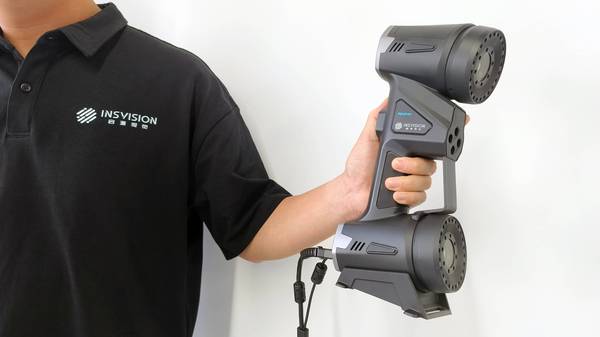
This pressure is driving adoption of automated optical metrology. High-precision 3D laser scanners now capture complete surface data in single passes—millions of measurement points versus the dozens extracted by manual methods. INSVISION has positioned its AlphaScan series specifically for this transition: maintaining quality velocity without sacrificing production throughput.
Compressing Inspection Windows from Hours to Minutes
Coordinate measuring machines deliver accuracy, but at a velocity cost. Fixturing, programming probe paths, and executing point-to-point routines for freeform surfaces can consume entire shifts. When engineering needs rapid tooling validation or legacy part documentation, CMM queues become the constraint.
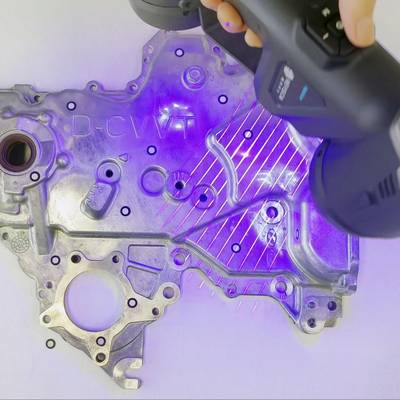
Handheld laserscanner technology inverts this equation. The AlphaScan captures dense point clouds across challenging surfaces—rough castings, reflective machined finishes, complex piping geometries—without fixturing requirements or programming overhead. Operators move the device around the part, not the part into a machine.
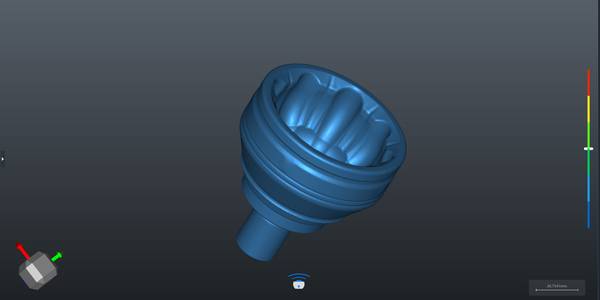
The operational impact is measurable. Inspection cycles that previously spanned multiple shifts now complete within single production windows. Engineering teams receive full-surface data immediately, enabling same-shift decisions on tooling adjustments or component retrofits. For manufacturers running lean operations, this acceleration directly translates to capacity gains and faster time-to-revenue.
Module title
- Fixturing and programming probe paths for freeform surfaces
- Executing point-to-point routines that consume entire shifts
- Moving the AlphaScan device around the part without fixturing
- Capturing dense point clouds across challenging surfaces in single passes
- Receiving full-surface data immediately for same-shift decisions
Taking Metrology to the Asset, Not the Asset to Metrology
Aging infrastructure creates a data paradox: original CAD files don’t exist, yet retrofitting demands precise dimensional records. Traditional approaches—disassembly, transport to metrology labs, reassembly—impose downtime costs that can exceed the retrofit itself.
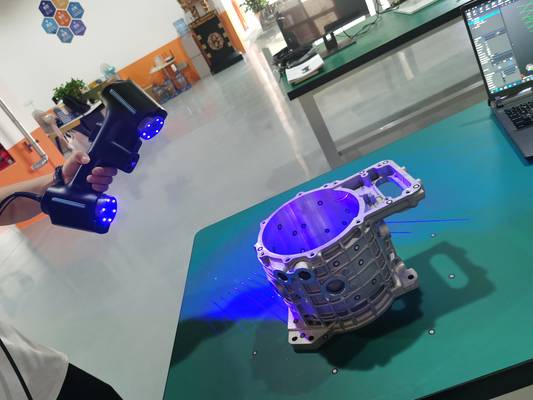
The AlphaScan’s battery-powered, cable-free design removes this friction. Technicians scan components in situ: offshore platforms, congested plant floors, elevated installations where power access is impractical. No disassembly. No production halts. The resulting point clouds feed directly into reverse engineering workflows, accelerating digital twin creation without operational disruption.
This portability transforms project economics. Facilities document complex installations once, then leverage that data across multiple engineering cycles—maintenance planning, component replacement, system expansion. The scanner becomes a capital asset with recurring utility rather than a single-project expense.
Module title
- □ Scan components in situ without disassembly
- □ Eliminate production halts during metrology
- □ Feed point clouds directly into reverse engineering workflows
- □ Leverage scan data across multiple engineering cycles
ROI Beyond the Spec Sheet: Scrap, Rework, and Warranty Exposure
Precision specifications matter, but procurement decisions ultimately hinge on operational returns. INSVISION’s installed base provides concrete benchmarks:
In aerospace tooling applications, early deviation detection through full-surface scanning has reduced scrap rates by 30-50% compared to sampling-based inspection. Material costs for titanium and Inconel forgings make this prevention value substantial.
Automotive supply chains report compressed first-article approval timelines—complex geometries validated in hours rather than days—directly accelerating program launches.
Most significantly, the shift from statistical sampling to 100% surface validation eliminates the blind spots that generate field failures. Latent defects—micro-cracks, dimensional drift in non-critical zones, surface finish variations—surface in the data rather than in customer hands. Warranty exposure and brand risk diminish accordingly.
The investment case rests on these operational metrics, not accuracy claims alone.
Module title
| Industry | Impact | Source Paragraph |
|---|---|---|
| Aerospace | 30-50% scrap rate reduction via full-surface scanning | |
| Automotive | First-article approval compressed from days to hours |
Integration Without Disruption
Metrology hardware purchases often stall on ecosystem concerns: Will this require new software licenses? Retraining programs? Workflow disruption?
AlphaScan data exports directly to standard platforms—SOLIDWORKS, Siemens NX, PolyWorks, Geomagic—without proprietary intermediaries. Engineering teams import point clouds immediately for design iteration, deviation analysis, or supplier communication. No translation layers. No data silos.
This interoperability protects existing technology investments while extending their utility. Scan data feeds directly into PLM workflows, quality management systems, and supplier collaboration portals. The scanner enhances operational infrastructure rather than fragmenting it.
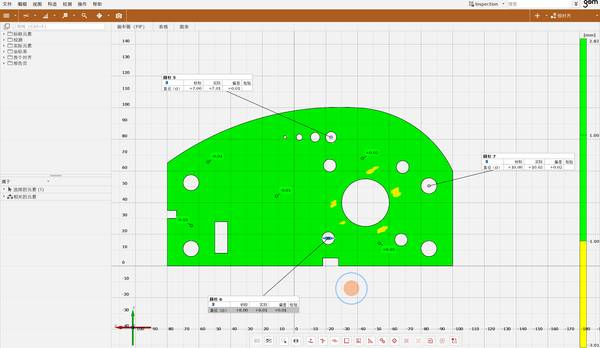
For manufacturers evaluating laser scanner technology, this seamless integration often determines whether the investment delivers projected returns—or becomes shelfware requiring additional integration spending to activate.
Module title
| Integration Feature | Benefit | Source Paragraph |
|---|---|---|
| Direct export to SOLIDWORKS, Siemens NX, PolyWorks, Geomagic | No proprietary intermediaries or translation layers | |
| Feeds into PLM, QMS, and supplier portals | Enhances rather than fragments operational infrastructure |
The Bottom Line
Industrial laser scanners have transitioned from specialized applications to mainstream metrology infrastructure. The AlphaScan exemplifies this evolution: field-proven hardware that addresses specific pain points—inspection velocity, portable reverse engineering, ecosystem integration—without the capability overkill that inflates cost and complexity.
For procurement and engineering leaders, the evaluation criteria are straightforward: Where does manual inspection currently constrain throughput? What rework and warranty costs stem from sampling-based quality approaches? How much operational value would portable, immediate metrology create?
The answers to these questions typically justify the investment faster than specification comparisons alone. The AlphaScan laserscanner delivers measurable ROI for manufacturers ready to modernize their quality control processes.