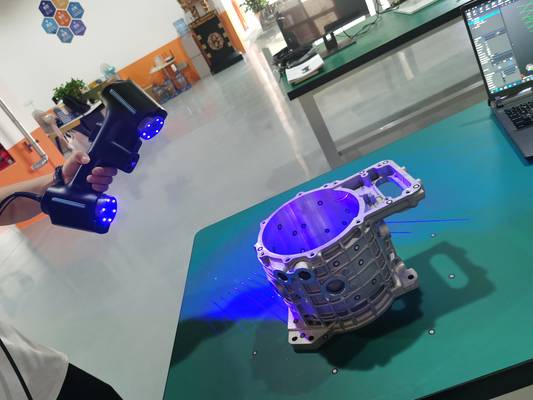
Why CMMs Hit Their Limits in Modern Manufacturing
Coordinate Measuring Machines built their reputation on precision, but today’s high-mix production environments expose their fundamental constraints. Tactile probing demands fixturing, climate-controlled labs, and cycle times measured in hours—not minutes. When physical probes cannot access internal channels, undercuts, or deep cavities, quality teams face an uncomfortable choice: ship with incomplete data or delay delivery.
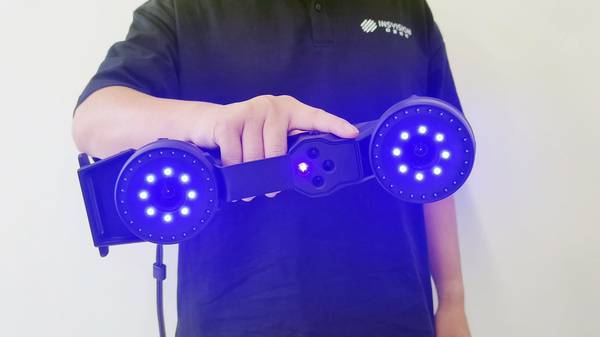
The data deficit compounds the problem. A CMM captures hundreds of points; complex surfaces require millions. Without dense point cloud coverage, warping, surface defects, and tooling wear remain invisible until failures surface downstream. This is where 3D laser scanning closes the gap. INSVISION‘s AlphaScan captures complete as-built geometry in seconds, delivering metrology-grade data without pulling parts from production. This advanced 3d lazer tarama solution transforms factory floor inspection capabilities.
CMM Limitations vs. 3D Laser Scanning Capabilities
| Aspect | CMM | 3D Laser Scanning (AlphaScan) |
|---|---|---|
| Data Density | Hundreds of points | Millions of points (dense point cloud) |
| Environment | Climate-controlled lab required | Factory floor deployment possible |
| Cycle Time | Hours | Seconds |
| Accessibility | Limited by probe reach (no internal channels/undercuts) | Full surface capture including complex geometries |
From Turbine Blades to Weld Seams: One Tool, Zero Compromise
Moving inspection to the shop floor sounds straightforward until you account for the variables: ambient vibration, temperature swings, and operators without specialized metrology training. The AlphaScan addresses these realities through handheld portability and onboard processing that compensates for environmental noise.
Aerospace castings with intricate cooling channels, automotive weld seams requiring penetration depth verification, large-scale tooling fixtures—each presents distinct challenges. Rather than deploying multiple specialized systems, manufacturers can document complete digital twins in a single scan session. The resulting mesh data feeds directly into reverse engineering workflows or GD&T analysis, collapsing the timeline between physical part and engineering decision.
Applications Enabled by AlphaScan
- □ Aerospace castings with intricate cooling channels
- □ Automotive weld seams requiring penetration depth verification
- □ Large-scale tooling fixtures documentation
- □ Digital twin creation for reverse engineering
- □ GD&T analysis with full surface data
Sub-50µm Accuracy Without the Lab Wait
Speed and precision are not mutually exclusive. The AlphaScan achieves sub-50µm accuracy in conditions where traditional systems would demand environmental isolation. Real-time feedback enables first-article inspections at line speed, catching deviations before they propagate through batch production.
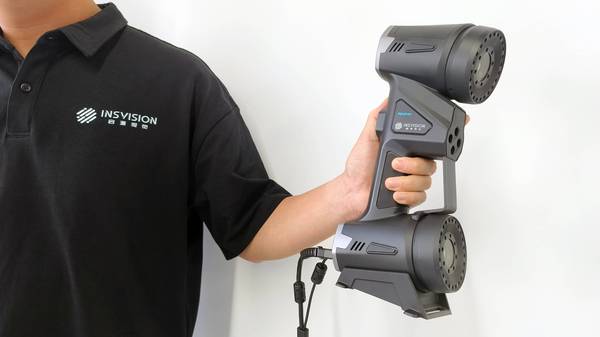
For robot guidance applications, this capability translates to precise path programming without manual teach points. For quality control, it means detecting tooling wear patterns before they produce scrap. The operational calculus shifts from reactive measurement to predictive intervention—protecting margins on tight-tolerance contracts where rework costs often exceed the original manufacturing value.
Workflow Integration Steps
- Deploy AlphaScan on the shop floor for immediate scanning
- Capture full surface data to detect deviations in real time
- Use scan data for robot path programming without manual teach points
- Identify tooling wear patterns proactively to prevent scrap
- Shift from reactive measurement to predictive quality intervention
Plug Into Existing Workflows—No Proprietary Lock-In
Technology adoption stalls when integration complexity outweighs performance gains. INSVISION designed the AlphaScan around this reality. Native output formats include STL, PLY, and ASCII point clouds compatible with PolyWorks, Geomagic, and open-source processing pipelines. QA engineers retain their software investments and established workflows.
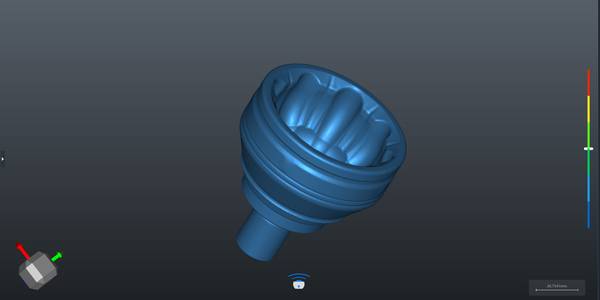
ISO-compliant reporting generates immediately, satisfying audit requirements without secondary processing. The system arrives calibrated and ready for production deployment, typically requiring less than a day for operator certification. For facilities running mixed equipment environments, this interoperability eliminates the hidden costs of vendor-specific training and data translation.
AlphaScan Integration Features
| Feature | Benefit |
|---|---|
| Native STL, PLY, ASCII output | Compatibility with PolyWorks, Geomagic, and open-source tools |
| ISO-compliant reporting | Immediate audit readiness without extra steps |
| Pre-calibrated system | Deployment-ready with <1 day operator certification |
| Vendor-agnostic design | Eliminates hidden costs of proprietary training/data translation |
Measurable Impact: 22% Scrap Reduction in Six Months
A Tier-1 automotive supplier recently deployed AlphaScan systems to address persistent assembly mismatches in a high-volume chassis component. Traditional gap-and-flush gauges identified problems post-assembly; 3D laser scanning revealed the root cause—progressive die wear producing subtle dimensional drift early in the stamping process.
By shifting measurement upstream and capturing full surface data, the quality team reduced root-cause analysis from days to hours. Scrap rates dropped 22% within six months. Customer returns fell proportionally. The equipment investment recovered through material savings alone, excluding the less quantifiable but equally valuable gains in delivery reliability and customer confidence.
The Bottom Line
Industrial inspection technology must justify itself on the factory floor, not in marketing materials. 3D laser scanning delivers that justification through measurable throughput gains, compatibility with established infrastructure, and data density that exposes problems invisible to conventional methods. For procurement teams evaluating metrology investments, the AlphaScan represents a calculated enhancement rather than a disruptive gamble—precision without the bottlenecks, integration without the headaches. This 3d lazer tarama technology proves its value where it matters most: on the factory floor.