The Hidden Cost of Legacy Parts
Every maintenance engineer knows the scenario: a critical component fails, the OEM stopped production years ago, and the original CAD files vanished with a retired supplier. Suddenly, a facility faces unplanned downtime with no clear path forward.
Traditional reverse engineering compounds the problem. Calipers, gauges, and manual measurement demand days of painstaking work—often requiring complete disassembly just to reach internal geometries. Human error creeps in. Tolerances stack up. What should take hours stretches into weeks.
3D scanning technology changes the equation entirely. Portable, high-precision scanners capture complete surface data in situ, transforming physical assets into dense point clouds without moving heavy machinery or breaking down assemblies. The INSVISION AlphaScan exemplifies this shift: sub-millimeter accuracy delivered directly on the shop floor, reducing data acquisition from weeks to hours while preserving the geometric fidelity required for precise reverse engineering and rapid prototyping.
Challenges of Traditional Reverse Engineering vs. 3D Scanning
| Traditional Reverse Engineering | 3D Scanning with AlphaScan |
|---|---|
| Requires complete disassembly | Captures data in situ without disassembly |
| Days of manual measurement | Data acquisition reduced to hours |
| Human error and tolerance stacking | Sub-millimeter accuracy and geometric fidelity |
Why CMMs Can’t Keep Pace With Modern Production
Coordinate Measuring Machines remain the gold standard for controlled environments. But in high-mix manufacturing, their limitations become liabilities.
Complex fixturing. Climate-controlled labs. Queue times that stretch across shifts. While CMMs deliver precision, they create a verification gap that agile production lines cannot tolerate. Deviations go unnoticed. Scrap accumulates. Rework costs mount.
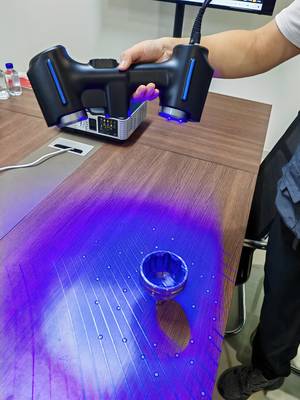
3D scanning technology removes these constraints through non-contact, shop-floor inspection. First-article validation happens in minutes, not hours. In-process verification spans diverse part families without retooling. The AlphaScan brings metrology-grade measurement to the point of production, catching dimensional drift before it becomes scrap. Quality control finally moves at the speed of manufacturing.
CMM Limitations vs. Shop-Floor 3D Scanning
| CMM Constraints | AlphaScan Advantages |
|---|---|
| Requires complex fixturing | No fixturing needed; non-contact scanning |
| Limited to climate-controlled labs | Operates directly on the shop floor |
| Queue times across shifts | First-article validation in minutes |
Documenting Assets Without Shutting Them Down
Facility retrofits traditionally demand a brutal choice: operate blind or stop production. Manual measurement of piping systems, heavy machinery, or complex infrastructure requires shutdowns that cost thousands per hour. Even then, estimations and incomplete data lead to field surprises, change orders, and budget overruns.
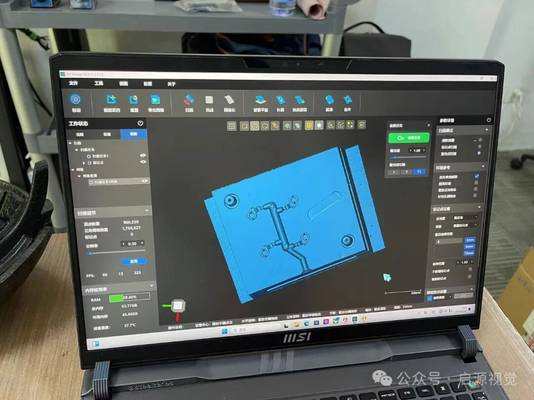
Modern 3D scanning technology eliminates this trade-off. The AlphaScan captures precise as-built conditions while equipment runs—generating digital twins in minutes rather than days. Maintenance teams plan modifications against accurate models. Compliance verification proceeds without interrupting revenue-generating operations. Asset documentation shifts from disruptive event to background process, with facility data remaining current and actionable.
Benefits of In-Operation Asset Documentation
- □ Captures precise as-built conditions while equipment runs
- □ Generates digital twins in minutes instead of days
- □ Enables planning against accurate models without shutdowns
- □ Shifts documentation from disruptive event to background process
Closing the Loop Between Field and Engineering
The disconnect between technicians and design engineers carries measurable costs. Manual measurements transmitted via email. 2D photographs lacking critical context. Interpretation errors that demand return site visits and delay project milestones.
3D scanning technology bridges this gap at the source. Field teams capture complete component geometry in situ, producing watertight mesh files shared instantly with engineering. Real-time visualization on the AlphaScan validates data completeness before leaving the site—eliminating the “we missed a dimension” phone call. Engineering decisions accelerate. Rework cycles shrink. The ROI materializes in compressed project timelines and reduced travel costs.
Field-to-Engineering Workflow with 3D Scanning
- Capture complete component geometry in situ using AlphaScan
- Produce watertight mesh files on-site
- Validate data completeness via real-time visualization before leaving site
- Share files instantly with engineering team
- Accelerate engineering decisions and reduce rework cycles
The True Price of “Good Enough”
Budget scanning hardware tempts procurement with lower capital outlays. The operational reality proves different.
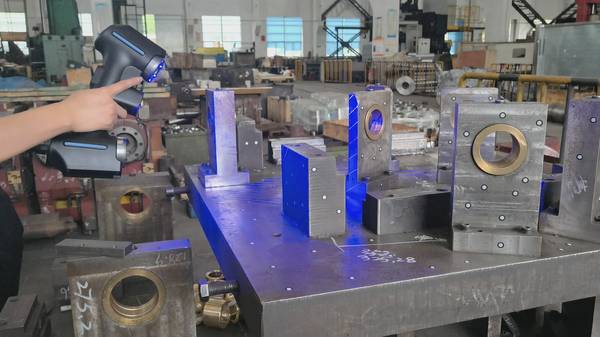
Consumer-grade devices lack traceable calibration. Environmental robustness fails on the shop floor. Measurement uncertainty propagates through quality systems, triggering rework, audit failures, and compliance risk. The hidden costs compound quickly.
Industrial-grade 3D scanning technology like the AlphaScan delivers what entry-level hardware cannot: certified accuracy, repeatable results, and seamless PLM integration. Every scan generates actionable data. Every measurement supports audit readiness. The higher acquisition cost returns multiples through reduced waste, faster time-to-market, and eliminated rework.
Precision, it turns out, costs far less than correcting the errors of approximation.