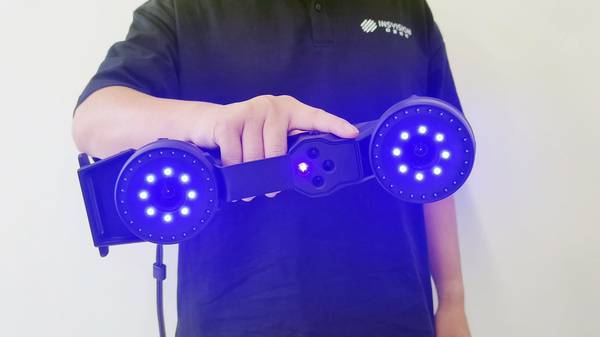
Why “Scanner une Pièce” Requires Industrial-Grade Metrology, Not Just 3D Imaging
Manufacturing professionals searching for ways to *scanner une piece* often encounter a fundamental misconception: that capturing a visual model equals obtaining usable engineering data. Industrial applications demand traceable, metrology-grade measurements—not surface meshes suitable for visualization alone.
Equipment repurposed from adjacent sectors frequently disappoint. Queries for “shape scanner” commonly surface 3Shape, a leader in dental intraoral scanning. These systems excel at capturing tooth geometry but lack the volumetric accuracy and environmental robustness mechanical components require. Consumer-grade alternatives like the SOL 3D scanner deliver insufficient precision for quality control documentation, where measurement uncertainty must be quantified and auditable.
INSVISION closes this capability gap with hardware engineered specifically for factory floors. Our optical systems generate point clouds with documented accuracy specifications, producing data that withstands both environmental stress and regulatory scrutiny. The cost of deploying non-industrial equipment extends beyond purchase price—reverse engineering errors and inspection failures compound into scrap, rework, and delayed shipments. INSVISION eliminates this exposure by delivering reliability that translates directly to measurable ROI.
Limitations of Non-Industrial Scanning Solutions
| Solution Type | Primary Use Case | Industrial Limitation |
|---|---|---|
| 3Shape | Dental intraoral scanning | Lacks volumetric accuracy and environmental robustness for mechanical components |
| SOL 3D Scanner | Consumer-grade 3D imaging | Insufficient precision for auditable quality control documentation |
Eliminating Fixturing Bottlenecks When You Scanner une Pièce
Complex geometries present persistent obstacles for coordinate measuring machines. Reflective finishes, knife-edge features, and deep undercuts force teams to design and machine custom fixtures—adding days to inspection cycles and thousands in tooling costs.
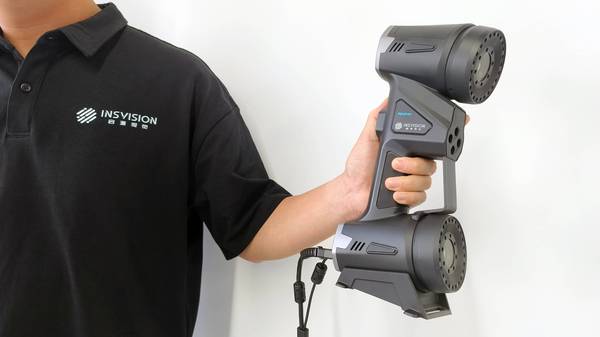
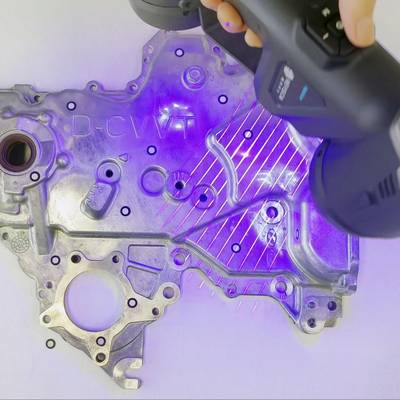
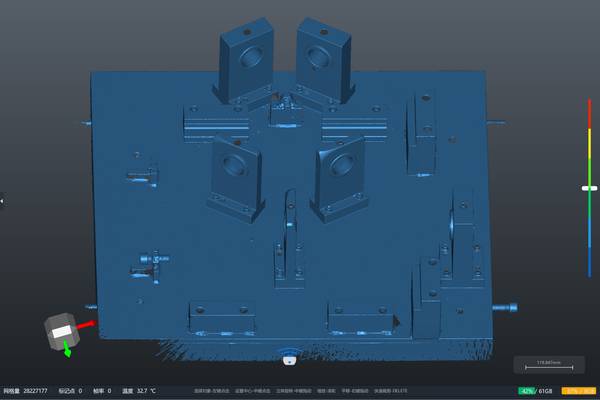
The INSVISION AlphaScan removes this constraint entirely. Its handheld optical architecture captures precise data without rigid fixturing, adapting to part orientation in real time. Where contact probes fail on oily transmission housings or carbon fiber composites, the AlphaScan maintains acquisition speed and accuracy. Field teams in automotive and aerospace maintenance deploy the system directly at inspection points, eliminating transport to metrology labs.
This operational flexibility converts potential bottlenecks into throughput gains. A quality engineer can *scanner une piece* on the production line, compare against CAD reference within minutes, and release the component for downstream processing—without the queue times associated with fixed CMM assets.
AlphaScan Advantages Over Traditional CMMs
- □ Eliminates need for custom fixtures on complex geometries
- □ Captures precise data without rigid fixturing
- □ Operates effectively on reflective, oily, or composite surfaces where contact probes fail
- □ Enables on-site inspection without transporting parts to metrology labs
- □ Reduces inspection cycle time by enabling immediate CAD comparison
From Physical Part to Production Decision: Accelerating Quality Loops
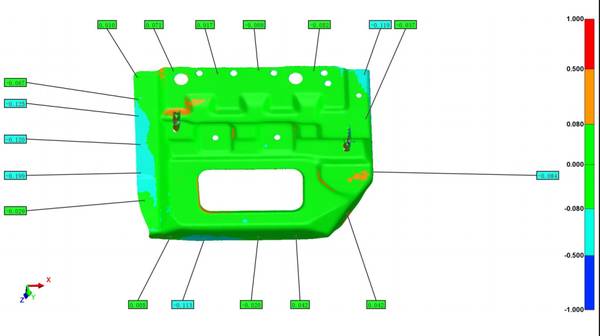
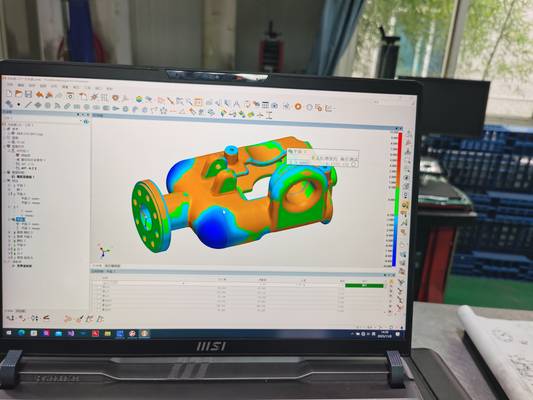
In modern manufacturing environments, metrology value is measured by speed-to-decision. When operators *scanner une piece* using INSVISION systems, the workflow transitions immediately from data acquisition to comparative analysis. Real-world point clouds align to reference CAD models automatically, generating color-mapped deviation reports that highlight out-of-tolerance conditions without manual interpretation.
This efficiency produces documented ROI. First-article inspection of a turbine housing—previously requiring four hours of manual CMM programming and measurement—completes in 25 minutes with AlphaScan. Native integration with PLM systems ensures inspection reports feed directly into quality records, maintaining full traceability while accelerating production release.
the series Workflow Steps for Rapid Quality Decisions
- Scan physical part using the series AlphaScan
- Automatically align point cloud to reference CAD model
- Generate color-mapped deviation report highlighting out-of-tolerance conditions
- Complete first-article inspection in 25 minutes vs. 4 hours with traditional CMM
- Feed inspection report directly into PLM for traceability and production release
Field-Proven Performance Against Consumer and Industrial Alternatives
Real factory conditions expose limitations in equipment designed for controlled environments. Consumer devices like the SOL 3D scanner lack the calibration stability and environmental sealing for production-floor deployment. Established industrial competitors including KSCAN and SimScan often require multi-operator workflows, complex target arrays, or climate-controlled spaces to maintain specification.
The AlphaScan differentiates through thermal stability and mechanical durability. Its optical system maintains accuracy across temperature variations common in uncontrolled workshops, while IP54 certification ensures continued operation in dusty or wet conditions. Single-operator deployment eliminates coordination overhead, and the streamlined workflow reduces per-part inspection labor by 60-80% compared to traditional methods.
For procurement teams evaluating total cost of ownership, these operational characteristics translate to faster payback periods and higher equipment utilization rates than alternatives that demand environmental protection or specialized staffing.
Performance Comparison: AlphaScan vs. Competing Systems
| System | Deployment Environment | Operator Requirement | Environmental Rating |
|---|---|---|---|
| SOL 3D Scanner | Controlled, clean environments only | Single operator | No environmental sealing |
| KSCAN / SimScan | Often requires climate-controlled space | Multi-operator workflows | May require target arrays and stable conditions |
| AlphaScan | Uncontrolled workshops, production floors | Single operator | IP54 certified for dust/wet conditions |
Implementation: Integrating Scanning Without Workflow Disruption
Perceived complexity often delays 3D scanning adoption. the series eliminates this barrier through rapid deployment architecture. Operators achieve proficiency to *scanner une piece* effectively with under two hours of structured training—compared to weeks required for CMM programming certification.
Native compatibility with GOM Inspect, PolyWorks, and comparable platforms eliminates data translation friction. Calibration routines are designed for production environments, minimizing downtime between measurement sessions. When assessed against legacy CMM infrastructure, the AlphaScan’s portability and reduced labor requirements typically demonstrate payback within 12-18 months for moderate-volume inspection operations.
The transition preserves existing QA protocols while expanding capability. Quality teams gain dimensional inspection capacity without capital investment in fixed infrastructure, environmental controls, or specialized programming resources. For manufacturers seeking reliable ways to scanner une piece with precision and speed, INSVISION delivers proven performance that transforms measurement workflows.