The Hidden Economics of Replacing Fixed CMMs
A German Tier-1 automotive supplier learned this lesson when transitioning from tactile CMMs to portable metrology. Initial quotes on 3D scan kosten looked straightforward—until ISO 10360 acceptance testing revealed calibration cycles that ate into operational uptime. Operators trained on fixed CMMs struggled with unfamiliar software interfaces, dragging down first-pass yield and OEE metrics. Then came the integration headache: legacy PLM systems demanded custom middleware for data export compatibility.
INSVISION addressed these friction points with workflows designed for quality engineers already managing multiple inspection protocols. By modeling total cost of ownership rather than capital expenditure alone, the supplier confirmed that reduced inspection cycles and eliminated fixture costs justified the switch. The hardware price was never the real decision variable.
Hidden Costs Encountered During CMM Replacement
| Cost Factor | Description |
|---|---|
| Calibration Cycles | ISO 10360 acceptance testing revealed frequent calibration needs reducing uptime |
| Operator Training | Operators struggled with new software interfaces, lowering first-pass yield and OEE |
| System Integration | Legacy PLM systems required custom middleware for data export compatibility |
Why Accuracy Under Thermal Load Determines Your True Costs
Shop-floor temperature swings in automotive and aerospace environments expose a critical distinction between marketed resolution and verified performance. Devices like the Handyscan Black or Handyscan EVO advertise attractive specifications, but metrology-grade operation requires demonstrated volumetric stability when ambient conditions shift.
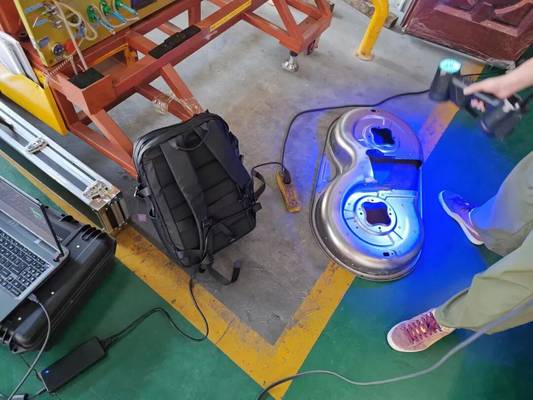
INSVISION AlphaScan carries NIST-compliant traceability documentation—not theoretical accuracy claims, but repeatability data across complex geometries. This matters for procurement teams accountable to ISO/ASME standards: measurement drift in lesser devices forces repeated scans, generates non-conformance reports, and triggers recalibration cycles that inflate labor costs. Traceable performance data provides the ROI assurance that marketing specifications cannot.
Steps to Validate Metrology Performance Under Real Conditions
- Require NIST-compliant traceability documentation over theoretical specs
- Verify repeatability data across complex geometries under thermal variation
- Assess impact of measurement drift on non-conformance reports and recalibration frequency
European Procurement: Where Sticker Price and Reality Diverge
2023–2024 aerospace MRO and medical device procurement cycles across DACH and Benelux markets show a consistent pattern. Hardware like the Handyscan Black or Metrascan dominates capital budgets, but proprietary software modules—VXmodel, PolyWorks, similar platforms—carry separate licensing structures that reshape long-term OPEX. Annual service contracts and probe accessories for systems like the Handyprobe Next add further layers.

The most expensive hidden variable: technician ramp-up time. Production windows do not pause for learning curves. INSVISION structures engagements to surface these expenditures early, enabling accurate ROI forecasting without mid-deployment surprises.
Key Takeaways on European Procurement Realities (Source: P8–P9)
- Hardware acquisition often overshadows recurring software licensing costs
- Annual service contracts and probe accessories significantly increase OPEX
- Technician ramp-up time is the most expensive hidden variable due to production downtime
Edge Computing and the Elimination of Infrastructure Dependencies
High-mix manufacturing environments—energy sector turbine inspections, for example—generate point cloud data volumes that strain conventional workflows. Typical setups demand high-end workstations and recurring software licenses to bridge scan data to CAD.
AlphaScan’s onboard processing architecture handles complex data generation at the device level. This eliminates external workstation requirements and removes dependency on third-party post-processing licenses. For procurement, the impact is dual: reduced IT capital expenditure and compressed cycle time per part. The workflow stays contained, without handoff friction or per-seat licensing accumulation.
The €25,000 Scanner That Cost €75,000 in Scrap
A North American medical implant manufacturer selected a sub-€25k device against the Go!Scan 50, optimizing for initial 3D scan kosten. The scanner performed adequately in climate-controlled demonstration conditions. On the production floor, thermal drift produced undetected dimensional errors. Scrap and rework rates tripled against projections.
The case illustrates a procurement failure mode: hardware acquisition price disconnected from operational reality. Regulated industries require metrology-grade environmental stability—specifications that low-cost devices rarely verify. INSVISION implements validation protocols testing scanner performance under specified thermal and vibration conditions. The objective is not premium positioning but accurate total ownership cost projection, ensuring industrial ROI without quality compromise.