The Precision Imperative in Automotive Reverse Engineering
Western automotive OEMs and Tier 1 suppliers operate under relentless pressure to maintain legacy fleets and validate tooling with near-zero tolerance for deviation. Lean manufacturing principles have compressed inspection windows, while tightening ISO and ASME standards demand traceable, metrology-grade data rather than approximations. When procurement teams search for the best 3D scanner for car parts, they face a fundamental choice: systems that deliver certified accuracy for first-article inspection and tooling validation, or devices that introduce measurement uncertainty into critical workflows. Reverse engineering legacy components—often with no surviving CAD documentation—requires hardware capable of capturing geometric truth, not just visual representations.
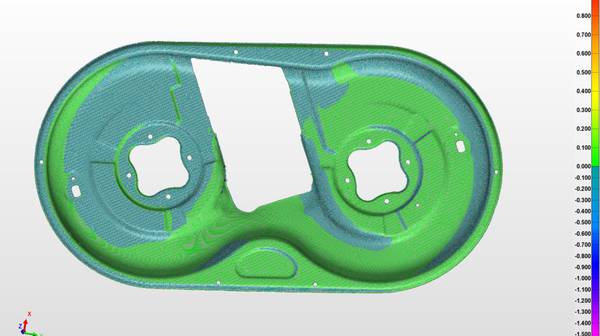
INSVISION addresses this industrial requirement through precision digital capture that reduces scrap rates linked to manual measurement techniques. Integration into quality control workflows minimizes downtime and ensures replacement parts and validated tools align with original design specifications, generating ROI through shortened iteration cycles.
Why Consumer-Grade Hardware Fails on the Factory Floor
The gap between consumer convenience and industrial metrology becomes apparent under production conditions. Devices marketed to hobbyists and crowdfunding backers—such as entry-level desktop scanners—lack the precision, environmental resilience, and traceability required for automotive quality control. These units struggle with under-hood component geometries and reflective stamped metal surfaces ubiquitous in OEM facilities.
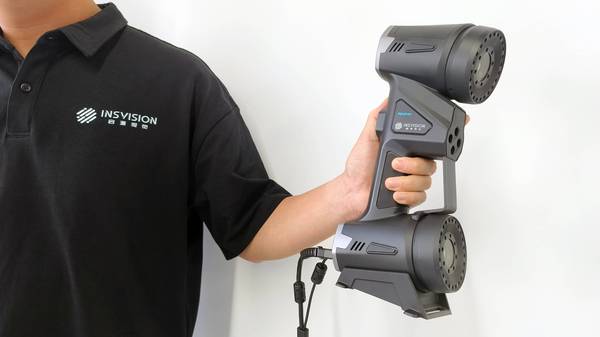
Industrial applications demand repeatability aligned with ISO 10360 and VDI/VDE standards. Factory floors subject equipment to vibration, airborne particulates, and temperature cycling that degrade non-industrial optics. INSVISION closes this gap with metrology-grade solutions engineered for high-volume production environments. For engineers and procurement professionals evaluating the best 3D scanner for car parts, this investment protects data integrity for critical decisions, preventing the rework costs that follow from measurement uncertainty.
Technical Criteria for Automotive Component Scanning
Volumetric accuracy supersedes resolution metrics alone when evaluating the best 3D scanner for car parts. Fixture verification requires metrology-grade precision to detect assembly tooling deviations measured in microns. Automotive surfaces present persistent challenges: polished aluminum, glossy painted bumpers, and carbon fiber composites demand high-density point cloud capture without surface preparation or target placement.
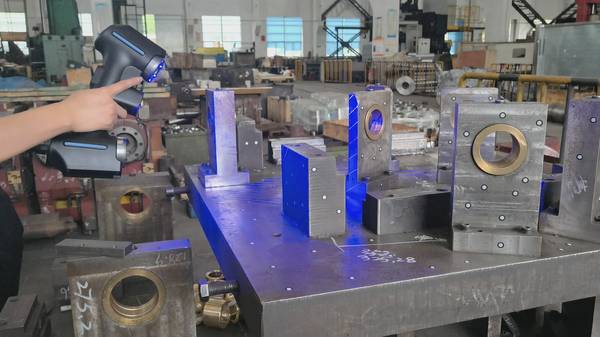
Scan performance under variable shop-floor lighting matters operationally—production stops to adjust illumination create measurable bottlenecks. GD&T analysis compatibility proves essential for crash-part digitization and structural component validation. The scanner must export clean, watertight meshes that integrate with inspection platforms for direct CAD comparison per ISO 1101 standards. Hardware meeting these criteria delivers actionable deviation maps and inspection reports, not merely visual models.
Key Technical Requirements for Automotive 3D Scanners
- Volumetric accuracy over resolution metrics alone
- Micron-level precision for fixture and tooling verification
- Ability to scan reflective and composite surfaces without preparation
- Robust performance under variable shop-floor lighting
- GD&T analysis compatibility for structural validation
- Export of watertight meshes compliant with ISO 1101
INSVISION AlphaScan: Engineered for Production Realities
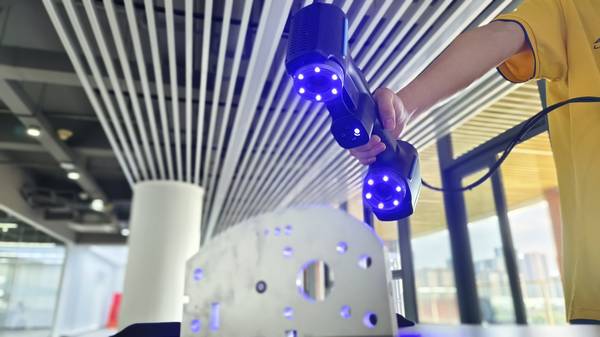
The AlphaScan handheld 3D scanner from INSVISION addresses automotive-specific challenges through metrology-grade optics designed for ISO/ASME compliance in tier-one supply chains. Unlike laboratory-dependent systems, the AlphaScan maintains specified accuracy despite ambient light interference, enabling direct scanning of reflective metal and composite components on active assembly lines without production disruption.
This optical resilience eliminates consumable surface preparation and controlled lighting setups, compressing inspection cycle times. INSVISION prioritizes connectivity with legacy PLM architectures and quality management systems standard in European and North American facilities. Direct integration into existing Industry 4.0 workflows accelerates the transition from physical inspection to digital twin deployment, ensuring data integrity across the manufacturing lifecycle.
Workflow Integration Beyond Hardware Specifications
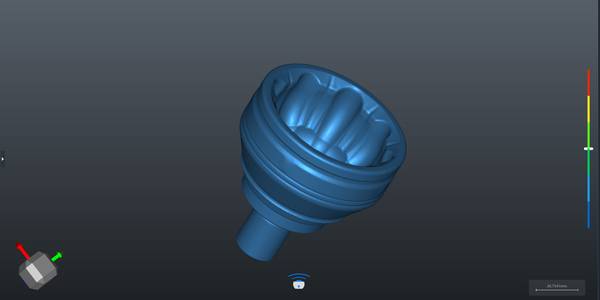
Hardware accuracy delivers limited value if operators require extended training or if data remains trapped in proprietary formats. The best 3D scanner for car parts must demonstrate rapid operator adoption—INSVISION emphasizes intuitive interface design that reduces quality assurance staff onboarding time. Native export to STEP, IGES, and industry-standard point cloud formats enables immediate CAD comparison and reverse engineering workflows.
Long-term serviceability determines actual ROI. Procurement teams should verify whether maintenance requires proprietary contracts or supports modular field service with available spare optics and calibration artifacts. INSVISION approach to operator adoption and open data architecture ensures metrology investments generate measurable efficiency gains rather than operational friction, particularly within ISO-regulated environments where process traceability is mandatory.
Critical Procurement Considerations for Industrial 3D Scanners
- □ Rapid operator adoption through intuitive interface design
- □ Native export to STEP, IGES, and standard point cloud formats
- □ Modular field serviceability with available spare optics
- □ Support for open data architecture to avoid vendor lock-in
- □ Compliance with ISO-regulated traceability requirements
Enabling Digital Twin Accuracy in Production Systems
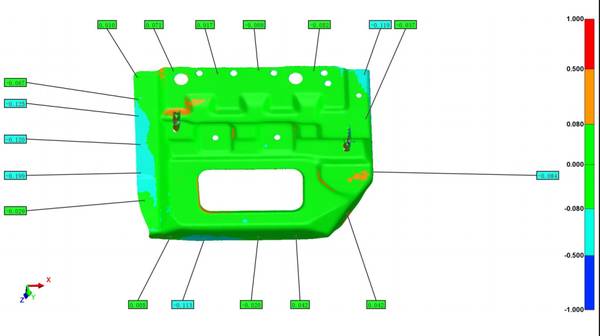
Effective digital twin implementation requires as-built data that captures tooling wear, springback variation, and thermal deformation—not theoretical CAD geometry. In automotive stamping and casting operations, undetected tool deviations compound into downstream assembly issues and warranty exposure.
Selecting the best 3D scanner for car parts establishes the data foundation for predictive maintenance and closed-loop correction. INSVISION systems deliver the accuracy required to identify tool degradation before it disrupts production schedules. Engineers can validate physical components against digital standards with statistical confidence, ensuring virtual simulations reflect operational reality. This capability supports Industry 4.0 objectives: reduced scrap rates, improved Overall Equipment Effectiveness, and virtual commissioning of process changes without physical prototyping.
Impact of High-Accuracy Scanning on Production Outcomes
| Production Benefit | Technical Enabler | Source Paragraph |
|---|---|---|
| Reduced scrap rates | Precision digital capture replacing manual measurement | |
| Shortened inspection cycle times | No surface preparation or controlled lighting needed | |
| Predictive maintenance capability | Accurate detection of tool wear and deformation | |
| Improved Overall Equipment Effectiveness | Data-driven closed-loop correction | |
| Virtual commissioning without prototyping | Statistically confident physical-to-digital validation |