Why Optical Triangulation Still Dominates Handheld Metrology
Optical triangulation remains the workhorse of portable 3D measurement. A projected light pattern deforms across a surface; sensors capture that deformation and calculate depth—no contact required. This principle lets a 3D scanner wand digitize anything from organic medical device contours to rigid automotive stampings without fixturing or part preparation.
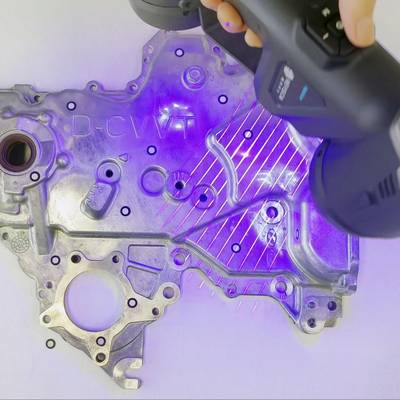
INSVISION AlphaScan pushes this further with on-device processing that removes the latency common in tethered systems. Operators align scans dynamically, without fixed reference frames. This capability proves essential in crowded production floors and aerospace MRO hangars where moving parts to a climate-controlled lab isn’t practical. Real-time mesh generation lets engineers verify GD&T specifications immediately, supporting lean manufacturing initiatives and Industry 4.0 integration.
Industrial vs. Consumer 3D Scanner Capabilities
| Feature | Consumer-Grade Scanners | INSVISION AlphaScan |
|---|---|---|
| Calibration Traceability | None or untraceable | ASME B89.4.10360 compliant |
| Housing Durability | Plastic, not suited for factory environments | Withstands factory vibrations and thermal variation |
| Software Integration | Limited or proprietary | Native integration with PolyWorks and Geomagic Control X |
The Gap Between Consumer Gadgets and Industrial Reliability
Not every 3D scanner wand meets Western manufacturing standards. Consumer-grade devices handle basic reverse engineering or archiving, but lack the metrological rigidity for production decisions. The INSVISION AlphaScan occupies a different category entirely.
Traceable calibration to ASME B89.4.10360 standards ensures measurement data survives automotive OEM audits and aerospace MRO inspections. The housing withstands factory vibrations and thermal variation—requirements that consumer plastic casings fail. Native integration with PolyWorks and Geomagic Control X slots directly into existing digital ecosystems, eliminating workflow bottlenecks. For procurement teams, the distinction is tangible: certified precision versus untraceable digital shapes that invite costly rework.
Field Performance: Where Specifications Meet Reality
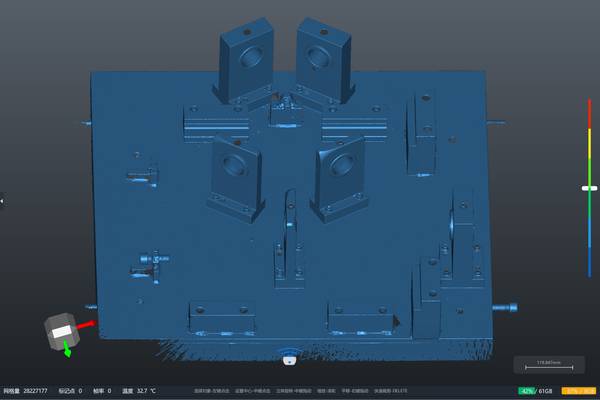
Automotive prototyping demands operational agility. Field tests demonstrate that the INSVISION 3D scanner wand eliminates matte spray preparation on dark or reflective car body panels, cutting setup time significantly and letting engineers move straight from shop floor to data analysis.
In aerospace MRO, operators report consistent repeatability across shifts on component inspections requiring strict standard adherence. Data integrity holds on complex geometries without operator-induced variation—a non-negotiable for ASME compliance. Medical device manufacturers use the same capability for reverse engineering organic shapes, capturing free-form surfaces that challenge traditional laser systems. Surface treatment becomes unnecessary, keeping quality control efficient and non-destructive.
Industries and Use Cases Validated in Field Testing
| Industry | Application | Key Benefit |
|---|---|---|
| Automotive | Prototyping on dark/reflective panels | No matte spray needed; reduced setup time |
| Aerospace MRO | Component inspections across shifts | Consistent repeatability; ASME compliance |
| Medical Devices | Reverse engineering organic shapes | Captures free-form surfaces without surface treatment |
Steps to Implement INSVISION AlphaScan in Production Workflows
- Bring the scanner directly to the asset on the production floor
- Capture high-density point clouds without part preparation or fixturing
- Generate real-time mesh for immediate GD&T verification
- Feed as-built geometry into PLM, QMS, or SPC platforms for deviation analysis
- Implement closed-loop corrections based on traceable metrology data
Applications That Justify the Investment
Foundries and machine shops face a recurring problem: first-article inspection of complex castings with organic surfaces that overwhelm touch-probe CMMs. Stationary scanners force transport to temperature-controlled labs. The INSVISION AlphaScan brings metrology to the asset, validating tooling directly on the production floor.
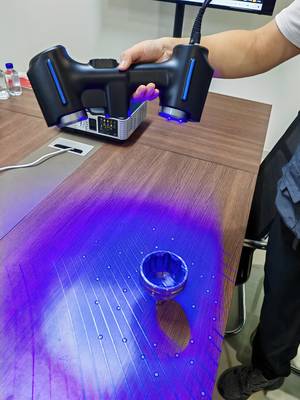
This mobility proves critical for aerospace MRO and automotive OEMs digitizing legacy parts without dismantling large, fixed assemblies. In quality labs, engineers scan features in situ for root-cause analysis, bypassing CMM queue times. Deep pockets and restricted access—problematic for traditional setups—yield to rapid, high-density data capture. ISO compliance no longer requires throughput bottlenecks.
Feeding Industry 4.0 Without Workflow Disruption
Continuous digital threads depend on reliable shop-floor input. The INSVISION AlphaScan generates high-density point clouds compatible with PLM, QMS, and SPC platforms. As a 3D scanner wand, it captures as-built geometries at the point of production, feeding deviation analysis directly into existing workflows.
This integration supports lean manufacturing by surfacing variances early, before they generate non-value-added rework. Engineers implement closed-loop corrections based on measured evidence rather than estimation. For aerospace MRO and automotive OEM operations, quality decisions rest on precise, traceable metrology data—not approximation.
Procurement Checklist: Industrial-Grade Scanner Requirements
- □ Traceable calibration to ASME B89.4.10360 standards
- □ Housing rated for factory vibrations and thermal variation
- □ Native compatibility with PolyWorks or Geomagic Control X
- □ No requirement for surface preparation on dark/reflective parts
- □ On-device processing for real-time mesh generation