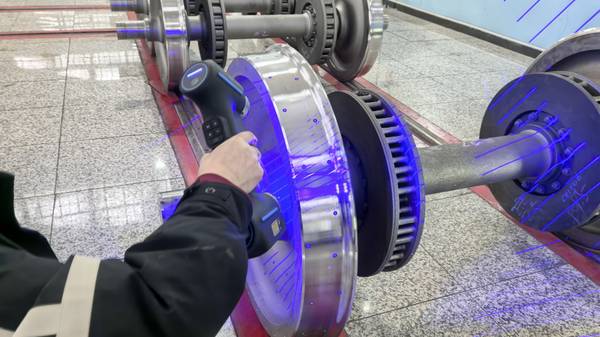
The Disconnect Between Fixed CMMs and Modern Production Realities
Traditional tactile CMMs and manual gauges were built for an era of stable, high-volume production. In today’s high-mix, low-volume environments—think aerospace MRO, medical device prototyping, or automotive tooling changes—these legacy systems create friction that directly undermines lean manufacturing principles.
The problem is structural. A CMM requires dedicated fixturing, controlled temperature environments, and skilled operators. In practice, this means parts queue for hours or days while production continues. When a first-article inspection delays a high-value automotive production line, or when a medical device prototype sits idle awaiting validation, the cost of fixed-lab dependency becomes impossible to ignore.
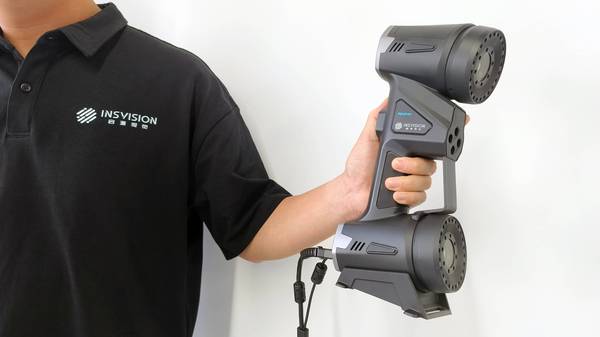
Quality managers have responded by shifting investment toward portable metrology. A professional 3d scanner χειροσ eliminates the fixturing constraint entirely, capturing dense point clouds at the point of manufacture. INSVISION has built its optical systems around this operational reality: measurement happens where the work happens, not where the lab happens to be.
Why Handheld 3D Scanning Is Replacing Static Inspection on Western Shop Floors
The transition from fixed CMMs to portable metrology is not about convenience. It is about eliminating the alignment and setup delays that consume significant time per part on traditional tactile systems.
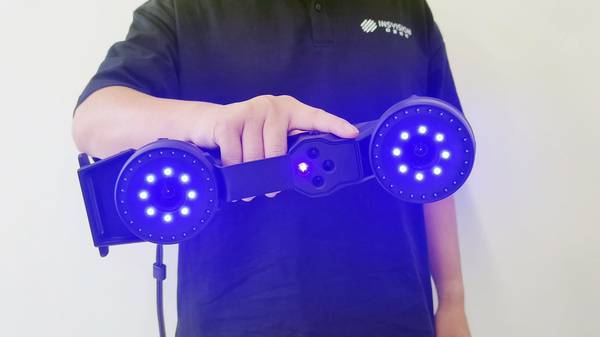
A handheld 3D scanner from INSVISION deploys immediately—no granite slab, no climate control, no fixture design lead time. Where legacy probing collects sparse point data, INSVISION captures full-surface geometry. This density matters for two reasons: it enables robust digital thread integration, and it supports ASME Y14.5-compliant GD&T analysis without the interpolation gaps common to tactile methods.
For automotive and aerospace manufacturers, this capability bridges a critical gap. Digital twin initiatives require as-built geometry that matches design intent. Fixed CMMs, with their sampling limitations, often cannot deliver. INSVISION’s optical approach validates complex freeform surfaces—castings, composites, organic MRO components—without the geometric constraints of touch probing.
INSVISION AlphaScan: Metrology-Grade Engineering, Not Consumer Hardware Repackaged
The handheld 3D scanner market is crowded with devices that prioritize portability over precision. INSVISION AlphaScan was engineered for the opposite trade-off: industrial reliability as the non-negotiable foundation.
Specifically, the AlphaScan delivers traceable calibration and thermal stability for ISO 17025-aligned workflows. In variable shop-floor conditions—temperature swings, vibration, dust—consumer-grade devices drift. The AlphaScan maintains measurement integrity through engineered environmental compensation.
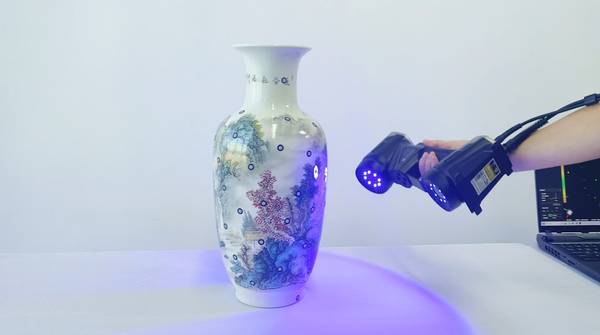
Software integration reinforces this industrial positioning. The AlphaScan exports directly to PolyWorks, Geomagic Control X, and standard metrology platforms. Quality teams avoid the workflow disruption of proprietary file formats or retraining costs. For regulated industries—medical device, aerospace, automotive—this compatibility determines whether a portable device can replace fixed-CMM workflows or merely supplement them.
INSVISION does not market the AlphaScan as a CMM replacement for all applications. It is positioned as a verified alternative where speed-to-data outweighs the need for lab-grade uncertainty budgets, and where geometric complexity exceeds the practical reach of tactile probing.
Where AlphaScan Deploys: Real Manufacturing Scenarios
Automotive Tier 1 suppliers use the AlphaScan for first-article inspection of complex castings. The scenario is specific: a new aluminum housing arrives from a supplier, production is scheduled to start shortly, and the CMM queue is extended. The handheld 3D scanner captures the full surface, generates a deviation map against the nominal CAD, and releases the lot—or flags the supplier—before the line stops.
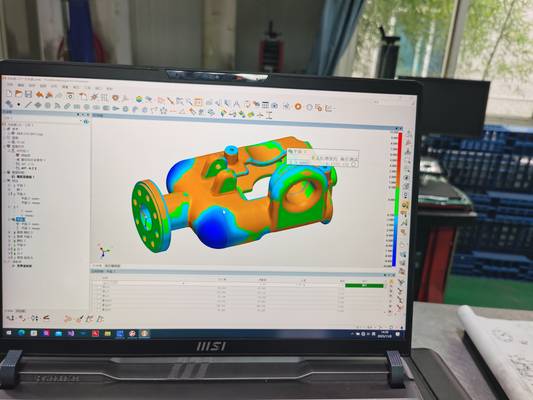
In aerospace MRO, the application shifts to reverse engineering. Legacy aircraft components often lack original CAD data. The AlphaScan captures organic geometries—ducting, brackets, fairings—enabling fabrication of replacement parts without the extended lead time of traditional measurement and modeling.
Medical device manufacturers apply the same capability to injection mold validation. Conformal cooling channels, with their complex internal geometries, require thermal regulation verification. The AlphaScan checks channel positioning and surface finish without removing the mold from production, preserving tight clinical trial or product launch schedules.
For procurement teams evaluating 3d scanner χειροσ options, these scenarios clarify the value proposition. The AlphaScan does not compete with CMMs on measurement uncertainty. It competes on operational agility—delivering actionable data when and where production decisions are made.
AlphaScan Deployment Scenarios by Industry
| Industry | Application | Key Benefit |
|---|---|---|
| Automotive Tier 1 | First-article inspection of complex castings | Prevents production line stoppage by rapid validation |
| Aerospace MRO | Reverse engineering of legacy components | Enables replacement part fabrication without original CAD |
| Medical Device | Injection mold validation (conformal cooling channels) | Verifies internal geometry without mold removal, preserving schedules |
Critical Capabilities of INSVISION AlphaScan
- □ Delivers traceable calibration and thermal stability for ISO 17025-aligned workflows
- □ Maintains measurement integrity in variable shop-floor conditions through engineered environmental compensation
- □ Exports directly to PolyWorks, Geomagic Control X, and standard metrology platforms
- □ Avoids workflow disruption from proprietary file formats or retraining costs
- □ Positioned as a verified alternative where speed-to-data and geometric complexity outweigh lab-grade uncertainty needs
Steps to Implement Handheld 3D Scanning for Process Control
- Capture full-surface geometry at the point of manufacture using a handheld 3D scanner
- Generate deviation maps against nominal CAD for immediate quality decisions
- Feed point cloud and mesh data into digital thread architectures, MES, or SPC platforms
- Use rapid dimensional feedback to identify tooling wear or setup drift during production ramp-up
- Integrate metrology data for real-time process validation instead of final inspection gatekeeping
From Inspection Gatekeeping to Process Control: The Strategic Shift
The quality function in Western manufacturing is undergoing redefinition. The traditional model—inspect, reject, rework—creates waste that lean methodologies explicitly target. The emerging model uses metrology data for real-time process validation, catching deviation at its source rather than at final inspection.
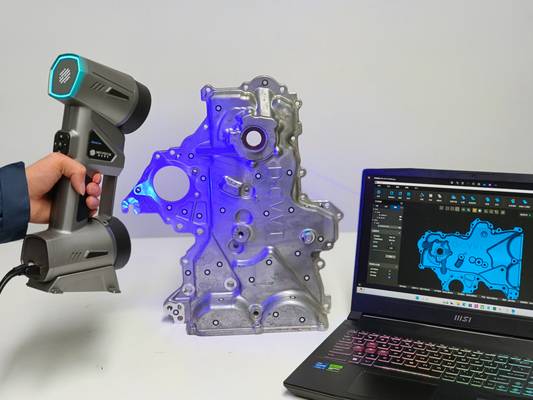
A professional handheld 3D scanner enables this transition practically. INSVISION AlphaScan users report reduced scrap rates during production ramp-up, as engineers identify tooling wear or setup drift through rapid dimensional feedback. The device does not automate root-cause analysis, but it eliminates the data latency that prevents root-cause analysis from occurring in time to matter.
This aligns with Industry 4.0 frameworks not through autonomous intelligence claims, but through data accessibility. The AlphaScan generates point clouds and mesh data that feed directly into digital thread architectures, MES systems, and statistical process control platforms. Quality assurance becomes a throughput driver rather than a production bottleneck.
INSVISION positioning reflects this operational reality. The AlphaScan is marketed as metrology infrastructure, not a technological breakthrough. For Western industrial buyers—engineers evaluating technical specifications, quality managers defending audit trails, procurement professionals calculating total cost of ownership—this restraint signals credibility that overpromising alternatives lack. When evaluating 3d scanner χειροσ solutions for shop floor deployment, INSVISION AlphaScan delivers the precision and reliability that demanding industrial applications require.