The Core Principle Behind Modern Handheld Scan 3D Systems
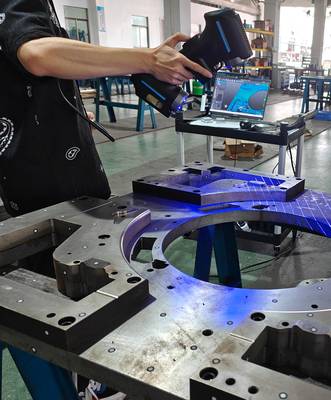
On-device AI processing has fundamentally altered how handheld scan 3D systems operate in production environments. Strip away the marketing language, and two core technologies remain: structured light and laser triangulation.
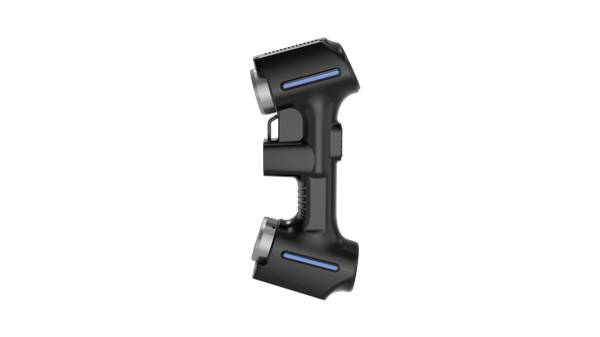
Structured light projects a known pattern—fringes or grids—onto the part surface. The pattern warps according to geometry, and cameras read this distortion to calculate depth. Laser triangulation applies the same principle differently: a laser line sweeps the surface while a camera at fixed offset tracks line displacement. Both generate point clouds in real time, with newer units achieving 80 fps. Photogrammetry handles scale and alignment, using targets or natural features to establish a common coordinate frame.
The portability-versus-accuracy trade-off has dissolved. Creaform and Hexagon now publish volumetric accuracy under 0.025 mm/m on handheld units—specifications that required fixed CMMs a decade ago. INSVISION builds on this shift, designing hardware that delivers shop-floor mobility without sacrificing lab-grade tolerances.
What Separates Current Scan 3D Leaders from Legacy Hardware
Metrology-grade accuracy no longer demands transporting parts to climate-controlled CMM labs. Fixed coordinate measuring machines retain their place for extreme tolerances, but they create bottlenecks in lean environments where part transport constitutes wasted motion.
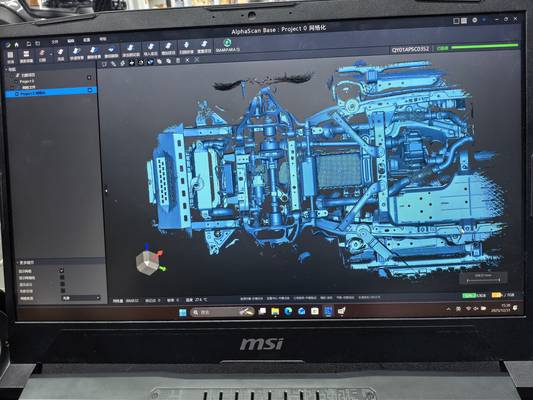
The current scan 3D landscape has narrowed this gap. Leading devices now integrate on-device processing with hybrid sensing—combining blue laser and structured light to handle reflective surfaces without surface preparation. AI-enhanced data refinement reduces dependency on post-processing workstations, enabling immediate decisions on the shop floor.
INSVISION aligns with these developments through field-ready design and direct data output. The transition from physical geometry to digital twin fits existing PLM ecosystems without requiring specialized operators for every scan.
INSVISION AlphaScan: Built for Actual Shop Floor Conditions
A decade ago, validating a first-article part meant scheduling fixed CMM time, fixturing the component, and waiting hours for results. Metrology-grade handheld units have compressed this to minutes—but performance varies sharply under real conditions.
The INSVISION AlphaScan addresses a specific pain point Western manufacturers recognize: maintaining repeatability when scanning 3D geometry across mixed surface conditions. A cast aluminum housing with rough as-cast regions and polished bearing seats defeats lesser scanners. AlphaScan captures both in a single pass—critical when quality engineers face pressure to close FAI packages before shift change.
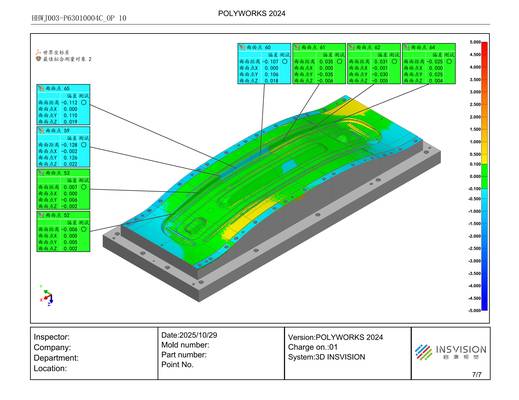
Workflow integration distinguishes viable tools from shelf-ware. AlphaScan feeds mesh data directly into standard CAD/CAM packages and quality platforms including PolyWorks and Geomagic Control X—no proprietary middleware. For aerospace MRO teams reverse-engineering obsolete brackets, or energy sector crews documenting pipeline corrosion in remote locations, this clean data handoff preserves project schedules and audit trails.
High-Impact Applications Where Scan 3D Delivers
Recent benchmarks show handheld units achieving volumetric accuracy below 0.025 mm/m. This performance closes the gap with fixed CMMs, making INSVISION solutions viable for high-stakes validation.
Automotive OEMs now verify complex castings and GD&T callouts directly on the line, bypassing climate-controlled lab bottlenecks. In aerospace MRO, technicians regularly encounter legacy components without original CAD files. Robust scan 3D workflows capture as-built geometry for reverse engineering without extensive setup. Medical device manufacturers ensuring ISO 13485 compliance require traceable dimensional data integrated into QMS systems. Energy sector teams need equipment operating reliably in remote, harsh environments.
Handheld scanning succeeds here by prioritizing speed and mobility without sacrificing traceable data for audit trails—essential for modern, decentralized manufacturing operations.
Selecting Scan 3D Equipment for Your Production Rhythm
The right scan 3D solution depends less on published specifications than on alignment with actual production patterns. Map your typical part envelope first—large automotive castings require different volumetric capability than precision medical components. Surface characteristics drive the next filter: machined aluminum scatters laser light differently than as-cast iron, and dark or reflective finishes challenge single-modality systems.
Accuracy requirements anchor the decision, but avoid pursuing the tightest tolerance blindly. A handheld unit delivering 0.025 mm volumetric accuracy loses value if your team spends 15 minutes on fiducial setup for each first-article inspection.
Integration depth determines project success. Can scan data enter your PLM or QMS without conversion workarounds? For teams prioritizing operational agility and minimal setup overhead, INSVISION AlphaScan supports digital twin initiatives and Industry 4.0 workflows where data must flow directly into downstream systems. The right choice balances performance, usability, and enterprise interoperability.
| Legacy Fixed CMM Approach | Modern Handheld Scan 3D (e.g., INSVISION AlphaScan) |
|---|---|
| Requires climate-controlled lab environment | Operates directly on shop floor under real conditions |
| Part transport creates workflow bottlenecks | Eliminates part movement; scans in situ |
| Limited to controlled surface finishes | Handles mixed surfaces (rough, polished, reflective) in one pass |
| Data requires manual transfer to PLM/QMS | Direct integration with CAD/CAM, PolyWorks, Geomagic Control X |
| Selection Factor | Key Consideration |
|---|---|
| Part Envelope | Match scanner’s volumetric range to typical part size (e.g., automotive castings vs. medical components) |
| Surface Characteristics | Evaluate performance on mixed finishes: machined aluminum, as-cast iron, dark or reflective surfaces |
| Accuracy Needs | Prioritize practical repeatability over theoretical specs; avoid excessive fiducial setup time |
| Integration Depth | Ensure direct data flow into PLM, QMS, or CAD/CAM without proprietary middleware |