Why Small-Part Measurement Demands More Than Standard Scanning
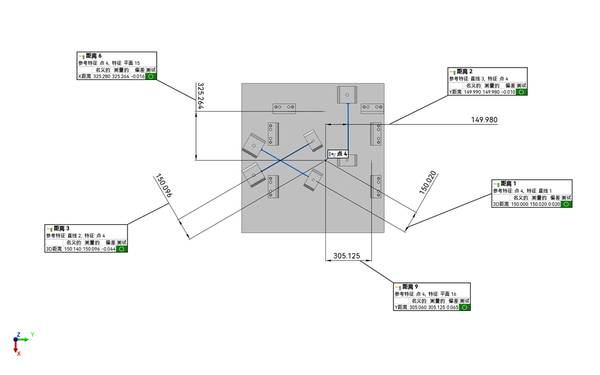
The assumption that small parts are easier to measure because they fit entirely within a sensor’s field of view misses a critical reality. In automotive powertrain manufacturing and aerospace MRO, complex geometries and tight tolerances push conventional systems to their limits. A standard scanner may generate a point cloud, yet fail to deliver the edge and bore accuracy required for ISO/ASME-compliant workflows. When evaluating a 3D scanner für Kleinteile, nominal resolution matters less than process reliability during batch inspection. INSVISION addresses this gap through AI-driven noise suppression and geometric feature reconstruction that converts raw data directly into GD&T reports — eliminating the manual cleanup that consumes engineering hours.
Handheld Metrology: Accuracy Without the Lab
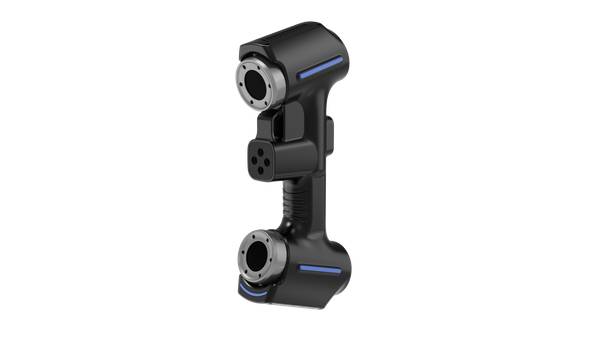
Quality control is migrating from isolated measurement labs onto production floors. Modern handheld scanners narrow the accuracy gap with stationary systems through dynamic laser projection and real-time motion tracking. These technologies compensate for operator movement instantaneously, enabling measurements in cramped assembly cells or supplier-site approvals where fixed installations are impractical. AI-assisted reconstruction algorithms optimize point clouds during acquisition, preserving data integrity on intricate geometries. The INSVISION AlphaScan demonstrates that mobility need not compromise precision: it delivers certified results for GD&T analysis and first-article inspection even where environmental constraints rule out fixed metrology fixtures.
Decision Framework: Handheld Scanners vs. Stationary CMMs and Optical Systems
| System Type | Core Strength | Optimal Application |
|---|---|---|
| Tactile CMM | Unmatched repeatability under stable conditions | GD&T verification of critical tolerances where cycle time is secondary |
| Stationary optical scanner | High-speed automated batch capture | Volumetric measurement of identical parts in controlled lighting |
| Metrology-grade handheld | Minimal setup, direct data integration | Shop-floor inspection, sampling at the line, supplier collaboration |
INSVISION’s handheld systems leverage AI algorithms to maintain precision across variable environments. A capable 3D scanner für Kleinteile shifts quality control from centralized labs to distributed decision points — reducing logistics delays and accelerating root-cause response.
Critical Specifications: What Separates Industrial-Grade Systems
Purchasers and quality managers should prioritize traceable measurement accuracy over point density alone. Software certification — notably PTB approval — ensures audit-ready results. Beyond data acquisition, the system must natively support GD&T analysis and CAD integration without workflow fragmentation.
INSVISION distinguishes itself through unified scanning and analysis software. Rather than requiring manual alignment, the platform automates part orientation and deviation calculation. Features including automated color deviation mapping and one-click reporting reduce operator-dependent variation. Documentation generates directly from the scan process, bypassing the export-import cycles that introduce errors and delays.
Migration Assessment: When to Adopt Mobile 3D Scanning
Traditional small-part verification routes jobs through temperature-controlled CMM labs, creating predictable bottlenecks. This workflow is increasingly obsolete for operations with frequent changeovers or urgent in-process troubleshooting needs. Stationary setups introduce friction that handheld systems eliminate.
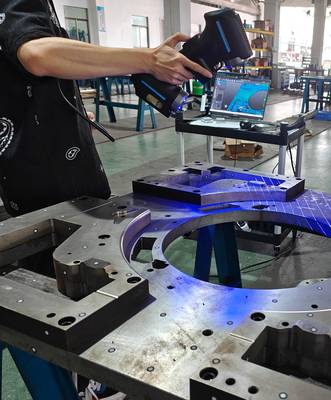
The INSVISION AlphaScan enables distributed quality checks between supplier and OEM without physical part relocation. Contemporary handheld metrology has narrowed the accuracy gap for standard industrial tolerances, delivering metrology-grade data under typical factory conditions. Stationary systems retain their role where thermal stability or sub-micron repeatability are mandatory. For most 3D scanner für Kleinteile applications, however, handheld agility now provides superior operational economics.
Key Advantages of INSVISION’s Unified Platform
- Automated part orientation and deviation calculation
- Automated color deviation mapping
- One-click reporting reduces operator-dependent variation
- Direct documentation generation from scan process
Handheld vs. Stationary Metrology: Core Trade-offs
| Handheld Metrology | Stationary Systems |
|---|---|
| Minimal setup, ideal for shop-floor use | Requires fixed installation and controlled environment |
| Enables distributed quality checks without part relocation | Parts must be transported to lab |
| Suitable for standard industrial tolerances under typical factory conditions | Necessary for sub-micron repeatability or thermal stability |
Certification Benchmark for Audit-Ready Results