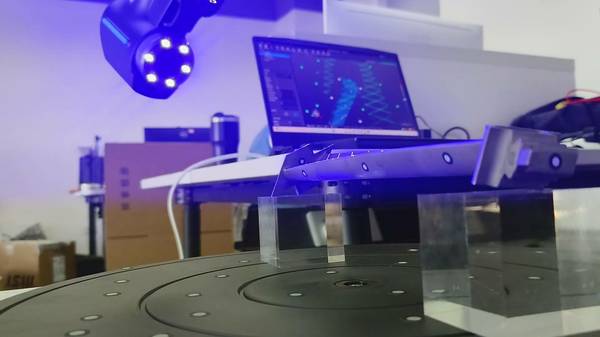
The Shift Toward On-Site Metrology in Modern Manufacturing
Fixed CMMs in climate-controlled labs have become a bottleneck for modern production lines. In aerospace MRO and energy equipment maintenance, moving massive components to a quality room disrupts lean workflows and often proves impractical. This operational reality drives demand for in-situ measurement solutions that validate parts directly on the assembly floor without sacrificing precision.
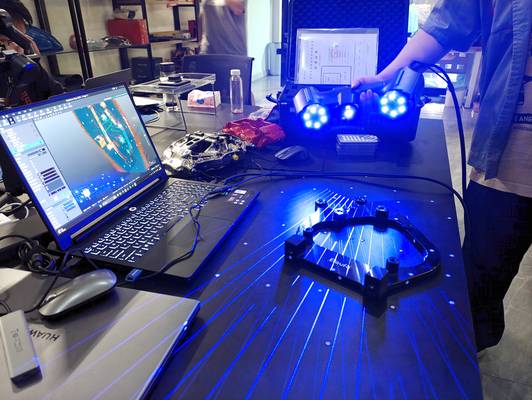
A 3d skanner from INSVISION addresses this need by combining AI algorithms with metrology-grade portable hardware. Engineers can now deploy a handheld 3d skanner to perform GD&T analysis and deviation checks on a wind turbine blade or automotive fixture—no transport to a stationary rig required. PTB-certified software supports these workflows, narrowing the gap between shop-floor conditions and lab-grade accuracy. The transition reduces latency and supports distributed supply chains where quality verification must happen outside traditional metrology labs.
Where AI-Enhanced 3D Scanning Changes the Calculation
Procurement teams often assume hardware specifications—accuracy ratings, laser line counts, scan rates—define metrology capability. The actual bottleneck in modern quality control is data processing speed and alignment accuracy under ISO 10360 or ASME Y14.5 frameworks.
AI-enhanced algorithms shift this equation. INSVISION pairs portable 3D scanning hardware with software that performs real-time coordinate alignment and deviation analysis against CAD references. The PTB-certified inspection platform handles GD&T callouts—position, flatness, runout—without exporting to separate metrology packages. Multi-source data fusion and on-the-spot deviation heat maps support first-article inspection or MRO workflows in aerospace and automotive.
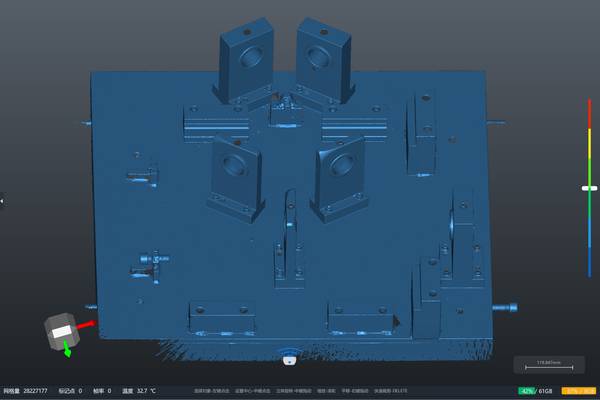
For Western manufacturers running lean operations, convergence matters more than isolated specs. A 3d skanner capturing millions of measurements per second delivers little value if post-processing bottlenecks the line. INSVISION embeds intelligence into the scan-to-CAD pipeline, enabling engineers to validate tolerances against design intent faster than traditional CMM workflows permit.
Traditional CMM vs. AI-Enhanced Portable Scanning
| Traditional CMM | INSVISION AI-Enhanced Portable Scanner |
|---|---|
| Requires climate-controlled lab environment | Operates directly on the shop floor or hangar |
| Component must be moved to the metrology room | Scanner brought to the part—no transport needed |
| Post-processing often requires separate software | PTB-certified software handles GD&T in one platform |
| Slower feedback loop for large or fixed assemblies | Real-time deviation analysis and heat maps |
Field-Ready Precision: The AlphaScan in Practice
Maneuverability on a crowded aerospace MRO hangar floor often constrains quality assurance more than measurement capability itself. The INSVISION AlphaScan brings metrology-grade performance directly to the part, delivering verified point accuracy of 0.073mm—sufficient for tight tolerances on complex assemblies. Dynamic 3D laser projection tracking maintains data fidelity in variable field conditions, whether scanning the internal structure of a fuselage or large-scale tooling. Environmental constraints typical of optical systems fade away. Engineers execute full GD&T analysis on the shop floor, bridging the distance between lab conditions and production reality.
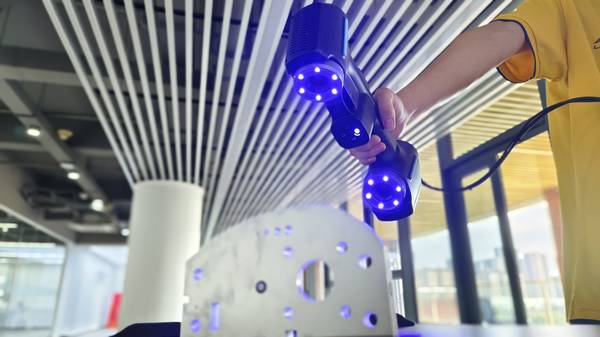
AlphaScan Verified Accuracy
From Capture to Insight: Closing the Quality Loop
On a busy aerospace MRO floor, the lag between scanning a turbine blade and understanding its wear patterns defines operational efficiency. An end-to-end digital inspection workflow eliminates this latency. When a metrology-grade 3d skanner feeds point cloud data directly into certified software, the process moves beyond capture to immediate intelligence.
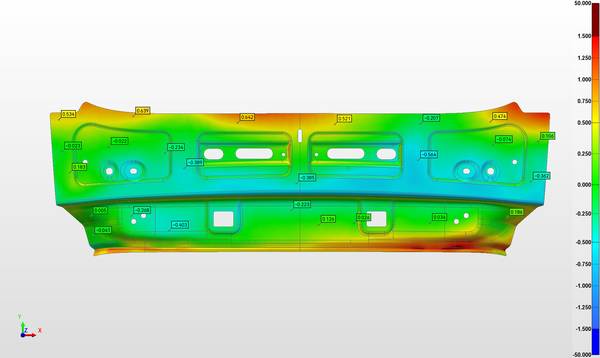
INSVISION structures this workflow through AI-enhanced algorithms integrated with PTB-certified inspection tools. Automated deviation mapping and multi-source alignment happen without data export hassles. Quality managers gain built-in GD&T tools and one-click reporting that accelerates root-cause analysis, converting raw scans into compliant documentation instantly. In regulated sectors where traceability is non-negotiable, deviations detected on the floor resolve before they disrupt the supply chain.
Key Workflow Advantages of INSVISION’s End-to-End System
- Direct point cloud ingestion into PTB-certified software
- Automated deviation mapping without manual export
- Built-in GD&T tools for position, flatness, and runout
- One-click compliant reporting for regulated industries
The Next Phase: Portability, Intelligence, and Interoperability
Procurement teams frequently fixate on spec sheets—accuracy thresholds, scan rates—assuming efficiency gains live there. This misses the mark. The next leap in metrology lies not in incremental hardware improvements but in seamless integration with the broader factory network. The modern 3d skanner must function as an intelligent endpoint, feeding clean, AI-processed data directly into PLM and MES loops without manual translation.
INSVISION anticipates this by embedding AI algorithms into the workflow itself, automating mesh processing and deviation analysis rather than leaving them to manual post-processing. The unified architecture supports CAD-driven task creation and multi-source data alignment—essential for complex assemblies in aerospace or automotive MRO. PTB-certified software handles GD&T validation automatically, positioning INSVISION to bridge portable metrology with stationary quality intelligence and ensure data flows across global manufacturing ecosystems.