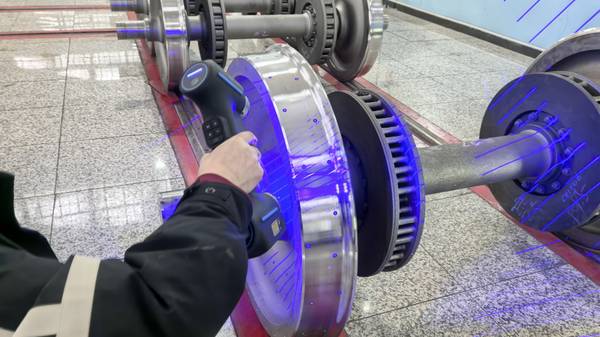
When CMMs Hit Their Limits: Why Portable Metrology Is Taking Over
Coordinate Measuring Machines have ruled quality control for decades. But in today’s industrial environments, they’re increasingly the bottleneck—not the solution.
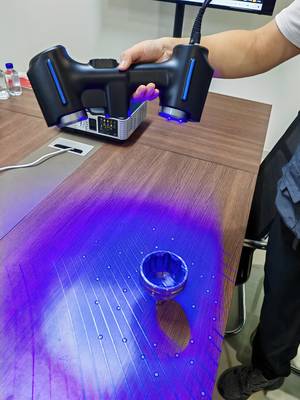
In aerospace, automotive, and heavy machinery manufacturing, parts often measure several meters across or weigh multiple tons. Moving these components to a climate-controlled metrology lab isn’t just impractical—it’s impossible. The result? Production delays, mounting downtime costs, and quality checks that happen too late to prevent scrap.
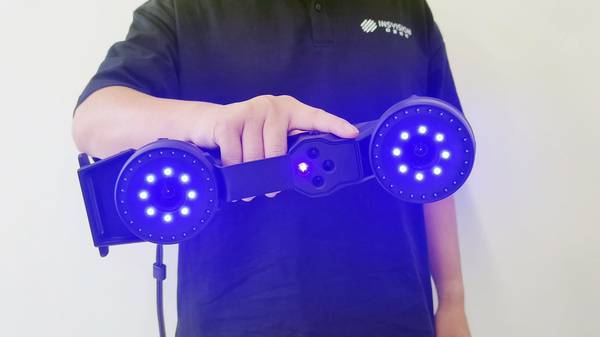
Handheld 3D scanning changes the equation. By bringing measurement directly to the workpiece, portable systems eliminate fixturing costs and logistical headaches. INSVISION built the AlphaScan specifically for this reality: capturing metrology-grade data where the part actually sits, whether that’s beside a CNC machine, on an assembly line, or at a remote maintenance facility. This handheld scanner en 3d technology delivers precision directly where it’s needed most.
Field-Proven Precision: What Sets AlphaScan Apart
Not every 3D scanner earns the “metrology-grade” label. The AlphaScan does—with documented ±0.02 mm accuracy achieved without laboratory conditions.
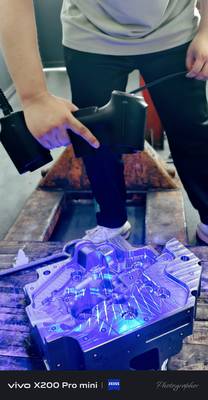
This matters because shop floors are hostile environments. Ambient lighting fluctuates. Temperatures swing. Vibration is constant. Consumer devices and even some “industrial” scanners falter here. AlphaScan’s optical system and onboard processing cut through these variables, delivering clean point clouds in real time.
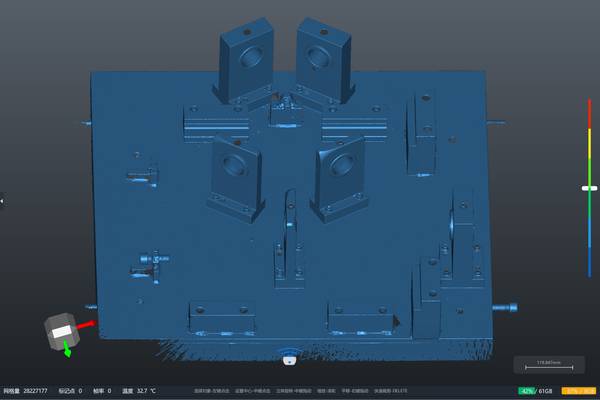
The ergonomic design reduces operator fatigue during extended scanning sessions. Real-time mesh generation means engineers see results immediately—no waiting for post-processing. For teams accustomed to CMM queue times measured in hours or days, this shifts the inspection timeline from a schedule constraint to a production enabler.
AlphaScan Performance in Hostile Environments
| Environmental Challenge | AlphaScan Response |
|---|---|
| Ambient lighting fluctuations | Optical system compensates in real time |
| Temperature swings | Thermal stability maintains accuracy |
| Constant vibration | Onboard processing filters noise |
The ROI Case: 70% Faster Inspections, Measurable Cost Impact
Western engineering teams face relentless pressure to compress production cycles. Here’s where AlphaScan delivers tangible returns:
Time Savings Achieved with AlphaScan
| Application | Traditional Time | AlphaScan Time |
|---|---|---|
| Turbine blade inspection | 4–6 hours | Under 90 minutes |
| Legacy part reverse engineering | Multiple shifts | Single production window |
| First-article inspection | Delayed verification | Immediate verification |
Key Financial Impacts of AlphaScan Deployment
- □ Faster measurement cycles reduce WIP inventory
- □ Immediate defect detection cuts scrap rates
- □ Reduced machine downtime protects throughput in high-mix, low-volume environments
- □ Measurement time reductions approach 70% on complex geometries
- □ Payback periods measured in months, not years
The financial impact extends beyond labor savings. Faster measurement cycles reduce WIP inventory. Immediate defect detection cuts scrap rates. Perhaps most critically, reduced machine downtime—when quality verification happens inline rather than offline—protects throughput in high-mix, low-volume environments where every hour of spindle time counts.
This isn’t theoretical. Manufacturers deploying AlphaScan report measurement time reductions approaching 70% on complex geometries, with payback periods measured in months, not years.
Plug-and-Play Integration: No Workflow Disruption Required
Technology adoption fails when implementation becomes its own project. AlphaScan sidesteps this by speaking the languages manufacturing engineers already use.
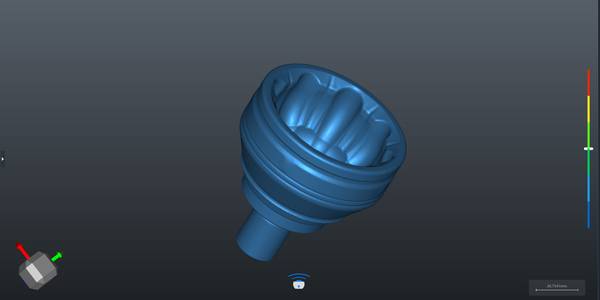
Output formats mesh directly into Siemens NX, SolidWorks, Geomagic, and other standard platforms. Watertight surface models require minimal cleanup—often none—accelerating the path to CAD comparison, reverse engineering, or toolpath generation.
For quality departments, traceability is non-negotiable. AlphaScan maintains calibration certificates and measurement uncertainty documentation that satisfy ISO requirements. This means the scanner enhances certified quality systems rather than forcing their redesign.
Integration Steps into Existing Workflows
- Connect AlphaScan to existing CAD/CAM platform via native output formats
- Generate watertight surface models with minimal or no cleanup required
- Proceed directly to CAD comparison, reverse engineering, or toolpath generation
- Maintain calibration certificates and measurement uncertainty documentation for ISO compliance
Industrial Grade vs. “Good Enough”: The Procurement Distinction
Budget-conscious buyers sometimes explore alternatives: repurposed dental scanners, desktop photogrammetry systems, or consumer devices marketed for “professional” use. The disappointment is predictable.
These tools lack thermal stability for shop-floor conditions. Repeatability drifts. Without ISO-compliant validation, their data introduces uncertainty into critical decisions—uncertainty that becomes expensive rework, failed audits, or warranty claims.
AlphaScan occupies a different category. Every specification is verifiable. Every scan contributes to auditable quality records. For procurement teams evaluating total cost of ownership, the distinction is stark: a device that performs reliably for years versus hardware that requires replacement—or worse, generates untrustworthy data.
In industrial metrology, precision isn’t a marketing claim. It’s the foundation of every downstream decision. AlphaScan ensures that foundation is solid, wherever measurement happens—making this handheld scanner en 3d solution the trusted choice for demanding manufacturing environments.