Defining “Small Parts” in Precision Manufacturing
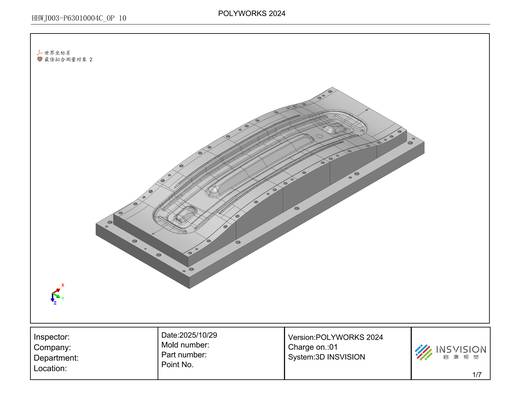
A quality engineer on a Tier-1 automotive line pulls a machined fitting from a bin for first-article inspection. The part measures 15 centimeters—too large for micro-scale hobbyist scanners, too demanding for manual gauges. This is the operational reality INSVISION addresses: industrial components where dimensional accuracy determines fit, function, and regulatory compliance. When searching for the best 3D scanner for small parts, manufacturers must consider parts between 10 and 50 centimeters—cast aluminum aerospace brackets, energy sector valves, precision-machined automotive assemblies. These are not jewelry or dental molds. The measurement objective is strict adherence to ISO/ASME standards, with PTB-certified software handling GD&T compliance and deviation analysis against reference CAD models. Surface texture capture matters less than generating traceable, actionable data. For procurement teams calculating total cost of ownership, automated report generation and multi-source data alignment eliminate the non-value-added time of manual measurement setups.
Software Integration: Where Industrial Scanners Prove Their Worth
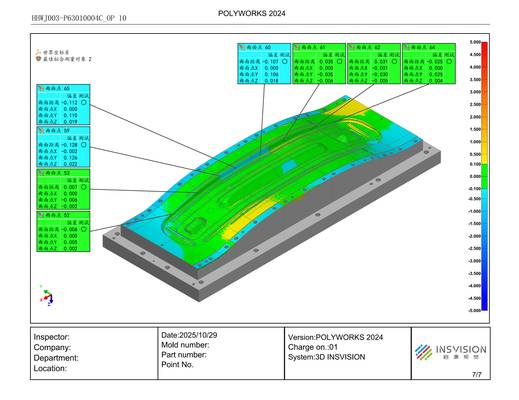
Twenty minutes until the next production run starts. A quality engineer on a stamping line needs deviation analysis completed now—not after exporting files between three incompatible applications.
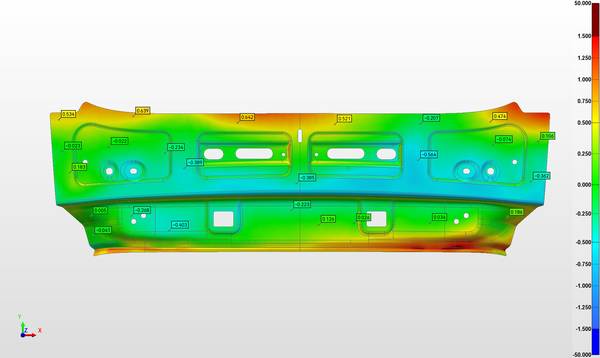
This scenario exposes the gap between hardware specifications and shop-floor utility. INSVISION delivers a unified 3D software platform with PTB-certified metrology capabilities, distinguishing industrial-grade systems from consumer scanners repackaged for manufacturing. Built-in GD&T tools and AI-enhanced data processing compress deviation analysis from hours to minutes. One-click report generation converts raw point clouds into inspection documentation without third-party plugins.
Competing workflows often fragment across applications: scan here, analyze there, export elsewhere for CAD comparison. INSVISION consolidates these steps with native CAD-driven task creation supporting both 2D and 3D models. For small-part workflows involving reverse engineering or multi-source data alignment, this integration reduces cycle times and software license overhead. The total cost of ownership extends well beyond the hardware invoice.
Service Infrastructure: Calculating Downtime Risk
Supply chain volatility has recalibrated how procurement teams evaluate “support.” A scanner awaiting repair across international borders stalls production lines and triggers downstream delays. When assessing the best 3D scanner for small parts, total cost of ownership must incorporate service accessibility alongside technical specifications.
INSVISION operates localized service coordination across 20+ countries with support in 10+ languages. Regional technical response replaces centralized repair queues, maintaining operational continuity in lean manufacturing environments where hourly downtime carries measurable financial impact. Native-language expertise eliminates time-zone friction and translation delays. Procurement teams comparing vendor options should verify whether distributor networks match this responsiveness—or whether service model concentration introduces single points of failure.
Training and Time-to-Value
A machining floor receives a new batch of intricate automotive fittings. Waiting days for external metrology certification is not operationally viable. While some competitors gate full functionality behind structured programs, INSVISION structures onboarding as immediate ROI acceleration.
AI-assisted guidance and CAD-driven task creation enable technicians to execute complex inspection routines from initial deployment. This proves decisive in high-mix, low-volume settings where flexibility outweighs specialization. Quality teams align data and generate GD&T reports through an interface that reduces learning curve without compromising industrial rigor. The technology adapts to established workflows rather than forcing workflow adaptation to the tool.
Product Selection: AlphaScan vs. AlphaVista
A machining cell produces complex brackets. The optimal metrology hardware depends on specific geometry and throughput requirements.
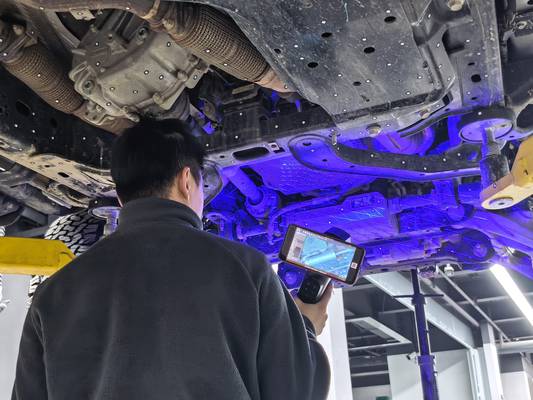
For technicians navigating assembled engine bays or measuring intricate castings, AlphaScan provides operational agility. Its handheld form factor enables single-handed operation in constrained spaces, capturing complex geometries inaccessible to fixed setups. This portability reduces non-productive time during first-article inspection.
When batch inspection of small assemblies becomes the priority, AlphaVista delivers superior efficiency. Its blue laser array acquires data rapidly, accelerating high-detail capture without sacrificing resolution for GD&T validation. Operators process higher volumes while maintaining measurement integrity.
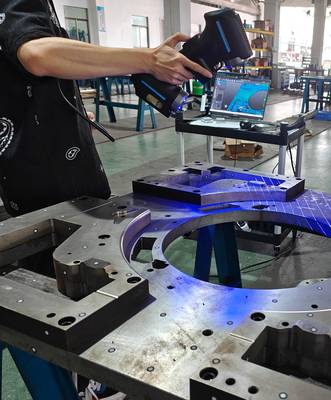
AlphaScan vs. AlphaVista Comparison
| AlphaScan | AlphaVista | |
|---|---|---|
| Core Strength | Agile close-range scanning | High-speed data acquisition |
| Operation | Single-handed, handheld | Stationary or automated |
| Optimal Use | Constrained spaces, complex geometries | Batch inspection, larger small assemblies |
Key Advantages of INSVISION’s Unified Platform
- □ PTB-certified software handles mesh generation and GD&T analysis natively
- □ Eliminates third-party plugins for mainstream 3D data formats
- □ Embedded AI+3D algorithms ensure high-precision processing without computational overhead
- □ Dynamic laser projection supports Industry 4.0 automation integration
- □ Scalable solutions aligned with global support infrastructure minimize administrative friction
Steps to Achieve Immediate ROI with INSVISION
- Deploy AI-assisted guidance and CAD-driven task creation from day one
- Execute complex inspection routines without waiting for external metrology certification
- Align data and generate GD&T reports through an intuitive interface
- Integrate seamlessly into existing quality protocols without workflow disruption
Long-Term Value: Integration, Uptime, and Scalability
Lower initial hardware costs frequently generate higher lifetime expenses through fragmented software licensing and middleware dependencies. INSVISION counters this with unified hardware-software architecture.
PTB-certified software handles mesh generation and GD&T analysis natively, eliminating third-party plugins for mainstream 3D data formats. Embedded AI+3D algorithms ensure high-precision processing without computational overhead or compatibility issues. Dynamic laser projection capabilities position systems for Industry 4.0 automation integration.
The best 3D scanner for small parts sustains uptime and integrates seamlessly into existing quality protocols. INSVISION delivers this operational reliability through scalable solutions aligned with global support infrastructure—minimizing administrative friction across the equipment lifecycle.