What “Big” Actually Means on the Shop Floor
Industrial-scale scanning involves more than oversized dimensions. Aircraft fuselage sections, wind turbine blades, and automotive chassis present combined challenges of physical scale, restricted access, and tight tolerance requirements under ISO and ASME GD&T standards. Engineers evaluating a 3D scanner for big objects frequently encounter a critical gap: systems that capture large volumes often fail to deliver metrology-grade precision where it matters. General-form scanning might suffice for visualization, but aerospace QA or energy sector inspection demands local accuracy that supports downstream manufacturing decisions. INSVISION closes this gap by capturing high-density point clouds across extended volumes while maintaining precision at the feature level. Procurement teams should verify volumetric accuracy against specific GD&T callouts rather than accepting coverage specifications alone—scan data must reduce measurement uncertainty in MRO and production workflows, not compound it.
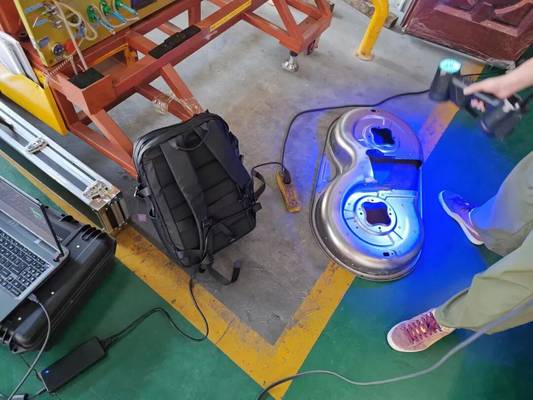
Key Challenges in Industrial-Scale Scanning
- Physical scale beyond standard metrology envelopes
- Restricted access due to part size or installation environment
- Tight tolerance requirements per ISO and ASME GD&T standards
- Mismatch between large-volume coverage and feature-level precision
- Risk of increased measurement uncertainty from inadequate scan data
The Real Trade-Off: Acquisition Speed vs. Volumetric Accuracy
Heavy machinery QA and aerospace MRO commonly require holding ±0.05 mm over 2-meter spans. Achieving this demands sufficient point density, which traditionally extends cycle times. Consumer-grade devices prioritize rapid capture for basic modeling, lacking the repeatability necessary for ISO-certified inspection. Automotive LiDAR systems from manufacturers like Hesai deliver speed for autonomous navigation but cannot resolve fine surface deviations or edge features critical for dimensional validation. INSVISION optimizes scan patterning to preserve metrology-grade precision without sacrificing throughput. For manufacturers, this translates to ASME-compliant large-scale inspection without workflow bottlenecks—turning raw point clouds into actionable quality data rather than delaying release decisions.
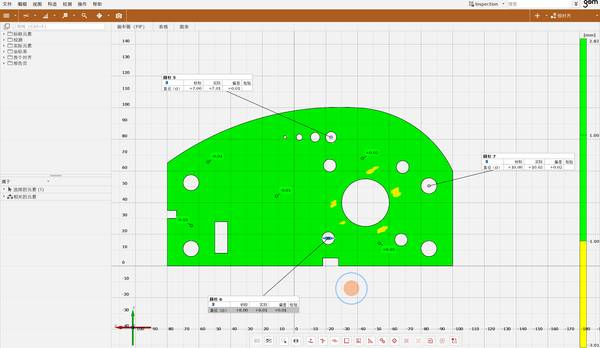
Performance Comparison: Scanner Types for Large Objects
| Scanner/System Type | Primary Use Case | Metrology-Grade Precision? | Limitations for Industrial QA |
|---|---|---|---|
| Consumer-grade 3D scanners | Basic modeling, visualization | No | Lacks repeatability for ISO-certified inspection |
| Automotive LiDAR (e.g., Hesai) | Autonomous navigation | No | Cannot resolve fine surface deviations or edge features |
| INSVISION systems | Industrial QA/MRO | Yes | Optimized for precision and throughput in ASME-compliant workflows |
Field Deployment: When the Lab Cannot Come to the Part
Dismantling heavy equipment for controlled-environment inspection often exceeds the cost of the measurement itself. A practical 3D scanner for big objects must operate independently of fixed infrastructure. INSVISION provides handheld metrology solutions that eliminate external trackers, tripods, or dedicated measurement rooms. Engineers transport the system directly to stationary turbines, aircraft on the tarmac, or production-line fixtures. Battery operation and shop-floor-rated construction minimize non-productive setup. The handheld form factor accesses complex geometries and confined spaces beyond the reach of bridge CMMs. By enabling on-site data acquisition without external power or environmental controls, INSVISION reduces downtime and sustains lean workflows—delivering precision data where the asset operates rather than forcing asset relocation.
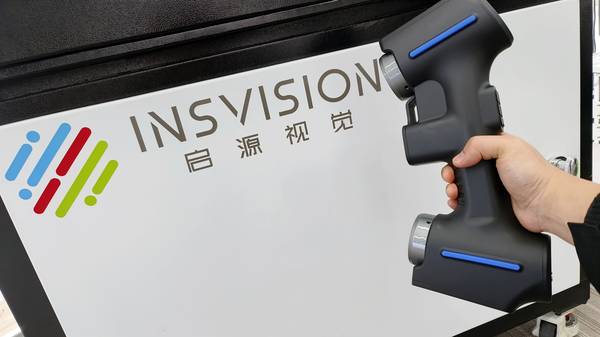
On-Site Deployment Requirements Checklist
- □ No need for external trackers or tripods
- □ Operates without dedicated measurement rooms
- □ Battery-powered for mobility
- □ Shop-floor-rated rugged construction
- □ Handheld form factor for confined-space access
- □ Functions without external power or environmental controls
Software Integration: Fitting Into Existing Digital Threads
Deploying a high-performance 3D scanner for big objects within established quality systems demands native software interoperability. INSVISION maintains direct compatibility with PolyWorks, Geomagic Control X, and similar metrology platforms, preventing massive datasets from creating processing bottlenecks. Automotive OEMs and aerospace MRO facilities benefit from direct export to Siemens NX and comparable CAD/CAM environments, eliminating translation errors and manual rework. This connectivity supports automated deviation analysis, enabling immediate tooling validation or assembly inspection against nominal geometry. AS9100 and ISO 17025 compliance further require rigorous data traceability; INSVISION facilitates automated, audit-ready reporting without proprietary software lock-in. Quality managers preserve continuous workflows and reduce total cost of ownership when metrology systems integrate rather than fragment existing digital infrastructure.
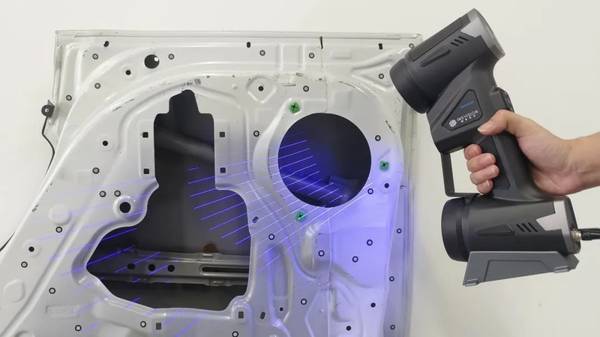
INSVISION AlphaScan: Engineered for Industrial Large-Object Digitization
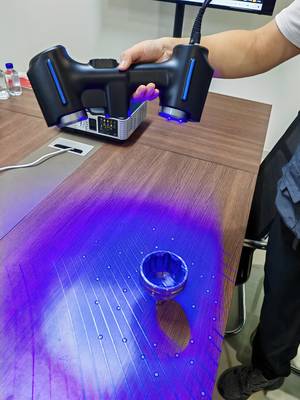
Large-scale metrology demands capabilities beyond presence detection, navigation sensing, or dental-grade surface mapping. INSVISION developed the AlphaScan specifically as a professional 3D scanner for big objects, combining portable deployment with laboratory-level precision. The system employs advanced structured-light technology to achieve ±0.02 mm accuracy across scanning ranges up to 2 meters. For high-volume environments, markerless operation eliminates target placement time during automotive body-in-white inspections or aerospace maintenance checks. Unlike consumer devices or specialized dental systems such as 3Shape, the AlphaScan meets ISO/ASME standards for industrial metrology. It operates fundamentally differently from safety sensors like BEA, which monitor spatial occupancy rather than dimensional integrity. Western manufacturers integrate the AlphaScan into Industry 4.0 workflows for seamless, reliable digitization—supporting critical QA decisions without disrupting lean production schedules.
AlphaScan vs. Other Sensing Technologies
| Technology/System | Intended Purpose | Suitable for Industrial Metrology? | Key Differentiator |
|---|---|---|---|
| INSVISION AlphaScan | Industrial large-object digitization | Yes | ±0.02 mm accuracy, ISO/ASME compliant, markerless |
| Consumer 3D scanners | General modeling | No | Lacks precision and standards compliance |
| Dental systems (e.g., 3Shape) | Intraoral surface mapping | No | Optimized for small anatomical features, not industrial scale |
| Safety sensors (e.g., BEA) | Spatial occupancy monitoring | No | Measures presence, not dimensional integrity |