How Data Density Drives Real ISO and ASME Compliance
Quality teams often treat ISO 17025 or ASME Y14.5 compliance as a documentation exercise. It isn’t. Compliance lives in the measurement data itself—the density and traceability behind every report. That’s where a 3D scan engine proves its value.
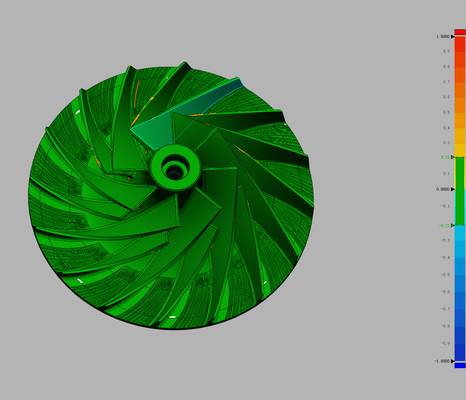
Full-field point cloud capture documents surface deviations across entire geometries, not just sampled locations. This creates measurement records auditors can verify from capture to final report. INSVISION embeds AI-driven algorithms directly into the scanning workflow, ensuring each point carries quantified measurement uncertainty. When engineers run first-article inspection against GD&T callouts—position, flatness, runout—they’re working from millions of verified data points rather than extrapolated assumptions.
This data density feeds straight into SPC systems, letting quality engineers identify trends before they trigger non-conformances. The AlphaScan platform generates inspection reports with embedded 3D models and deviation heat maps, producing audit trails that withstand scrutiny. For automotive OEMs and aerospace suppliers navigating PPAP submissions, this documentation separates approved parts from rejected lots.
Maintaining Measurement Integrity Beyond the Climate-Controlled Lab
The gap between metrology lab and production floor has long plagued quality teams. INSVISION designed its AI-enhanced 3D scan engine specifically for this transition.
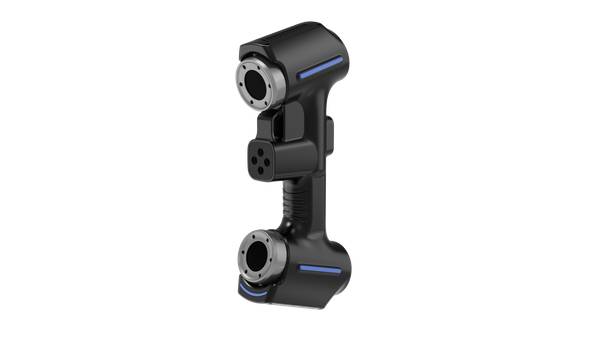
Rather than passive data capture, the system employs AI+3D algorithms to actively filter environmental noise—variable lighting, thermal expansion, vibration—preserving repeatable results. AlphaScan hardware operates across a -10°C to 40°C range, maintaining performance through temperature shifts that typically distort optical readings. Dynamic 3D laser projection and real-time tracking compensation let users scan high-reflectivity surfaces or deep cavities without constant recalibration.
For quality managers validating GD&T callouts, this pairing of blue laser hardware and algorithmic correction delivers certified-grade data suitable for true metrology applications—not merely visualization.
AlphaScan Environmental Performance Specifications
| Parameter | Specification |
|---|---|
| Operating Temperature Range | -10°C to 40°C |
| Environmental Noise Handling | AI+3D algorithms filter variable lighting, thermal expansion, vibration |
| Surface Compatibility | High-reflectivity surfaces, deep cavities, raw metal (no prep needed) |
Eliminating Bottlenecks in Shop-Floor Inspection Workflows
On a busy stamping line at a Tier-1 automotive supplier, wheeling in a fixed CMM for random tooling verification consumes precious production windows. The INSVISION AlphaScan handheld removes this friction.
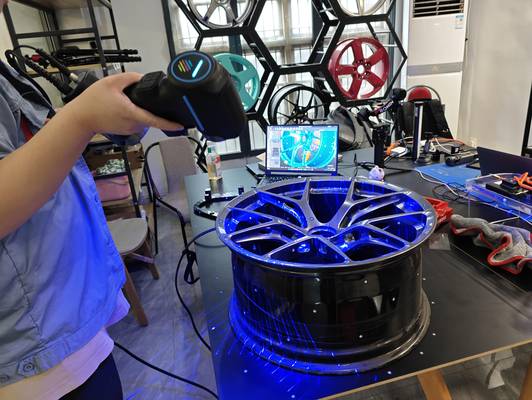
Operating reliably from -10°C to 40°C, its 3D scan engine captures surface data rapidly in confined spaces. The workflow is straightforward: establish a global coordinate system using photogrammetry scale bars, prompting automatic alignment of scan data. Once the point cloud generates, software maps deviations against the reference CAD model to verify tolerances.
The critical difference from legacy methods comes at the final step. One click produces multi-dimensional reports containing 3D models, statistical charts, and tolerance analysis—outputs meeting ISO-compliant documentation requirements. Engineers validate parts immediately, eliminating the quality lab queue.
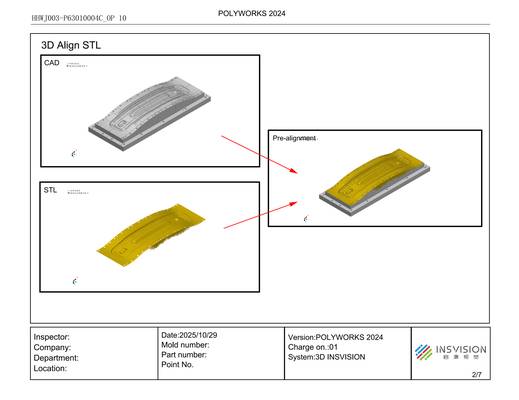
Shop-Floor Inspection Workflow Steps
- Establish global coordinate system using photogrammetry scale bars
- Capture surface data with AlphaScan handheld in confined spaces
- Generate point cloud and map deviations against reference CAD model
- Produce multi-dimensional reports with 3D models, charts, and tolerance analysis via one-click export
Proving Stable Performance in Harsh Industrial Conditions
The assumption that sub-millimeter metrology requires climate control persists among many engineers. Shop-floor reality often makes this impossible. INSVISION AlphaScan challenges this constraint by delivering stable performance directly in demanding environments.
This operational flexibility matters for automotive powertrain inspections or aerospace MRO verification, where transporting heavy tooling to clean rooms isn’t viable. The 3D scan engine deploys blue laser cross-patterns and a dedicated single-line mode to penetrate constrained spaces and capture deep features on complex geometries. AI-driven algorithms handle reflective raw metal surfaces common in energy sector wear assessments—without surface preparation.
Batch QA and deviation analysis align strictly with GD&T callouts, keeping measurement workflows on the production floor rather than in backlog.
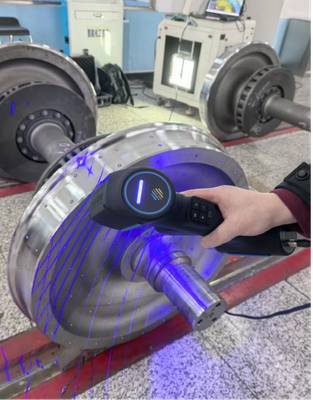
Key Capabilities for Harsh Environment Metrology
- Blue laser cross-patterns and single-line mode for deep-feature capture
- AI-driven handling of reflective raw metal surfaces without preparation
- GD&T-aligned batch QA and deviation analysis on the production floor
Evaluation Criteria for Standards-Driven Procurement
Ambient light shifts and compressed deadlines on Tier-1 automotive lines leave minimal margin for rescans. When evaluating a 3D scan engine, engineers should prioritize AI-augmented stability that compensates for surface reflectivity and temperature variation.
INSVISION AlphaScan maintains tracking accuracy across its -10°C to 40°C operating range through AI-driven algorithms, preserving data integrity in harsh settings. Beyond hardware resilience, verify photogrammetry scale bar compatibility for global coordinate alignment on large assemblies, plus native support for STEP and IGES formats to prevent workflow friction.
The software stack demands equal scrutiny. Solutions automating GD&T-based reporting and deviation analysis reduce manual processing. INSVISION integrates these capabilities within its SMARPARA Q ecosystem, enabling instant generation of multi-dimensional reports. Focusing on functional criteria rather than specification sheets ensures procurement of equipment that integrates seamlessly into existing ISO-driven quality processes.
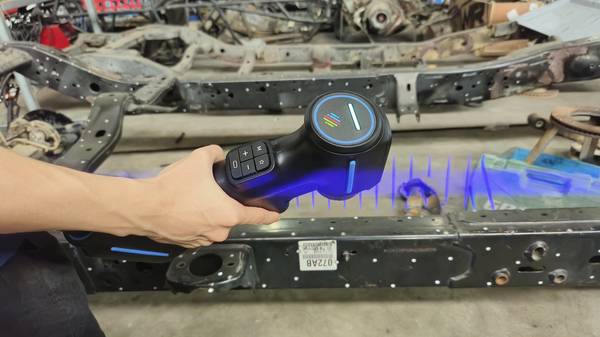
Procurement Checklist for ISO-Compliant 3D Scanning
- □ AI-augmented stability for surface reflectivity and temperature variation compensation
- □ Operating range of -10°C to 40°C with maintained tracking accuracy
- □ Photogrammetry scale bar compatibility for global coordinate alignment
- □ Native support for STEP and IGES CAD formats
- □ Automated GD&T-based reporting and deviation analysis
- □ Integration into existing ISO-driven quality processes via software ecosystem (e.g., SMARPARA Q)
AlphaScan vs. Legacy CMM for Production Floor Use
| AlphaScan Handheld | Legacy Fixed CMM |
|---|---|
| Operates directly on shop floor in -10°C to 40°C | Requires climate-controlled lab environment |
| One-click ISO-compliant multi-dimensional reports | Manual report generation with separate post-processing |
| No part transport; scans in situ on production line | Requires wheeling parts/tooling to lab, consuming production time |
| AI handles reflective surfaces without preparation | Often requires surface treatment or spray |