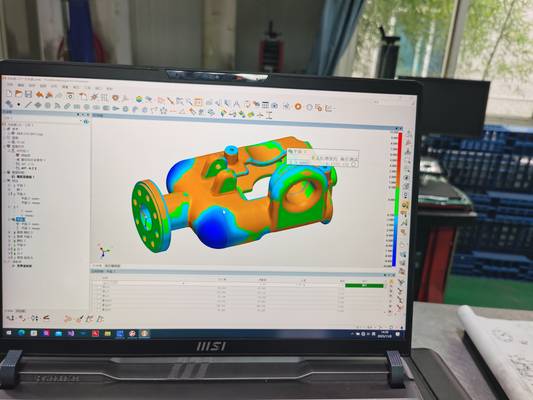
Matching 3D Scanning Performance to Real Industrial Conditions
The gap between a scanner’s datasheet and its performance on an actual factory floor separates useful equipment from expensive shelfware. Western manufacturers working under ISO 10360 and ASME B89 standards need hardware that delivers metrological certainty despite vibration, dust, and shifting ambient light—not pristine laboratory conditions.
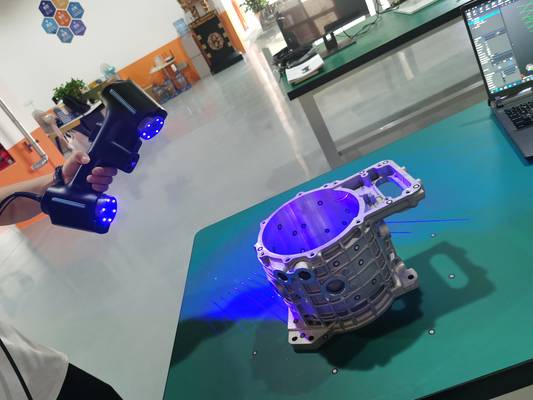
Consider two operational realities. First-article inspection in automotive supply chains demands high local accuracy to verify critical tolerances on brake calipers or transmission housings. Aerospace MRO documentation, meanwhile, requires portability: technicians must capture complete geometric records of wing assemblies or engine nacelles without dismounting components from jigs. INSVISION addresses both scenarios with systems engineered for environmental robustness rather than theoretical benchmarks.
Reverse engineering workflows present another test. Raw point clouds must integrate directly into Siemens NX, CATIA, or SolidWorks without manual translation steps that introduce error and delay. When hardware aligns with these specific operational tasks, engineering teams compress inspection cycles and ensure digital twins accurately reflect physical assets—delivering measurable ROI in high-mix, low-volume environments where setup flexibility determines profitability.
Operational Requirements by Industry Segment
| Industry Segment | Key Scanning Requirement | Source Paragraph |
|---|---|---|
| Automotive Supply Chain | High local accuracy for critical tolerances (e.g., brake calipers, transmission housings) | |
| Aerospace MRO | Portability to capture full assemblies without dismounting from jigs | |
| Medical Device Manufacturing | Real-time deviation mapping to prevent defective units from advancing |
What Volumetric Accuracy Actually Means on the Production Line
Laboratory precision figures rarely predict field performance. Volumetric accuracy—the system’s ability to maintain tolerance across the full measurement volume—determines whether a scanner can certify a three-meter aerospace panel or an automotive chassis without sectional stitching that compounds uncertainty.
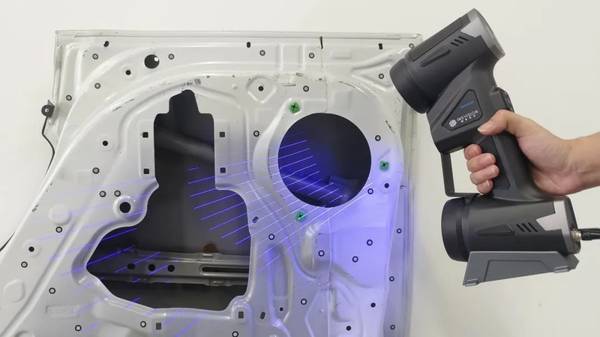
Environmental robustness proves equally decisive. Temperature swings of 15°C between morning and afternoon shifts, forklift-induced floor vibration, and overhead LED arrays replacing sodium vapor lighting all degrade measurement consistency. INSVISION calibrates for these variables, ensuring 3D scanning solutions function where production actually occurs.
Scan speed matters, but integration velocity matters more. Data that flows directly into PLM and quality systems without proprietary format conversion eliminates the hidden cost of engineering hours lost to file translation. Procurement teams prioritizing ISO-compliant field performance over isolated peak specifications secure equipment that sustains lean manufacturing rather than disrupting it.
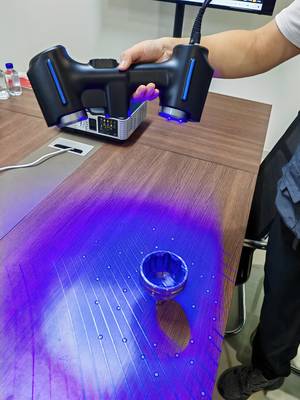
Environmental Factors Impacting Field Accuracy
| Environmental Factor | Impact on Measurement Consistency | Source Paragraph |
|---|---|---|
| Temperature swings (15°C shift) | Degrades measurement consistency across shifts | |
| Forklift-induced floor vibration | Introduces instability during scanning | |
| Overhead LED lighting replacing sodium vapor | Alters optical conditions affecting scan reliability |
Why Fixed CMMs Are Losing Ground to Portable Systems
Traditional coordinate measuring machines and tripod-mounted terrestrial scanners like legacy Cyrax units remain fixtures in climate-controlled metrology labs. Their repeatability is established. Their rigidity is proven. Their mobility is nonexistent.
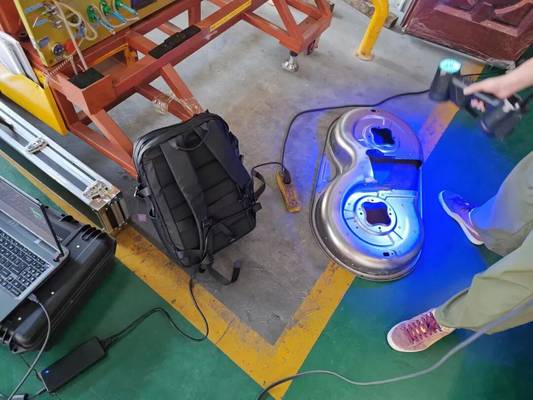
Setup times of 45 minutes to two hours, dedicated foundation requirements, and inability to reach parts still fixtured on machine tools create friction that lean manufacturing cannot tolerate. Modern handheld 3D scanning eliminates this waste. Quality technicians inspect directly at the point of manufacture, cutting non-value-added transport and queuing.
Historical skepticism toward handheld units centered on operator-dependent accuracy. Early systems required substantial training to maintain consistent capture angles and overlap patterns. INSVISION’s current metrology software automates real-time alignment and mesh generation, reducing skill-based variance. For automotive OEMs and aerospace MRO facilities balancing throughput pressure against ISO documentation requirements, the calculation has shifted: fixed systems retain niche applications in static labs, but portable 3D scanning provides the agility that data-driven production lines demand.
Steps to Transition from Fixed CMMs to Portable Scanning
- Evaluate current inspection bottlenecks caused by transport and queuing
- Assess operator training requirements for consistent handheld capture
- Validate real-time alignment and mesh generation capabilities
- Confirm compatibility with existing ISO documentation workflows
The INSVISION AlphaScan: Designed for Shift-Long Deployment
Automotive OEM and aerospace MRO teams evaluate equipment differently than laboratory researchers. Weight distribution and grip geometry determine whether operators maintain measurement consistency through eight-hour shifts. The INSVISION AlphaScan addresses this with an ergonomic chassis that reduces forearm strain during extended scanning sequences.
Real-time mesh generation replaces the traditional workflow of capture-then-process. Engineers visualize deviation maps immediately, identifying out-of-tolerance features while the part remains accessible. For medical device manufacturers operating under ISO 13485, this immediacy prevents defective units from advancing through subsequent value-added operations.
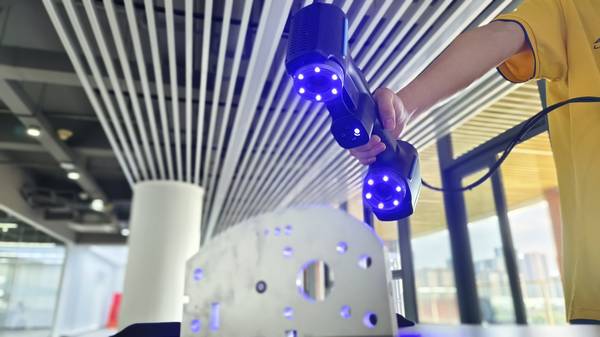
Native export to PolyWorks, Geomagic, and GOM Inspect avoids the middleware bottlenecks that plague proprietary systems. The AlphaScan integrates into existing Industry 4.0 architectures without forcing infrastructure replacement—a critical consideration for capital-constrained facilities.
A Procurement Evaluation Framework for 3D Scanning Hardware
Resolution specifications alone mislead. A rigorous assessment framework addresses five operational dimensions:
Procurement Checklist for 3D Scanning Hardware
- □ Calibration traceability: Verify ISO 10360-8 certification and request documentation of artifact-based validation procedures. Automotive and aerospace applications require auditable measurement uncertainty budgets.
- □ Service geography: Map the vendor’s technical support footprint against your facility locations. North American and European coverage with sub-48-hour response times prevents production delays that erase equipment savings.
- □ Software economics: Clarify update policies explicitly. Perpetual licenses with included maintenance, subscription models, and major-version upgrade fees each impact TCO differently. Demand written confirmation.
- □ GD&T interoperability: Confirm direct compatibility with existing analysis tools. Workflow interruption from format conversion undermines productivity claims.
- □ Validation evidence: Require demonstration against your internal reference standards, not generic promotional cases. INSVISION provides this validation pathway for AlphaScan deployments.
This structured evaluation distinguishes solutions that deliver operational ROI from those that add complexity to quality control processes. Western manufacturers investing in 3D scanning technology should prioritize field-verified performance over laboratory specifications alone.