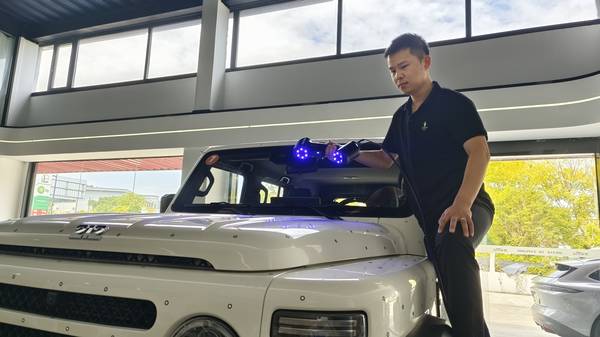
When First-Article Inspection Becomes the Bottleneck
A Tier-1 automotive supplier landed a transmission housing contract and hit a wall. Legacy CMMs—accurate to microns, but chained to elaborate fixturing—were consuming 6-8 hours per first-article inspection. Single-point probe data left gaps where porosity and dimensional drift went undetected. ASME Y14.5 GD&T callouts demanded full-surface validation, not spot checks. The two shared CMM cells became battlegrounds: production needed throughput, quality needed time.
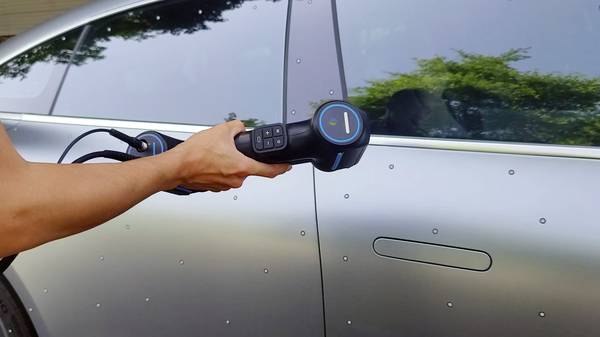
The team had already burned cycles on Artec units that demanded constant recalibration under shop-floor lighting. INSVISION‘s AlphaScan handheld scanner changed the equation. Scan 3D surface geometry across entire castings in minutes. Catch defects between probe points that CMMs had missed for months. Reduce fixturing time from hours to negligible.
Why Structured Light Survives Where Others Fail
Handheld structured light only delivers when it actually survives the shop floor. INSVISION built the AlphaScan for QA cells that don’t live in metrology labs: dense point clouds, full-field data, zero fixturing. The pattern projects, cameras capture, the mesh builds in real time. No guessing about coverage.
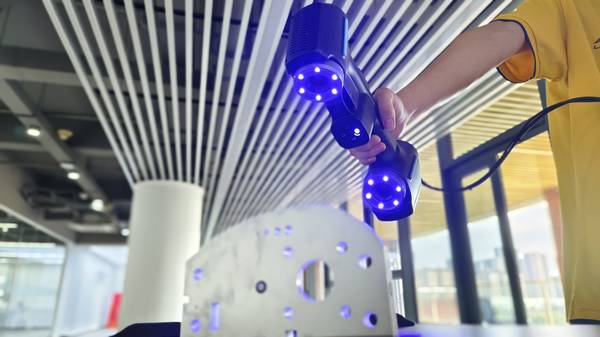
Environmental sensitivity kills throughput. Scanners that drift when the loading bay opens or afternoon sun hits the inspection area force recalibration breaks that blow takt time. AlphaScan handles ambient light shifts and temperature variation without interruption. When you scan 3D geometry for first-article inspection, the output is inspection-ready. No hole-filling. No manual alignment before CAD comparison. Colleagues spending half an hour cleaning up scans from other systems—AlphaScan eliminates that step entirely.
Deployment Timeline Comparison
| Scanner Type | Deployment Timeframe | Setup Requirements | |
|---|---|---|---|
| Legacy/Previous Systems | Two weeks calibration + three days vendor support | Darkroom, external tracking arms, specialist involvement | |
| INSVISION AlphaScan | Unboxed Tuesday morning → production inspections by 2 PM | No darkroom, no external tracking arms—just unit and laptop |
From Unboxing to Production Inspection in Hours
Three years ago, new scanner deployment meant two weeks of calibration and three days of vendor support. Last month, this supplier unboxed the INSVISION AlphaScan Tuesday morning and ran production inspections by 2 PM. No darkroom. No external tracking arms. Just the unit and a laptop.
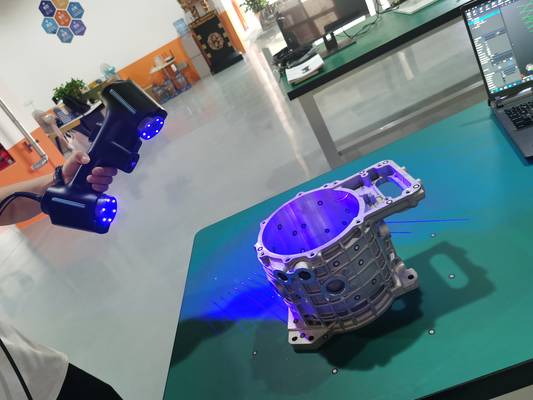
The gap is in what’s absent. Where previous setups required recalibration for five-degree temperature shifts, AlphaScan holds stable through daily ambient fluctuation near loading docks. Floor operators—not metrology specialists—trained to scan 3D surface data independently after a half-day session.
Output flows directly to STEP and IGES. No proprietary middle layers, no VXelements conversion wrestling. Cloud-ready files let the Monterrey plant pull inspection data minutes after a Detroit scan completes. For lean global supply chains, this is baseline, not bonus.
Key Advantages of AlphaScan in Production Environments
- □ Stable performance through ambient temperature fluctuations near loading docks
- □ Floor operators trained in half a day to perform independent scans
- □ Direct export to STEP and IGES—no proprietary middleware
- □ Cloud-ready files enable real-time global data sharing
Throughput Without Trading Traceability
On a Tier-1 stamping line, a medium-complexity bracket inspection tells the story. Traditional CMM: 45+ minutes including programming, fixturing, probing. Result: sparse point cloud, frequent misses on warpage and sink marks between locations. AlphaScan: single continuous pass, immediate full-surface deviation map.
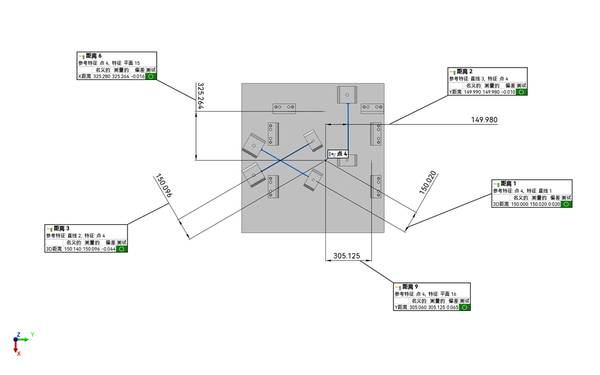
The speed doesn’t compromise quality. Sub-0.1mm volumetric accuracy meets aerospace and medical requirements where ISO 17025-aligned protocols are mandatory. High-density data finally arrives without touch-probe bottlenecks.
Steps to Achieve Full-Surface First-Article Inspection with AlphaScan
- Unbox the AlphaScan unit and connect to a standard laptop
- Perform a half-day operator training session—no metrology specialist required
- Scan the entire part surface in a single continuous pass
- Generate immediate full-surface deviation map against CAD
- Export inspection data directly to STEP/IGES for global team access
Where Handheld 3D Scanning Earns Its Place
Same stamping line, different problem: die setter flags potential wear on a 2-meter fixture. CMM approach—four hours of scheduled downtime—was dead on arrival with a 40-minute restart window. AlphaScan handled the medium-to-large validation without setup overhead.
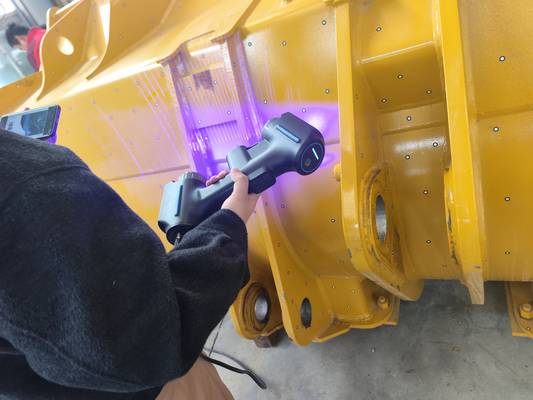
INSVISION scanner fits where GD&T callouts demand complex curvatures that touch-probe systems can’t reach efficiently. Composite panels. Castings. The constraint isn’t accuracy—it’s whether operators can execute in noisy, variable environments. AlphaScan’s interface delivered independent scans within a day.
For MRO reverse engineering on legacy tooling with no CAD history, scan 3D geometry directly to mesh-to-CAD output. Keep maintenance schedules intact. When first-article inspection demands collide with line uptime, that speed determines whether you ship or explain.