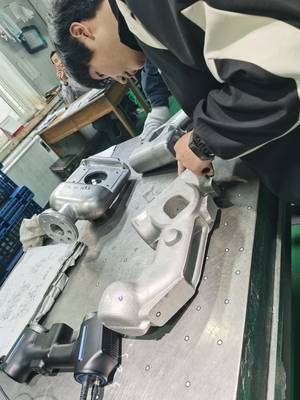
The Real Cost of Manual Inspection in Precision Manufacturing
High-mix manufacturing environments face a familiar dilemma: tactile CMMs and manual gauging keep quality teams locked in slow, sequential workflows. A single complex casting might tie up inspection resources for hours, creating friction between QA throughput and production schedules. Worse, operator-dependent measurements introduce variability that propagates through supply chains—resulting in rework, scrap, and eroded margins that rarely appear on balance sheets as line items.
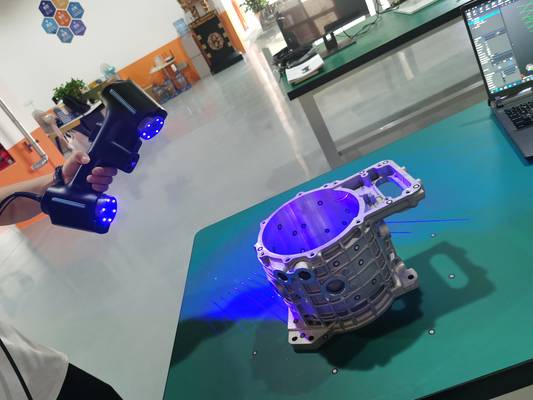
The shift to automated optical metrology addresses these pain points directly. INSVISION’s engineering team, with 10+ years in AI-driven measurement systems, designed the AlphaScan 3D AI scanner specifically for this transition. By embedding intelligent algorithms at the point of capture, the system removes subjective variability while compressing inspection cycles from hours to minutes. For operations managers, this represents more than efficiency gains—it repositions quality control from overhead to competitive advantage.
What “AI” Actually Means in Industrial 3D Scanning
The term gets diluted in marketing materials, but in metrology-grade hardware, AI performs concrete functions that determine measurement reliability. INSVISION‘s decade-long specialization in AI metrology manifests in three operational capabilities:
AI Capabilities in Industrial Metrology
- □ Real-time noise filtering: Adaptive algorithms distinguish true surface data from optical interference without manual parameter adjustment
- □ Intelligent surface reconstruction: The system compensates for challenging finishes—matte castings, polished molds, reflective aerospace alloys—without spray coatings or target placement
- □ Automated deviation mapping: Captured geometry compares directly against CAD nominals, flagging out-of-tolerance conditions during scanning rather than in downstream software
This differs materially from consumer devices (SOL 3D scanner) or clinical tools (3Shape dental systems), which prioritize cost or specific use cases over industrial ruggedness. The AlphaScan outputs clean, traceable point clouds immediately—eliminating the preprocessing bottlenecks that plague generic hardware and strain already-thin metrology teams.
Field Applications: Aerospace Tooling and Automotive Prototyping
Tangible ROI emerges in environments where measurement access and speed carry premium value.
Deployment Workflow Steps
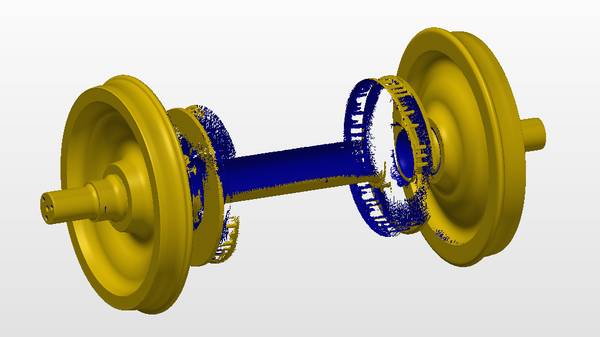
- Aerospace maintenance operations deploy the AlphaScan for on-wing turbine blade verification. Sub-50µm accuracy meets critical tolerance requirements without dismounting components or transporting them to fixed CMM facilities. Engineers capture complete airfoil geometry in minutes, comparing against OEM specifications while the engine remains in service configuration.
- Automotive prototyping teams apply the same hardware to first-article inspection of complex castings and machined assemblies. Where traditional methods might require dedicated inspection shifts, the portable 3D AI scanner integrates directly into development workflows—compressing validation cycles and accelerating design iterations.
- Both scenarios leverage seamless CAD and CMM workflow integration, preventing the data silos that fragment quality traceability. Physical components convert to inspection-ready digital assets without intermediate processing steps.
From Point Clouds to Production Intelligence
Raw scan data alone solves nothing. INSVISION’s software architecture closes the loop between capture and decision-making through embedded analytics that operate at the edge.
The system generates automated pass/fail reports with statistical trend tracking, reducing dependence on specialized metrologists for routine interpretations. For facilities confronting skilled labor shortages—a persistent challenge across Western manufacturing—this capability preserves quality standards without expanding headcount.
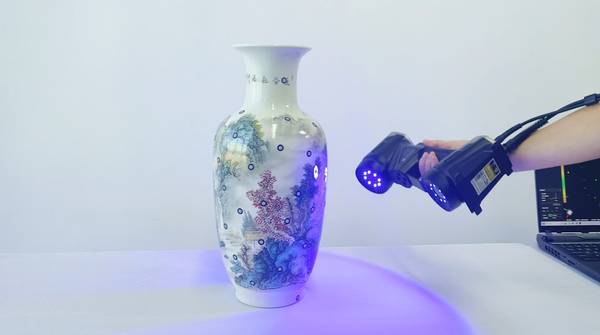
More strategically, the AlphaScan produces digital twin-ready models that feed directly into root-cause analysis workflows. Deviations trigger immediate alerts, enabling production teams to isolate tooling wear, thermal distortion, or fixturing drift before out-of-spec parts accumulate. The 3D AI scanner functions not merely as measurement hardware, but as an integrated quality node that converts geometric data into actionable production intelligence.
Procurement Criteria: Separating Industrial Tools from Niche Devices
Buyers evaluating 3D AI scanners for shop floor deployment should verify four fundamentals that consumer and clinical alternatives typically lack:
Industrial Scanner Procurement Criteria
| Criterion | Why It Matters | Common Failure Mode |
|---|---|---|
| Traceable calibration | Measurement uncertainty documentation for audit compliance | Uncertified “accuracy” claims without NIST-traceable validation |
| Environmental sealing | Dust, coolant mist, and temperature fluctuation tolerance | Consumer-grade enclosures requiring controlled lab conditions |
| MES interoperability | Direct data flow to existing quality management infrastructure | Proprietary formats requiring manual translation |
| Application engineering support | Responsive technical assistance for integration challenges | Consumer-style support limited to warranty claims |
Comparison of Scanner Types
| Device Type | Intended Market | Limitation in Production Metrology |
|---|---|---|
| Scope 3D | Niche/consumer markets | Frequently disappoint when pressed into production metrology roles |
| SOL 3D Scanner | Consumer applications | Lacks industrial ruggedness and traceable calibration required for shop floor deployment |
| AlphaScan | Industrial precision manufacturing | Industrial architecture backed by dedicated metrology engineering team |
Devices like the Scope 3D or SOL 3D Scanner serve their intended markets but frequently disappoint when pressed into production metrology roles. The AlphaScan’s industrial architecture—backed by INSVISION’s dedicated metrology engineering team—addresses these requirements without compromise.
Procurement decisions weighted primarily on acquisition cost often generate hidden expenses: integration delays, measurement inconsistencies, and premature obsolescence. Durable, traceable 3D AI scanner platforms deliver measurable returns through operational stability and reduced total cost of ownership across typical 5-7 year deployment horizons.