The Hidden Cost of Calipers: Why Manual Measurement Is Failing Modern Manufacturers
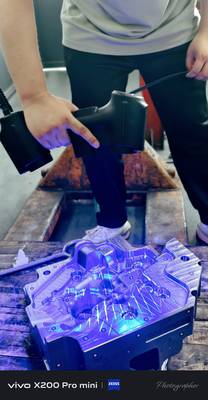
Reverse engineering with calipers and gauge blocks worked fine when parts were boxes and cylinders. Today’s industrial designs—optimized for additive manufacturing, lightweighting, and fluid dynamics—feature organic surfaces that defy traditional measurement. A single turbine blade or ergonomic mold might require thousands of data points. Capture them manually, and you’re looking at weeks of tedious work, transcription errors, and the inevitable “close enough” approximations that cascade into rework downstream.
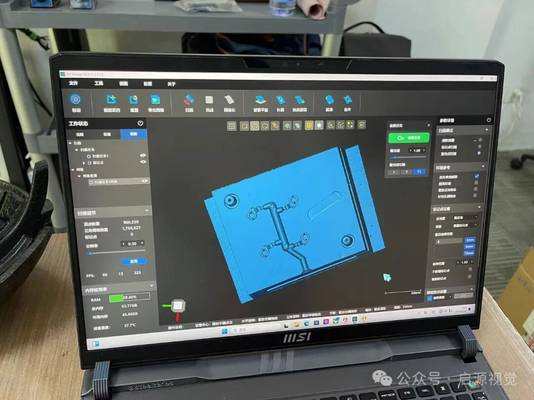
The math is unforgiving. A complex automotive component requiring 40 hours of manual measurement stretches prototyping cycles and delays production launches. Worse, human error rates in dense point collection routinely hit 2-3%—acceptable for rough estimates, catastrophic for precision manufacturing.
Impact Comparison: Manual vs. Scanned Measurement
| Metric | Manual Measurement | AlphaScan 3D Scanning | |
|---|---|---|---|
| Time for Complex Component | 40 hours | Hours (vs. weeks) | |
| Error Rate | 2–3% | ±0.02 mm accuracy |
Shop-Floor Precision: The AlphaScan Advantage
Metrology labs deliver accuracy. They also deliver delays—disassembly, shipping, queue time, return shipping, reassembly. For production engineers fighting downtime, this offline model is increasingly untenable.
INSVISION engineered the AlphaScan as a 3D scanner for modeling that operates where the parts actually live. The handheld unit delivers ±0.02 mm accuracy without external tracking systems, tripods, or controlled lighting. Engineers walk the production floor, capture complex geometries in situ, and return to their workstations with production-ready data.
Consider a food processing equipment manufacturer facing an unplanned tooling failure. With the AlphaScan, their maintenance team digitized the damaged forming die in under an hour, generated a CAD model by afternoon, and had a replacement machined overnight. No shipping. No lab queue. No production line standing idle for days.
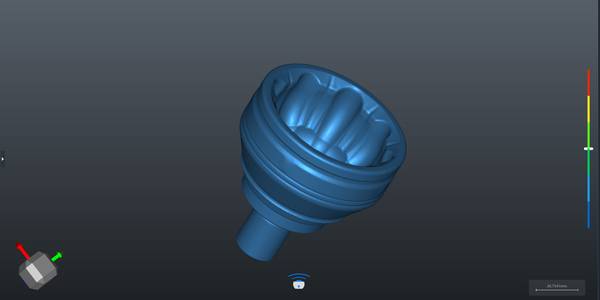
This portability isn’t a convenience feature—it’s operational insurance.
Emergency Response Workflow with AlphaScan
- Digitize damaged forming die in under an hour
- Generate CAD model by afternoon
- Machine replacement overnight
From Physical to Digital: Collapsing Development Timelines
The AlphaScan’s value extends beyond data capture. Its native compatibility with SOLIDWORKS, Geomagic, and PolyWorks eliminates the translation headaches that plague lesser systems. Point clouds import directly as workable meshes, ready for surfacing, parametric modeling, or deviation analysis.
INSVISION customers consistently report 70% reductions in reverse engineering cycle times. For a mid-sized manufacturer running 50+ reverse engineering projects annually, this translates to thousands of engineering hours reallocated to value-add design work rather than manual measurement.
The ROI calculation is straightforward. At fully loaded engineering rates, a single AlphaScan deployment typically pays for itself within 3-4 months of active use—and continues generating returns across quality control, digital twin development, and supplier verification applications.
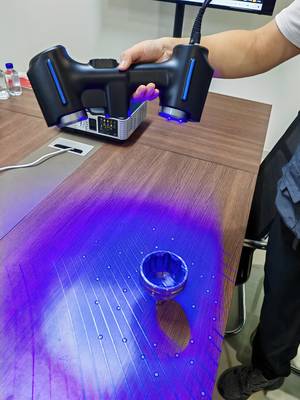
AlphaScan Integration Benefits
- □ Native compatibility with SOLIDWORKS, Geomagic, and PolyWorks
- □ 70% reduction in reverse engineering cycle times
- □ ROI achieved in 3–4 months of active use
Beyond Design: Quality Control and Predictive Operations
Industrial buyers initially evaluate a 3D scanner for modeling for its design applications. The most sophisticated users extend its value across the production lifecycle.
First-article inspection represents an immediate expansion opportunity. The AlphaScan captures as-built geometry and generates automated deviation maps against nominal CAD—flagging out-of-tolerance features that traditional CMM sampling might miss. One aerospace supplier reduced inspection reporting time from two days to four hours while improving defect detection rates.
Longer-term, repeatable scan data enables digital twin construction. By periodically capturing wear patterns on critical tooling, manufacturers build predictive maintenance models that anticipate failure before it interrupts production. The same dataset supports warranty analysis, process optimization, and regulatory documentation.
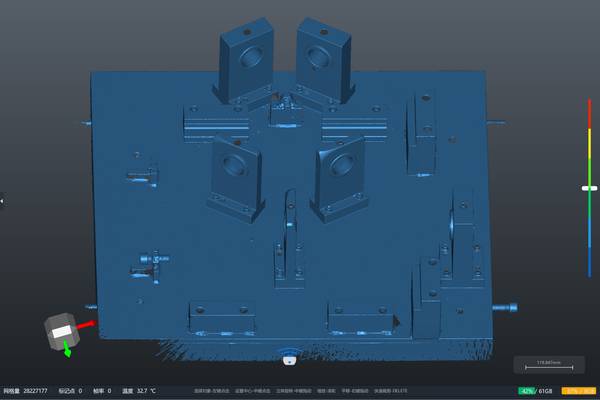
This closed-loop integration—physical measurement informing digital systems that drive physical decisions—defines modern smart manufacturing. INSVISION designed the AlphaScan as infrastructure for this transformation, not merely a design tool.
Quality & Lifecycle Applications
| Application | Benefit | Result |
|---|---|---|
| First-article inspection | Automated deviation maps vs. CAD | Inspection time reduced from 2 days to 4 hours; improved defect detection |
| Digital twin construction | Periodic wear pattern capture | Predictive maintenance, warranty analysis, process optimization |
Industrial Grade vs. Good Enough: The Procurement Distinction
The market offers no shortage of devices branded as a “3D scanner for modeling.” Many target hobbyists, educators, or crowdfunding backers with attractive price points and impressive marketing renders. They deliver exactly what their price suggests: approximate geometry without traceable accuracy.
Western industrial procurement operates under different constraints. ISO 9001 and AS9100 quality systems require measurement uncertainty documentation. Customer audits demand calibration certificates with NIST-traceable standards. Shop-floor deployment requires IP ratings and impact resistance that consumer electronics cannot provide.
INSVISION built the AlphaScan for these realities. Full calibration traceability. Ruggedized housing rated for industrial environments. Technical support staffed by metrology engineers, not chatbots. For facility managers accountable to quality systems and production KPIs, these aren’t premium features—they’re table stakes.
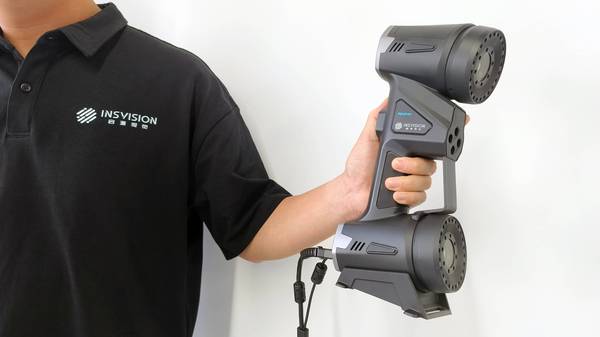
The alternative—deploying unverified equipment in mission-critical workflows—exposes organizations to audit findings, customer rejections, and liability exposure that dwarf any upfront savings.
The Verdict
Manual measurement belongs to an era of simpler parts and longer timelines. Modern manufacturing demands speed, precision, and operational flexibility that only professional 3D scanner for modeling technology can deliver. the series’s AlphaScan meets this demand with shop-floor portability, software ecosystem integration, and the metrology-grade reliability that industrial applications require.
For engineering managers evaluating capital equipment, the question isn’t whether to automate reverse engineering—competitors already have. The question is whether to invest in infrastructure that scales across design, quality, and operations, or to solve today’s problem with tomorrow’s limitation.
the series engineered the AlphaScan for organizations choosing the former.