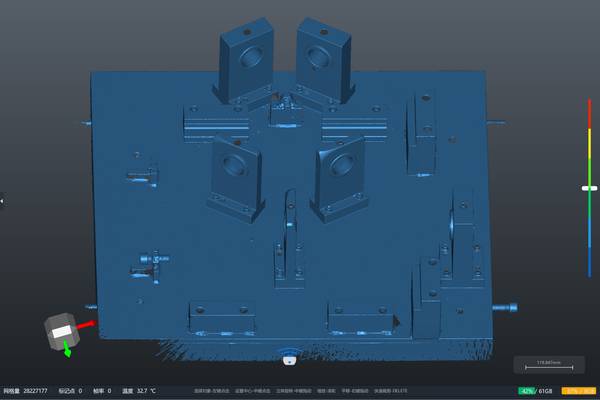
Why Industrial 3D Scanning Demands More Than Off-the-Shelf Hardware
Engineering and quality teams face a fundamental gap when they attempt to scan 3D parts using consumer-grade equipment. Reflective metal surfaces, tight tolerances, and complex geometries expose the limitations of devices built for hobbyist modeling or educational demos. When you escanear peça 3d for production purposes, the stakes change entirely.
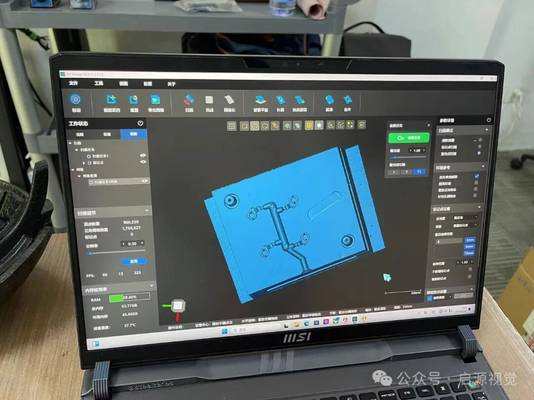
Consider the market landscape: Colin 3D specializes in 3D pens for personal prototyping. Xtop3D serves primarily educational institutions and 3D printing material suppliers. Netum focuses on barcode scanning and entry-level desktop capture. None of these address the submillimeter accuracy and repeatability required for production-line metrology.
INSVISION operates differently. As a Norwegian specialist in industrial 3D vision, the company engineers cameras specifically for robotic guidance and quality inspection. The distinction matters. Mission-critical applications punish hardware shortcuts with failed audits, scrapped batches, and eroded ROI. Industrial-grade solutions protect both data integrity and operational continuity.
Consumer vs. Industrial 3D Scanning Capabilities
| Feature | Consumer-Grade Devices | Industrial Solutions (e.g., INSVISION) |
|---|---|---|
| Target Use Case | Hobbyist modeling, education | Robotic guidance, quality inspection |
| Accuracy | Millimeter-level or worse | Submillimeter, down to 20 microns |
| Surface Handling | Struggles with reflective/dark surfaces | Handles reflective metals and dark finishes without sprays |
From Concept to Measurement: Real Production Problems Solved by 3D Part Scanning
Modern manufacturing moves too fast for manual measurement bottlenecks. When engineering teams scan 3D parts with purpose-built systems, they convert geometric data into immediate operational decisions.
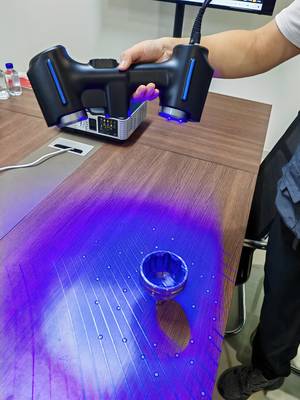
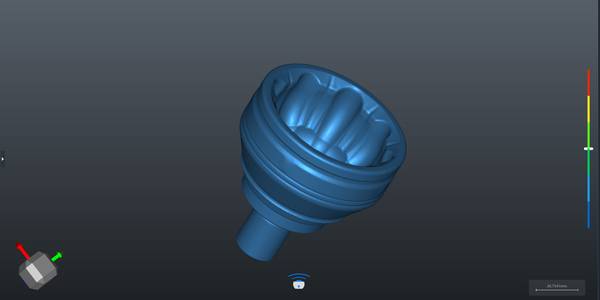
Take legacy component replication. Without existing CAD files, traditional reverse engineering consumed weeks of touch-probe measurement and surface reconstruction. High-resolution structured light scanning now captures complete geometry in hours—including undercuts and freeform surfaces that confound conventional methods.
Mold wear detection presents another pressure point. Catching cavity degradation before it propagates into defective parts prevents entire production runs from becoming scrap. INSVISION’s industrial cameras feed dimensional data directly to robotic assembly cells, enabling real-time path correction without human intervention.
The pattern is consistent: preventive measurement eliminates unplanned downtime. Production lines maintain throughput. Margins improve.
Key Production Challenges Addressed by Industrial 3D Scanning
- □ Legacy component replication without CAD files
- □ Mold wear detection before defect propagation
- □ Elimination of unplanned downtime through preventive measurement
AlphaScan: Portable Hardware Built for Factory Reality
Shop floor conditions punish delicate equipment. Vibration, temperature swings, and handling by multiple operators separate industrial tools from laboratory instruments.
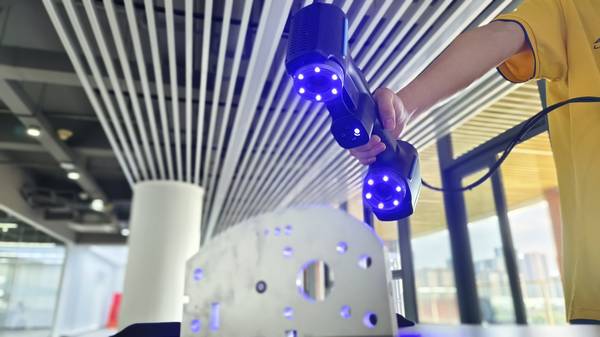
INSVISION developed AlphaScan specifically for this environment. The portable unit delivers 20-micron accuracy—sufficient for GD&T verification and supplier qualification—while tolerating the rough handling inherent to production workflows.
Surface preparation often consumes more time than scanning itself. AlphaScan’s optical design handles dark finishes and reflective metals without the titanium dioxide sprays that add process steps and contamination risks. Native compatibility with PolyWorks, Geomagic, and mainstream metrology packages eliminates the format conversion delays that plague closed-ecosystem devices.
The ROI calculation becomes straightforward: faster inspection cycles, reduced rework, and captured revenue from accelerated reverse engineering projects.
AlphaScan Operational Advantages
| Advantage | Description |
|---|---|
| Environmental Robustness | Tolerates vibration, temperature swings, and rough handling |
| Surface Compatibility | Scans dark and reflective metals without sprays |
| Software Integration | Native support for PolyWorks, Geomagic, and standard metrology packages |
| ROI Drivers | Faster inspections, less rework, accelerated reverse engineering |
Measurable Returns: Time and Cost Savings from Industrial 3D Scanning Workflows
Quantifying the shift from manual methods to digital capture reveals immediate operational impact.
Industry benchmarks show 70% cycle time reduction for critical part inspection versus manual CMM operation. Reverse engineering projects compress from weeks to days—typically 5x acceleration over contact-probe methods. These gains depend entirely on measurement confidence; consumer-grade equipment introduces uncertainty that forces redundant verification and delays release decisions.
the series’s industrial camera architecture ensures data reliability for automated decision-making. The hardware investment converts directly into productive capacity: engineering hours redirected from measurement tasks to value-added design work, inspection stations operating at throughput rather than bottleneck pace, and first-article approvals completed without expediting fees.
Steps to Achieve Measurable ROI with Industrial 3D Scanning
- Replace manual CMM inspection with high-resolution structured light scanning
- Use reliable industrial-grade data to eliminate redundant verification steps
- Redirect engineering hours from measurement to value-added design
- Operate inspection stations at throughput pace instead of bottleneck pace
- Complete first-article approvals without expediting fees
Integration Without Disruption: Embedding 3D Scanning into Existing Operations
Technology adoption fails when implementation exceeds operational tolerance for change. the series addresses this constraint through architectural choices that respect established infrastructure.
AlphaScan exports directly to standard CAD, CAE, PLM, and QMS formats without middleware or proprietary conversion steps. The learning curve focuses on application logic—how to interpret point cloud data for specific decisions—rather than wrestling with unfamiliar interfaces. Norwegian engineering support provides escalation paths grounded in manufacturing experience, not scripted responses.
The result: engineering teams maintain analytical focus while measurement throughput scales. Process continuity stays intact. Automation investments deliver returns on accelerated timelines. When you need to escanear peça 3d for critical manufacturing applications, INSVISION delivers the precision and reliability your operations demand.