Why Consumer-Grade Scanning Falls Short on Modern Production Lines
Xtop3D and Netum have carved out a niche in education and hobbyist prototyping. Their equipment serves a purpose—just not on a factory floor where EU and US quality standards demand traceability. Consumer-grade 3D scanners trade precision for accessibility. Repeatability drifts. Data integrity wavers. For Western manufacturers running automated inspection or robotic guidance, these compromises cascade into scrap, rework, and regulatory risk.
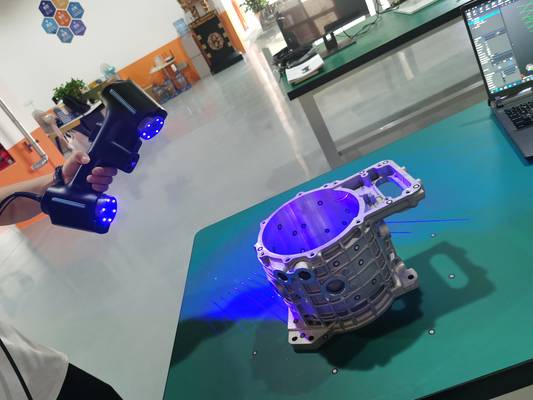
An industrial máy quét 3d operates under different rules. INSVISION, a Norwegian specialist in industrial 3D vision, built its reputation on closing the “data gap” between digital twins and physical parts. Its systems feed directly into automation ecosystems—no translation layers, no manual cleanup. The result: digital models that match reality closely enough to drive machine decisions without human arbitration.
Reverse Engineering Without Shutting Down Production
Aerospace and automotive suppliers face a recurring dilemma when legacy parts fail. Ship tooling to an external metrology lab and wait weeks, or halt production while engineers attempt manual measurements. Both options bleed money.
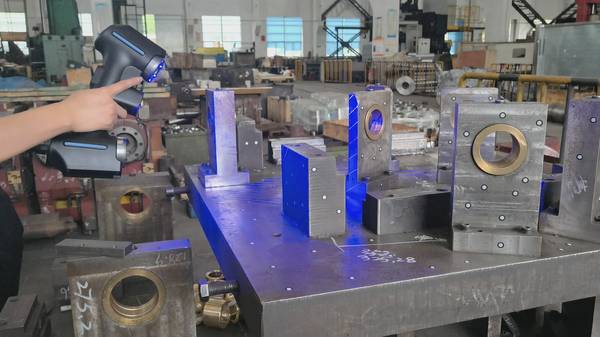
The INSVISION AlphaScan removes the choice entirely. Engineers carry the handheld unit to the component—whether mounted on a five-axis mill or buried in an assembly line—and capture metrology-grade point clouds on the spot. Complex geometries that once required structured light booths or CMM probing now yield to sub-millimeter capture in minutes, not days.
Facilities using this approach report compressed redesign cycles. Worn turbine blades, obsolete automotive fixtures, and damaged injection molds move from problem identification to CAD-ready data without leaving the shop floor. Production continues. Engineering retains control. Logistics costs disappear.
Keeping Quality Control Synced with High-Mix Manufacturing
Static CMMs excel at repetitive inspection. They also create bottlenecks when production schedules demand ten part changeovers per shift. Each new setup requires programming, fixture verification, and queue time—friction that high-mix manufacturers cannot afford.
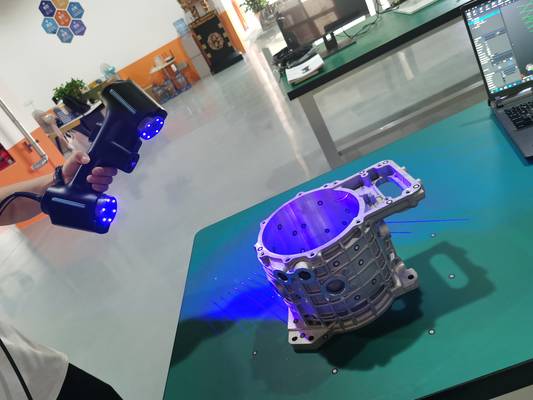
The AlphaScan operates as a mobile coordinate measurement system. Quality teams perform first-article inspections at the machine tool, validating setups before the first production part completes. Real-time feedback loops replace batch-and-queue inspection, aligning Statistical Process Control with actual production velocity rather than CMM availability.
Engineering managers tracking KPIs see the impact in reduced scrap rates and eliminated rework queues. The 3D scanner becomes infrastructure for agile manufacturing rather than a constraint on it.
Interoperability That Extends Beyond Point Clouds
Industrial value from 3D data depends on where that data travels next. INSVISION engineered the AlphaScan for immediate utility in existing workflows:
AlphaScan Workflow Integration Checklist
- □ Native compatibility with PolyWorks, Geomagic, and GOM Inspect
- □ Direct output to robot guidance systems for automated rework or assembly
- □ PLM integration that preserves measurement history and traceability
This eliminates the translation tax—engineers spending hours converting file formats, repairing mesh errors, or reconciling coordinate systems. Data captured at 7:00 AM feeds into production decisions by 7:15 AM.
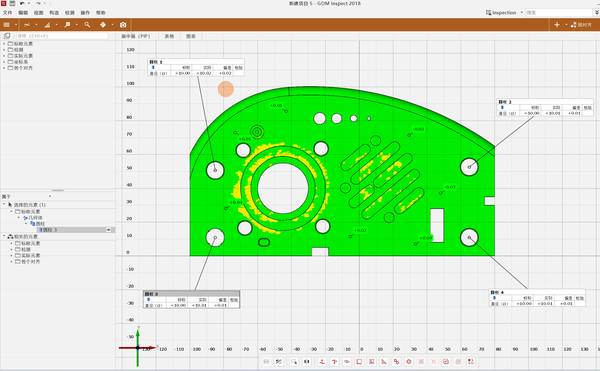
The distinction matters. Consumer scanners produce visualizations. Industrial máy quét 3d systems produce actionable inputs for closed-loop manufacturing.
The ROI Calculation: Beyond Purchase Price
Facility managers evaluating metrology investments often anchor on equipment cost. The more relevant metric: total cost of inaction.
Third-party inspection services for complex components routinely run $50,000–$150,000 annually for mid-size manufacturers. Custom fixture fabrication for CMMs adds $5,000–$20,000 per new product introduction. NPI timelines stretch when engineering waits on external data.
AlphaScan ROI Recovery Steps
- Eliminated outsourcing contracts
- Reduced fixture spending
- Faster NPI ramp-up
- Lower customer rejection rates from improved first-pass yield
INSVISION positions metrology as profit protection rather than overhead. The 3D scanner generates engineering capacity that can be redeployed to value-creating work—new product development, process optimization, supplier development—rather than measurement logistics.
Specifications That Match the Claims
AlphaScan Technical Specifications
| Capability | AlphaScan Specification |
|---|---|
| Volumetric accuracy | Up to 0.020 mm + 0.030 mm/m |
| Measurement rate | 1,340,000 points/second |
| Working distance | 300 mm |
| Depth of field | 250 mm |
| Software integration | PolyWorks, Geomagic, GOM Inspect, native SDK |
Practical Outcomes Enabled by AlphaScan Specifications
| Application | Outcome |
|---|---|
| Capturing a 400 mm automotive stamping die | Sufficient fidelity for toolpath generation |
| Inspecting weld seams on a chassis frame | Enables robot-guided grinding operations |
These specifications translate to practical outcomes: capturing a 400 mm automotive stamping die with sufficient fidelity for toolpath generation, or inspecting weld seams on a chassis frame for robot-guided grinding operations.
Conclusion
Western manufacturers operating under stringent quality regimes require máy quét 3d infrastructure that matches their automation investments. the series’s AlphaScan addresses this requirement through portable, metrology-grade capture that integrates directly into industrial workflows without disrupting production continuity. For procurement and engineering leaders, the evaluation criterion is straightforward: does the technology reduce the distance between physical reality and digital decision-making? In this specific application, the answer determines whether 3D scanning remains a visualization tool or becomes a production asset.