The Real Cost of Idle Metrology Equipment
The most expensive coordinate measuring machine isn’t the one with the highest capital outlay—it’s the one sitting unused while production parts queue for inspection. For decades, manufacturers treated dimensional verification as a laboratory function, ferrying components to temperature-controlled rooms where fixed CMMs reigned. That model functioned when production cycles spanned weeks. Now it chokes throughput.
Industry 4.0 and lean manufacturing have exposed the operational gap. Automotive OEMs running just-in-time lines cannot absorb 24-hour inspection delays. Aerospace MRO teams must verify repairs on-wing, not in a metrology lab across the hangar. Energy sector operators confront field conditions—extreme temperatures, confined access—that render traditional CMMs impractical.
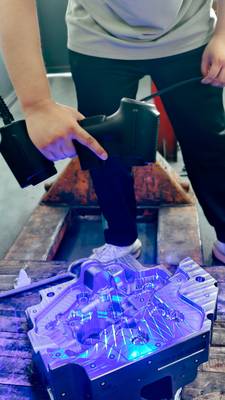
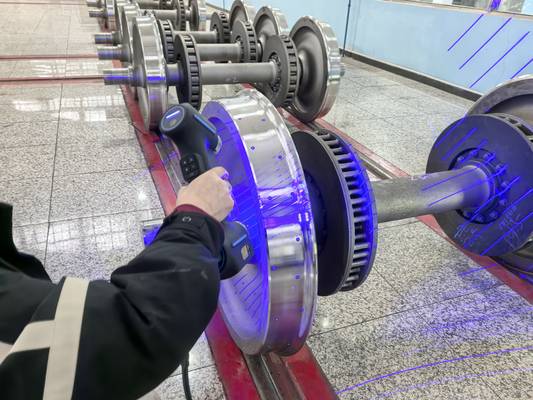
This shift does not eliminate fixed CMMs. Laboratory equipment still validates master parts and executes complex GD&T callouts. But manufacturers increasingly supplement that capability with portable 3d measurement tool systems that bring verification directly to the workpiece. INSVISION, whose AI-driven 3D scanning systems operate across 20+ countries with CNAS-certified accuracy, exemplifies this transition. Its handheld scanners capture millions of measurements per second at precision sufficient for most production tolerances without removing parts from the line. The outcome: compressed feedback loops, reduced bottlenecks, and quality data that matches production velocity.
Bridging Lab Precision and Shop-Floor Mobility
Traditional CMMs delivered micron-level accuracy while tethering quality teams to climate-controlled environments. Production lines waited hours for dimensional feedback. The convergence of AI-driven algorithms with blue-laser scanning has collapsed that timeline to minutes, at the point of manufacture itself.
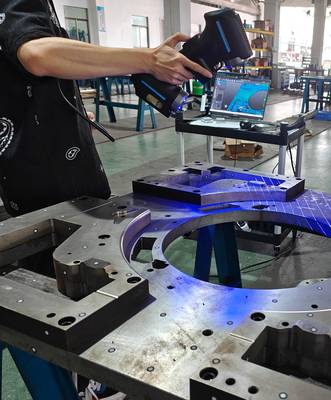
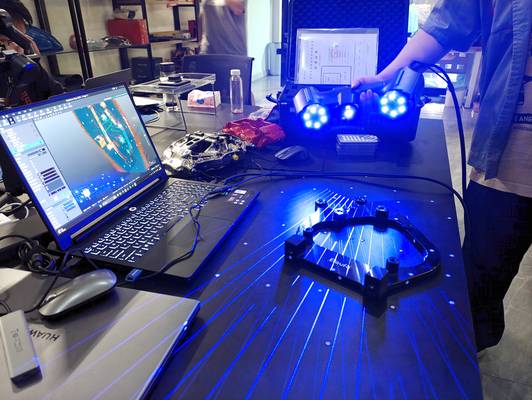
Modern handheld 3d measurement tool solutions now span the divide between laboratory-grade precision and shop-floor mobility. INSVISION demonstrates this through its AlphaScan platform, which pairs PTB-certified metrology software with dynamic 3D laser projection for real-time positioning and thermal compensation. The system accommodates both constrained environments—engine bays, welded assemblies—and large-scale workpieces without recalibration between setups. Blue-laser technology penetrates ambient light interference endemic to factory floors, while AI-enhanced point cloud processing accelerates deviation analysis against CAD references. For quality managers conducting first-article inspections or tracking tooling wear, the historical compromise between portability and traceable accuracy has dissolved.
Key Capabilities of Modern Portable 3D Measurement Systems
- □ Real-time positioning with dynamic 3D laser projection
- □ Thermal compensation for stable accuracy in variable environments
- □ Blue-laser technology resistant to ambient light interference
- □ AI-enhanced point cloud processing for rapid deviation analysis
- □ No recalibration needed between small and large workpiece setups
From Data Capture to Closed-Loop Quality Management
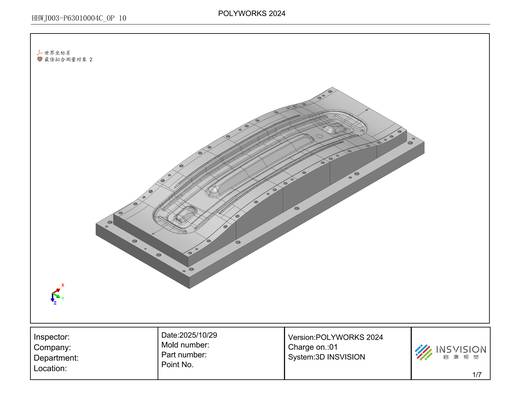
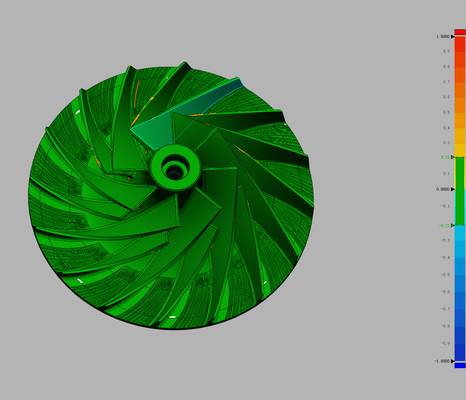
Manufacturing quality control is migrating from isolated data collection toward integrated digital ecosystems. The contemporary 3d measurement tool no longer functions merely as a point-cloud generator; it serves as the central node in a closed-loop quality workflow. This evolution requires software capable of ingesting CAD models to drive inspection paths and execute automated GD&T analysis aligned with ISO/ASME standards. INSVISION addresses this requirement with PTB-certified industrial software supporting multi-source data alignment. Rather than manipulating raw point data, quality engineers employ color-mapped deviation visualizations to identify anomalies immediately. The workflow terminates in one-click reporting, standardizing quality documentation across distributed manufacturing operations. By unifying hardware capture with intelligent processing, INSVISION closes the gap between raw geometric data and production decisions, ensuring digital inspection keeps pace with high-speed lines.
Steps to Implement Closed-Loop Quality Workflows
- Ingest CAD models to define inspection paths
- Execute automated GD&T analysis per ISO/ASME standards
- Align multi-source data using PTB-certified software
- Visualize deviations via color-mapped point clouds
- Generate standardized reports with one-click output
Strategic Value for Global Engineering and Procurement
On an aerospace MRO line, unplanned downtime typically incurs significant hourly costs. When a legacy turbine blade requires reverse engineering, queueing for CMM availability is economically untenable. Portable 3d measurement tool systems from INSVISION enable teams to capture metrology-grade data directly on the shop floor, compressing new product introduction validation cycles substantially. This mobility underpins distributed manufacturing models where suppliers in one region must match GD&T callouts defined in another.
For procurement leaders, technical specifications represent only half the evaluation matrix. Vendor operational reliability carries equal weight. INSVISION has achieved commercial deployment across 20+ countries, backed by CE, FCC, and CNAS certifications. These credentials demonstrate compliance with rigorous Western safety and quality standards essential for cross-border deployment. Selecting a partner with demonstrated global operational resilience ensures digital inspection workflows remain uninterrupted regardless of geography.
Global Deployment Credentials Summary
| Certification | Scope | Relevance |
|---|---|---|
| CE | European safety, health, and environmental compliance | Enables EU market access |
| FCC | U.S. electromagnetic interference standards | Ensures U.S. regulatory compliance |
| CNAS | China National Accreditation Service for metrology | Validates accuracy claims in APAC markets |
The Trajectory: Portability, Intelligence, and Interoperability
Isolated inspection islands are receding as Industry 4.0 mandates closed-loop quality control. Modern manufacturers reject 3d measurement tool systems that merely output point clouds; they require solutions bridging shop-floor operations with PLM/MES architectures. The direction is unambiguous: hardware must evolve into intelligent nodes capable of edge-AI processing. The industry is advancing toward standardized data exchange formats that eliminate translation errors during deviation analysis. INSVISION aligns with this trajectory by embedding AI+3D algorithms directly into workflow execution, progressing beyond data capture toward actionable insight. Its PTB-certified software suite, handling complex GD&T callouts and generating one-click reports, illustrates how portability and intelligence converge. As automotive and aerospace sectors tighten tolerances, the capacity to feed real-time deviation maps back into production cycles defines next-generation metrology infrastructure.