From CMM Labs to the Production Line: What Changed
Quality control is leaving the lab. Automotive first-article inspection, aerospace MRO, and medical device manufacturing now demand verification at the point of production—not hours later in a climate-controlled room. This shift exposes a gap: traditional fixed CMMs cannot follow parts through lean workflows, and manual scribing introduces human error at exactly the wrong moment.
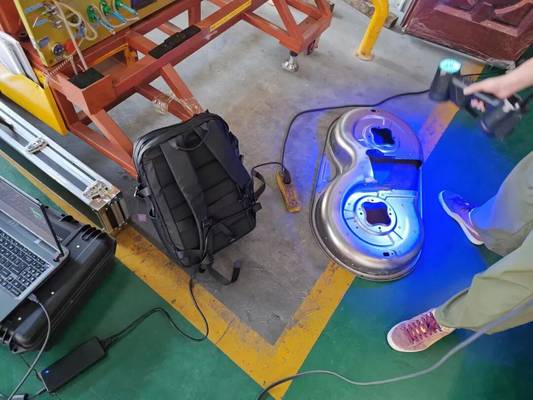
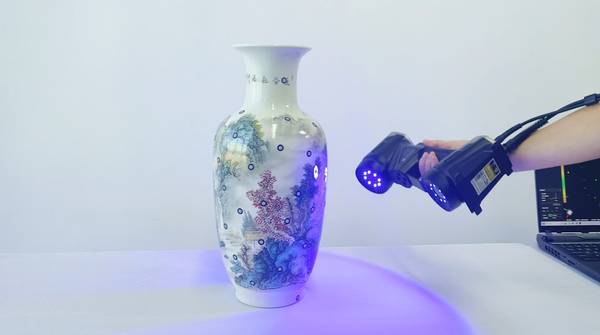
Portable 3D scanners for CAD integration close this gap. INSVISION deploys binocular machine vision with 0.25mm verified accuracy to project CAD-derived guidance directly onto physical workpieces. When a composite panel shifts during layup or a fixture requires in-place validation, the system tracks motion dynamically and maintains alignment without stopping production. The result: ISO/ASME-compliant verification happens where the work happens, compressing the feedback loop between design intent and physical reality.
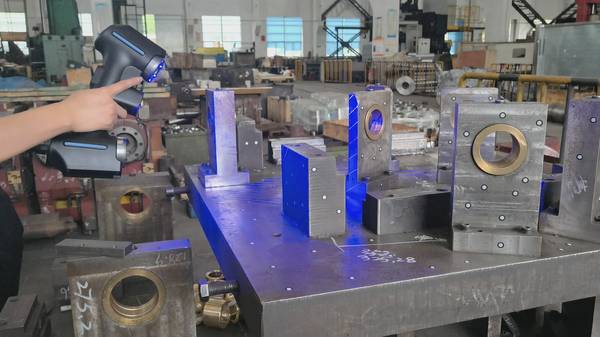
What Separates Industrial-Grade Systems from Survey Hardware
Not all portable scanners serve manufacturing. Procurement teams navigating this market must distinguish between three categories: long-range units engineered for civil surveying, LiDAR systems optimized for autonomous navigation, and close-range metrology tools built for GD&T verification. The first two categories fail on tolerance. Only the third delivers the spatial fidelity required for CAD-driven workflows.
Effective 3D scanners for CAD must satisfy four non-negotiable requirements:
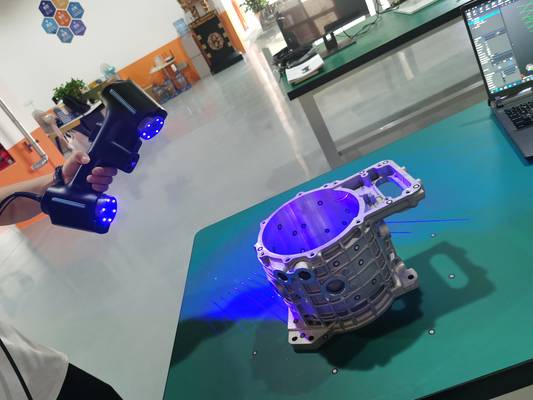
Non-Negotiable Requirements for CAD-Integrated 3D Scanners
- □ Metrology-grade precision: Dual-camera machine vision provides stability for complex assemblies. INSVISION’s binocular visual positioning achieves 0.25mm accuracy—sufficient for aerospace laminate inspection and automotive body-in-white verification.
- □ Real-time motion compensation: Shop-floor environments vibrate, shift, and flex. Static alignment fails; the system must automatically correct projection paths when workpieces move during assembly.
- □ Native CAD interoperability: Data translation errors destroy value. Direct compatibility with CATIA CPD and FiberSIM eliminates format conversion risks that plague generic point cloud exports.
- □ Operator-driven deployment: Complex programming creates bottlenecks. The interface must allow task generation without specialized metrology staff.
INSVISION AlphaScan: CAD-Native Architecture
The AlphaScan eliminates the programming layer that slows competing systems. Engineers load 2D and 3D CAD files directly; the software auto-generates projection tasks without intermediary steps. This replaces manual layout—tape measures, scribe lines, and template alignment—with digital guidance projected in green laser contour.
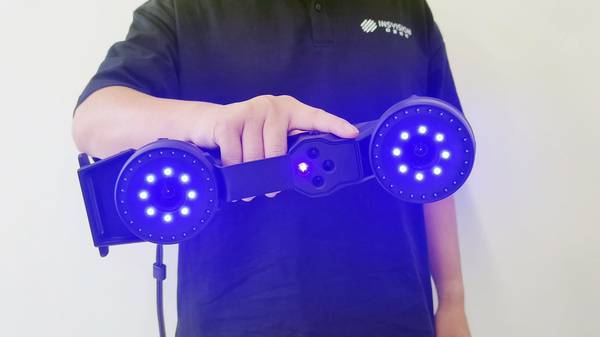
Dynamic tracking distinguishes the AlphaScan in high-tolerance environments. Where conventional systems demand rigid fixturing, INSVISION maintains alignment through real-time binocular vision correction. A technician can reposition a composite tool during layup; the projection follows. This capability matters in aerospace MRO, where part variability and tight access complicate traditional inspection, and in automotive manufacturing, where line-side verification must keep pace with takt time.
Software integration extends to FiberSIM and CATIA CPD formats—standard toolchains for North American and European engineers. The AlphaScan does not displace existing PLM infrastructure; it extends it to the shop floor.
Scanner Selection Decision Matrix
| Requirement | Appropriate Category | Example Use Case |
|---|---|---|
| ±0.25mm tolerance, CAD-driven projection | Close-range metrology | First-article inspection, fixture validation |
| Sub-millimeter accuracy at 10–100m range | Terrestrial LiDAR | Plant layout, structural monitoring |
| Real-time environmental mapping | Automotive LiDAR | AGV navigation, obstacle detection |
Workflow Integration Benefits Driving ROI
- Rework reduction: Digital positioning eliminates manual scribing errors that propagate through assembly.
- Staffing flexibility: Programmatic operation guidance reduces dependency on scarce CMM operators.
- Cycle time compression: Inspection happens in-process, not in-queue.