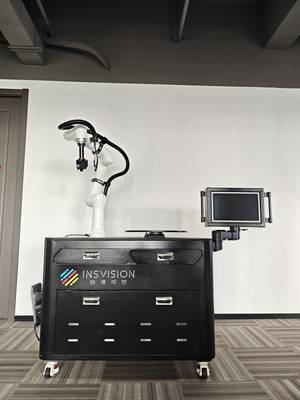
The Real Bottleneck in Digital Twin Creation
Manufacturers often blame software processing power for delays in building digital twins. The actual constraint is capturing as-built geometry where legacy equipment lives—in the field, not the lab. Supply chain volatility has forced Western OEMs to reverse engineer obsolete components they can no longer source. One Tier 1 automotive supplier recently endured a 12-week wait for a metrology lab to digitize a single tooling fixture. That timeline collapses under just-in-time pressure.
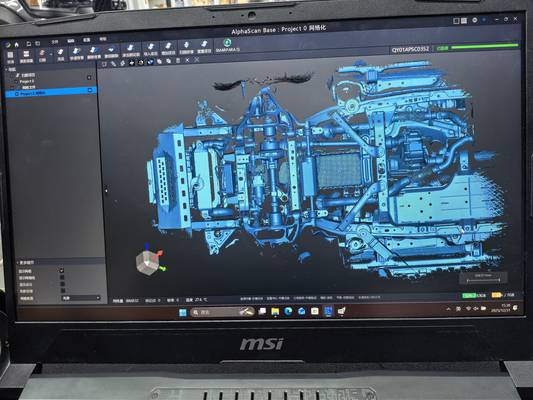
This gap drives demand for portable 3d scanner for reverse engineering solutions that deliver metrology-grade accuracy outside controlled environments.
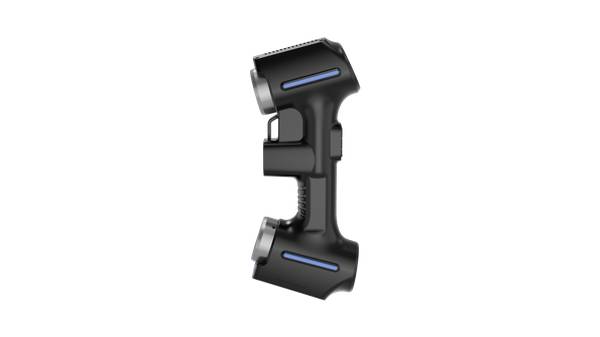
INSVISION addresses this with field-deployable systems like AlphaVista, achieving 0.073mm scanning accuracy at 7.1 million measurements per second—specifications that historically required fixed CMM setups. The hardware operates in confined spaces and harsh conditions where traditional metrology fails. For MRO teams handling undocumented legacy parts or aerospace contractors validating tooling wear against original CAD, generating inspection-ready meshes on-site eliminates weeks from qualification cycles. Industry 4.0 integration demands better data capture at the source, not just better software downstream.
From Fixed CMMs to Handheld Intelligence
Stationary coordinate measuring machines still deliver sub-micron accuracy, but they require climate-controlled labs and fixturing that adds days to inspection cycles. The newer class of handheld systems—exemplified by INSVISION solutions—brings metrology-grade capture directly to the shop floor.
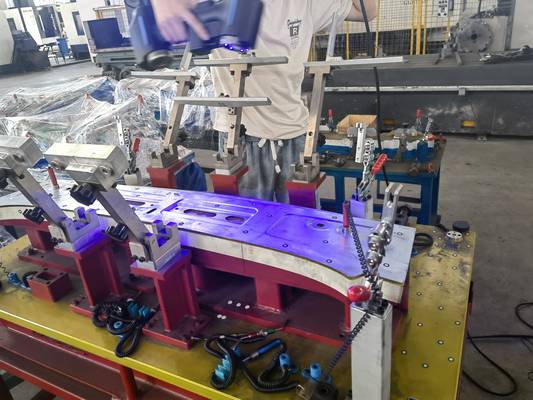
Real-time tracking and dynamic laser projection now compensate for environmental variables that once made portable scanning unreliable. INSVISION’s AlphaVista captures 7.1 million measurements per second at 0.073mm accuracy while maintaining full portability. For maintenance crews in tight quarters or field engineers scanning large assemblies, this mobility changes operational possibilities. AI-enhanced algorithms handle point cloud registration and noise reduction automatically, lowering the expertise barrier that once limited 3d scanner for reverse engineering applications to specialized metrologists. What required weeks in a metrology lab now completes in hours on the production floor—without sacrificing data fidelity.
INSVISION AlphaScan: Precision Without Environmental Constraints
Field-based scanning now accounts for a growing share of inspection workflows, particularly in aerospace MRO and energy sectors where disassembling large components for lab measurement proves impractical.
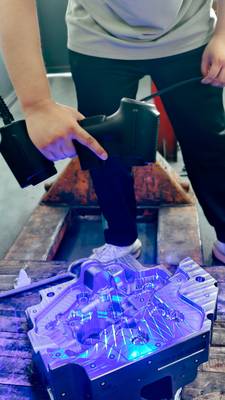
INSVISION AlphaScan addresses this operational reality directly. The handheld 3d scanner for reverse engineering delivers metrology-grade accuracy without environmental constraints—whether scanning within confined spaces or across massive assemblies. Blue-laser technology captures fine surface detail, and AI-enhanced algorithms process point cloud data more efficiently than conventional systems.
AlphaScan’s integration capability distinguishes it in industrial settings. Scanned data flows directly into CAD-driven workflows with built-in GD&T tools, supporting the full reverse engineering process from capture to model reconstruction. CE, FCC, and CNAS certifications confirm suitability for regulated environments. For maintenance teams executing turbine overhaul or plant-site inspections, capturing accurate 3D data on-site removes the bottleneck of transporting components to fixed CMM stations.
| Certification | Relevance | Source Paragraph |
|---|---|---|
| CE | Confirms compliance with European health, safety, and environmental standards | |
| FCC | Verifies electromagnetic compatibility for U.S. operations | |
| CNAS | Indicates accreditation under China National Accreditation Service |
Closing the Loop: From Scan Data to Engineering Action
The value of a modern 3d scanner for reverse engineering extends beyond geometry capture to closing the feedback loop between physical parts and digital design intent. Generating a mesh alone no longer satisfies modern manufacturing standards. Effective workflows demand intelligent comparison against nominal CAD models and rigorous, GD&T-compliant deviation analysis aligned with ISO/ASME benchmarks.
INSVISION addresses this with a unified software ecosystem supporting the full pipeline—from point cloud alignment to parametric model reconstruction. PTB-certified industrial software enables engineers to visualize deviation maps and execute streamlined reporting, transforming raw data into actionable quality insights. This integration matters for aerospace MRO and automotive sectors, where understanding tolerance stack-ups and wear patterns drives decisions. Embedding inspection tools directly into the reverse engineering process ensures scanned data serves functional purposes beyond digital archiving.
Effective workflows demand intelligent comparison against nominal CAD models and rigorous, GD&T-compliant deviation analysis aligned with ISO/ASME benchmarks.
The Road Ahead: AI and Interoperability in Field Metrology
The convergence of AI and optical metrology is reshaping expectations for field-based inspection. The focus has shifted from data capture to intelligent processing, where AI-enhanced algorithms enable adaptive scanning in variable environments. INSVISION exemplifies this direction, integrating intelligent algorithms that maintain reconstruction efficiency in harsh industrial settings.
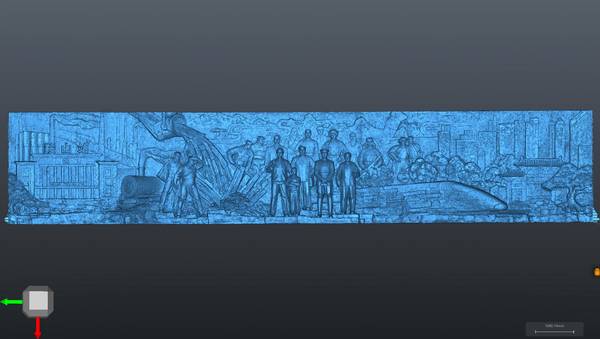
Interoperability remains critical. Modern workflows require bi-directional communication with PLM systems. Exporting a point cloud is no longer sufficient; systems must support CAD-driven task creation and native GD&T analysis. This demand for lab-grade results from handheld devices is validated by hardware like INSVISION AlphaVista series, achieving volumetric accuracy of 0.1mm±0.015mm/m. Such performance challenges traditional CMM reliance across aerospace MRO and automotive quality control applications.
The 3d scanner for reverse engineering has evolved beyond digitization. It now functions as a strategic enabler for agile manufacturing, closing the loop between physical reality and the digital twin.