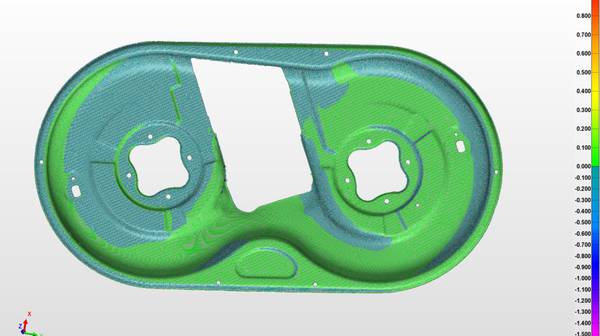
Reclaiming Lost Geometry from Legacy Tooling
Automotive OEMs face a persistent data gap: original CAD models for fixtures installed 15–25 years ago rarely match what sits on the production line. Undocumented weld repairs, shim adjustments, and field modifications have rendered many digital records obsolete. Yet reverse engineering these assets with traditional touch-probe CMMs forces production halts and requires transporting multi-ton tooling to climate-controlled labs—directly contradicting lean manufacturing principles.
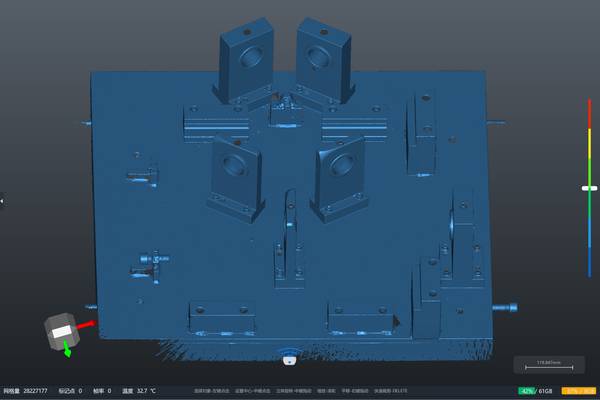
INSVISION addresses this through high-accuracy portable metrology deployed directly at the point of use. Engineers utilizing 3D scanning in automotive industry workflows capture complex surface geometries of large fixtures without dismantling or moving them. The non-contact approach generates dense point clouds suitable for rapid reverse engineering and deviation analysis, compressing what previously required multiple shifts into a single shift. Manufacturers update digital twins of critical assets in near-real-time, enabling replacement parts to be fabricated without disrupting production cycles or compromising ISO 9001/IATF 16949 traceability requirements.
Bridging the Lab-to-Line Divide
Fixed CMMs deliver metrology-grade accuracy, yet their dependency on vibration-isolated granite tables and temperature-controlled environments creates systemic delays. Transporting large sheet metal assemblies or welding fixtures across the plant adds non-value-added time and introduces damage risk during handling.
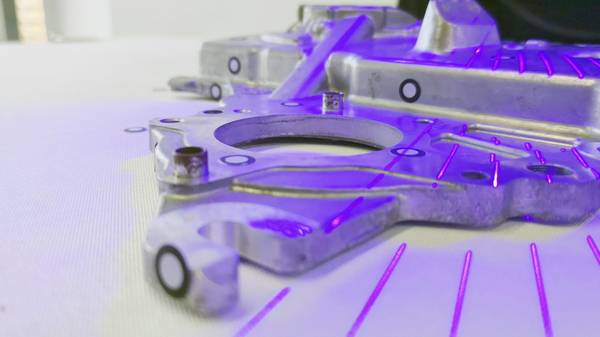
Handheld 3D scanning in automotive industry applications closes this operational gap by bringing measurement capability to the production line. INSVISION solutions enable quality engineers to capture dense surface data in-situ, verifying complex geometries against ISO/ASME GD&T standards without queuing for CMM availability. This shift supports agile manufacturing through rapid first-article inspection and tooling validation performed directly on the shop floor. Plant managers retain the rigorous documentation required by OEM customers while reducing inspection cycle times and eliminating transport-related part damage.
Benefits of In-Situ 3D Scanning vs. Traditional CMM Workflow
| Aspect | Traditional CMM | INSVISION Portable 3D Scanning |
|---|---|---|
| Location | Climate-controlled lab | Production line (in-situ) |
| Tooling Movement | Requires transport of multi-ton fixtures | No dismantling or movement needed |
| Inspection Time | Multiple shifts | Single shift |
| Risk of Damage | High during transport | Eliminated |
| Traceability Compliance | Maintained | Maintained per ISO 9001/IATF 16949 |
Validating Shop-Floor Accuracy for Western Standards
Western quality systems demand rigorous correlation between portable and fixed-base measurement. Implementing 3D scanning in automotive industry environments requires hardware that maintains lab-grade precision amid vibration, temperature variation, and electromagnetic interference from welding equipment.
INSVISION engineers its portable solutions for these conditions, allowing quality managers to inspect complex geometries—deep draw stampings, multi-cavity injection molds, composite layup tools—directly adjacent to assembly operations. The elimination of fixed measuring room bottlenecks represents only part of the value equation. Seamless data integration into existing digital ecosystems proves equally critical: high-density point clouds feed directly into Siemens Teamcenter, Dassault ENOVIA, and specialized quality platforms like PolyWorks or Geomagic Control X. This interoperability minimizes translation errors between acquisition and analysis software, accelerating root cause identification when dimensional drift occurs. By embedding compatibility within established Industry 4.0 architectures, INSVISION helps manufacturers realize ROI through reduced inspection cycles and enhanced statistical process control.
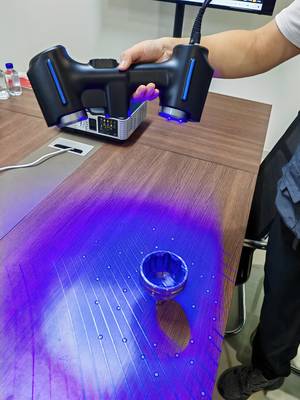
Steps to Integrate Portable Scanning into Existing Digital Ecosystems
- Capture high-density point clouds using INSVISION portable scanners adjacent to assembly operations
- Feed point cloud data directly into enterprise PLM systems such as Siemens Teamcenter or Dassault ENOVIA
- Process and analyze data in specialized quality platforms like PolyWorks or Geomagic Control X
- Minimize translation errors between acquisition and analysis software to accelerate root cause identification
- Embed compatibility within Industry 4.0 architectures to enhance statistical process control
Operational Deployment for Tier 1 Suppliers
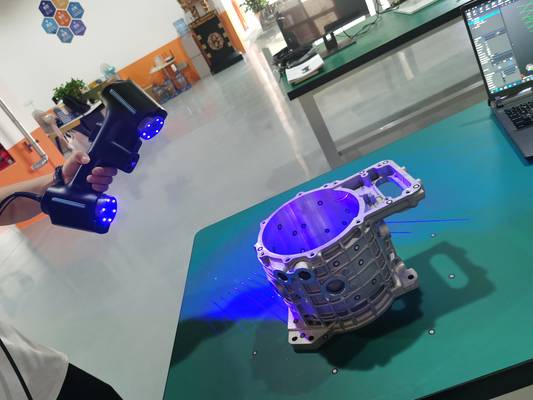
Tier 1 suppliers integrating 3D scanning in automotive industry workflows prioritize equipment that sustains continuous flow. The INSVISION AlphaScan deploys through a rapid setup protocol—operators begin measurement within minutes rather than the hours required to thermally stabilize a fixed CMM enclosure. Training curricula emphasize proficiency over certification speed; technicians typically achieve independent operation in days rather than the multi-week programs associated with programmable CMMs.
Positioning the AlphaScan at critical control points enables real-time GD&T verification without removing parts from assembly fixtures. This immediate feedback loop reduces work-in-progress inventory and prevents scrap accumulation, directly supporting Just-in-Time delivery commitments. The scanner’s portability embeds quality assurance within the assembly sequence rather than segregating it as a downstream bottleneck. Suppliers report measurable throughput gains from reduced inspection queue times and the ability to release conforming parts immediately upon completion.
Key Takeaways: Impact of AlphaScan Deployment for Tier 1 Suppliers
- Rapid setup allows measurement within minutes vs. hours for fixed CMM thermal stabilization
- Technicians achieve independent operation in days, not weeks
- Real-time GD&T verification occurs without part removal from fixtures
- Immediate feedback reduces WIP inventory and prevents scrap buildup
- Conforming parts can be released immediately, improving throughput
Complementary Metrology Strategy
Leading automotive manufacturers treat portable 3D scanning in automotive industry applications as a complement to—not replacement for—fixed CMM infrastructure. CMMs retain primacy for final validation of tight-tolerance features on prismatic components. INSVISION portable solutions excel where rapid feedback delivers greater value: in-process inspection stations, tooling tryout phases, and root cause analysis when dimensional drift emerges.
This strategic allocation maximizes capital equipment ROI. Complex free-form surfaces—body panels, aerodynamic components, interior trim—route to scanners where dense data capture accelerates analysis. Simple prismatic features remain with CMMs optimized for speed on geometrically straightforward parts. The point cloud data generated through INSVISION systems additionally feeds digital twin initiatives, updating virtual models with as-built conditions to ensure simulation environments reflect actual asset geometry. Manufacturers integrating portable scanning within existing quality frameworks reduce unplanned downtime and sustain continuous improvement momentum without disrupting validated CMM workflows.