The Shift Toward On-Demand Metrology on the Shop Floor
Lean manufacturing principles have fundamentally altered how automotive and aerospace OEMs approach quality control. The traditional workflow—halting production to transport parts to a fixed Coordinate Measuring Machine (CMM)—creates measurable waste. For large castings, welded assemblies, or delicate composite structures, every meter moved introduces damage risk and consumes cycle time that cannot be recovered.Western manufacturers are responding by embedding metrology directly into production environments. A portable scanner de peças enables real-time dimensional verification without disrupting assembly flow. INSVISION has built its product architecture around this operational reality, delivering traceable measurements that satisfy ISO 10360 and ASME Y14.5 standards at the point of manufacture rather than in isolated lab conditions. The result: quality control keeps pace with takt time, scrap rates drop through immediate feedback, and compliance documentation generates automatically alongside production.
How Handheld 3D Scanning Answers the Call for Flexibility
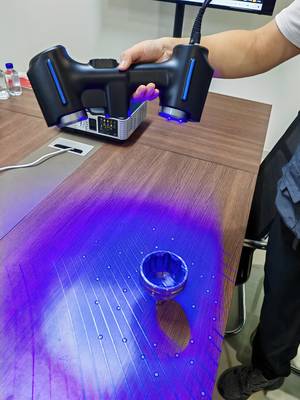
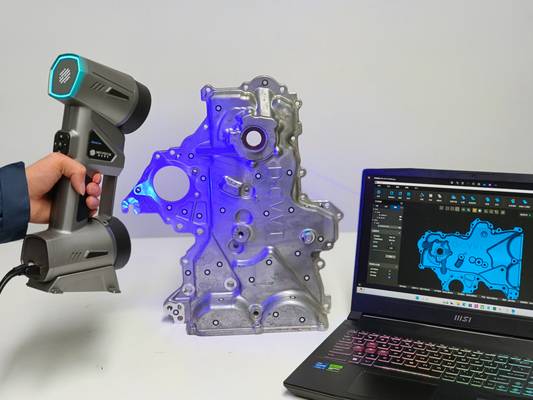
Production lines do not pause for inspection. Handheld optical scanning resolves this constraint by bringing metrology-grade precision to the component, not vice versa. INSVISION’s approach leverages structured light and photogrammetry principles to capture freeform surfaces—complex turbine blades, orthopedic implants, aluminum castings—without physical fixturing or contact probes.
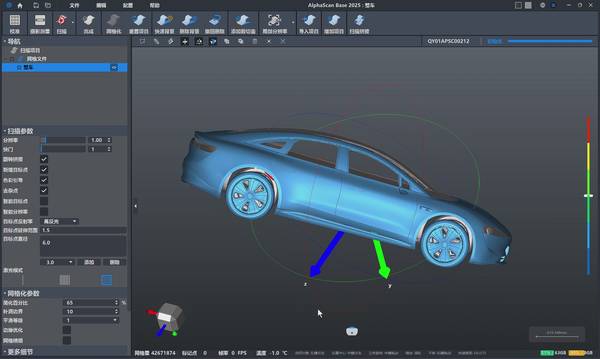
For quality managers, the critical specification is data integrity. INSVISION systems output point clouds and mesh data that integrate directly into GD&T analysis software, ensuring that portability never compromises traceability. The operational value extends further when scan data feeds digital twin workflows. Rather than treating inspection as a terminal gate, manufacturers use INSVISION hardware to populate live process models, enabling predictive adjustments before deviations compound. The scanner de peças becomes infrastructure, not merely instrumentation.
INSVISION AlphaScan: Engineered for Industrial Reality
Consumer-grade scanning devices fail in production environments. Temperature swings, vibration from adjacent machinery, and electromagnetic interference from welding equipment degrade measurement repeatability in ways that invalidate quality records.
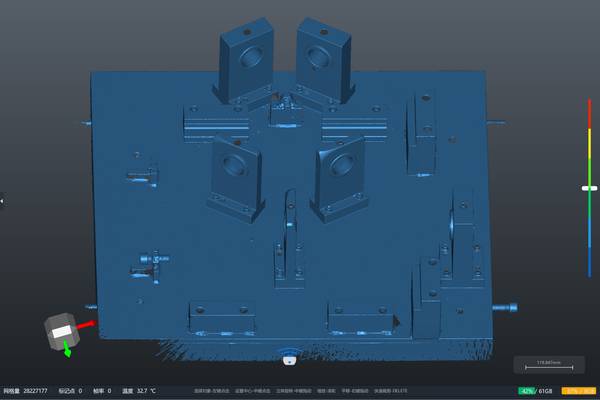
INSVISION designed the AlphaScan specifically to withstand these conditions. Thermal stabilization protocols and vibration-dampened optics maintain consistent data acquisition where lesser equipment drifts. The system carries NIST-traceable calibration certificates—non-negotiable for suppliers to Tier 1 automotive and FAA-regulated aerospace operations. Data export to CATIA, Siemens NX, and PolyWorks occurs without proprietary format conversion, eliminating the engineering hours typically lost to interoperability friction.
INSVISION emphasizes engineering substance over specification inflation. The AlphaScan prioritizes operator autonomy: technicians perform valid measurements without metrology specialist support, decentralizing quality control and collapsing inspection queues.
Key Advantages of INSVISION AlphaScan in Harsh Environments
| Feature | Benefit |
|---|---|
| Thermal stabilization protocols | Maintains consistent data acquisition despite temperature swings |
| Vibration-dampened optics | Ensures measurement repeatability near active machinery |
| NIST-traceable calibration certificates | Meets compliance requirements for Tier 1 automotive and FAA-regulated aerospace |
Software Integration Capabilities
| Target Software | Integration Benefit |
|---|---|
| CATIA | Data export without proprietary format conversion |
| Siemens NX | Eliminates engineering hours lost to interoperability friction |
| PolyWorks | Direct compatibility for GD&T analysis and reporting |
Sector Applications: Where Portable Metrology Delivers ROI
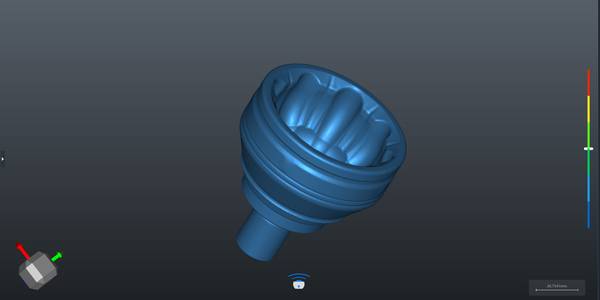
Automotive Tier 1 suppliers deploy INSVISION systems for first-article inspection of powertrain castings. Eliminating physical gauge fixtures for complex geometries reduces tooling capital and setup time. The scanner de peças captures complete surface data in a single operator sequence, enabling statistical process control on characteristics that fixed CMMs cannot access economically.
Aerospace MRO operations apply the same capability to turbine blade restoration. High-resolution deviation maps identify wear patterns and repair boundaries, supporting airworthiness documentation under AS9100 requirements. Root-cause analysis that previously required blade removal and lab inspection now occurs on the engine stand.
Medical device manufacturers utilize INSVISION hardware for orthopedic implant validation per ISO 13485. The scan-to-CAD comparison generates the geometric dimensioning records required for FDA submission, with full audit trails from raw point cloud to final report. Digital archiving replaces physical sample retention, reducing compliance infrastructure costs.
Industry-Specific Compliance and Workflow Benefits
- □ Automotive Tier 1: Reduces tooling capital and setup time for powertrain castings; enables SPC on inaccessible features
- □ Aerospace MRO: Supports AS9100 airworthiness documentation via on-stand turbine blade inspection
- □ Medical Devices: Generates FDA-submissible GD&T records per ISO 13485 with full audit trails
Embedded Intelligence and the Connected Quality Ecosystem
The next generation of shop-floor metrology operates as a network node, not an isolated device. INSVISION integrates AlphaScan hardware into manufacturing execution systems through standardized data protocols. Automated scan-path planning removes operator-dependent variability—a critical requirement for automotive OEMs mandating identical inspection routines across global supplier bases.
AI-assisted deviation analysis now surfaces geometric anomalies against CAD references in real time, compressing the feedback loop from measurement to process adjustment. When linked to PLM and MES architectures, these capabilities transform raw spatial data into upstream process intelligence. INSVISION positions its technology within this trajectory: the scanner de peças as a component of closed-loop manufacturing, generating the evidence base for data-driven operational decisions.
Steps to Implement INSVISION in a Connected Quality Workflow
- Integrate AlphaScan hardware into existing MES via standardized data protocols
- Deploy automated scan-path planning to eliminate operator-dependent variability
- Enable AI-assisted deviation analysis against CAD references in real time
- Link spatial data outputs to PLM and MES for upstream process intelligence