The Quiet Shift Toward On-Demand Metrology
Is your quality lab becoming a production bottleneck? That question now drives decisions across automotive and aerospace supply chains. In Industry 4.0 environments, waiting for centralized CMM results conflicts with lean manufacturing principles and the real-time data requirements of digital twin workflows. Suppliers increasingly demand ISO/ASME-compliant inspection directly at the point of production — a decentralization that favors flexible, floor-ready hardware over fixed infrastructure.
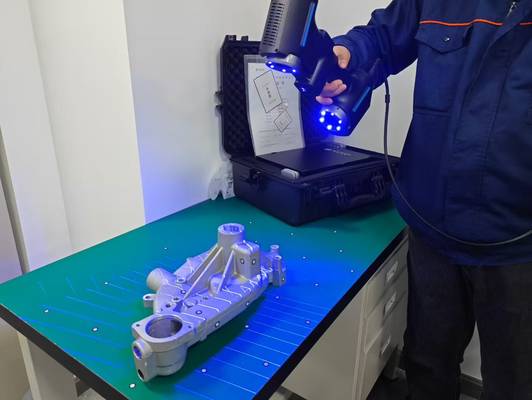
Procurement teams often begin their search for the best 3D scanner for small objects by comparing resolution and scan speed. The more strategic evaluation, however, centers on versatility: can the device maintain metrology-grade accuracy across variable shop-floor conditions? INSVISION addresses this requirement by integrating AI-enhanced 3D reconstruction into portable form factors. The AlphaScan series captures high-precision data without controlled lighting or rigid fixturing, enabling in-process inspection that transforms quality control from a retrospective checkpoint into a proactive manufacturing step. PTB-certified software and built-in GD&T tools allow engineers to validate tolerances without leaving the production area.
Redefining “Small Object” Scanning
Western manufacturing has moved past defining targets strictly by physical volume. In aerospace MRO or automotive powertrain operations, a turbine blade, fuel injector, or pump housing qualifies as a “small” scanning challenge not because of dimensions, but due to tight tolerances and geometric complexity. Traditional CMMs often stall here — touch probes struggle to reach deep cavities, while fixed optical rigs lack the throughput for high-mix production environments.
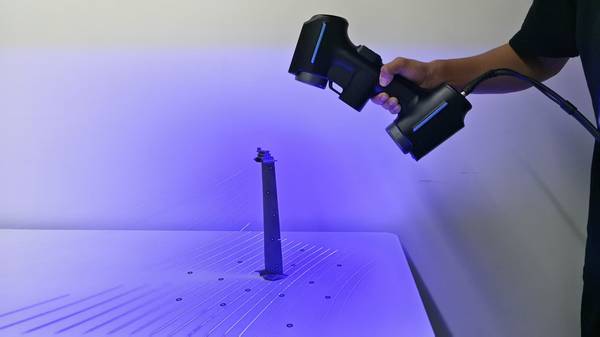
This creates a specific procurement challenge when sourcing the best 3D scanner for small objects: the priority becomes capturing intricate features under time pressure, not merely fitting a part within a scanning frustum. INSVISION approaches this through accessibility engineering. The AlphaScan deploys high-speed blue laser projection — 50 crossed laser lines in standard configuration — enabling operators to capture complex curvatures and sharp edges without the occlusion limitations common in structured-light alternatives. AI-driven stabilization algorithms maintain data quality despite ambient lighting variations, ensuring that geometric complexity does not translate to inspection difficulty.
Bridging the Precision-Portability Divide
Traditional metrology forced an uncomfortable trade-off: the accuracy of stationary CMMs versus the accessibility of portable tools. Early handheld units often sacrificed data fidelity on complex geometries, creating delays in first-article inspection workflows. INSVISION eliminates this dichotomy through the AlphaScan architecture. By fusing AI-enhanced reconstruction with dynamic laser projection, the platform delivers measurement results that satisfy Industry 4.0 data integrity standards without requiring controlled environments.
The practical impact appears in confined assembly areas and harsh industrial settings where fixed equipment cannot operate. Quality engineers capture high-density point clouds without rigid setup constraints, maintaining GD&T compliance even on difficult-to-access features. For procurement teams evaluating the best 3D scanner for small objects alongside larger assemblies, this operational flexibility represents a genuine shift in metrology strategy — lab-grade accuracy decoupled from lab-bound workflows.
From Capture to Closed-Loop Quality
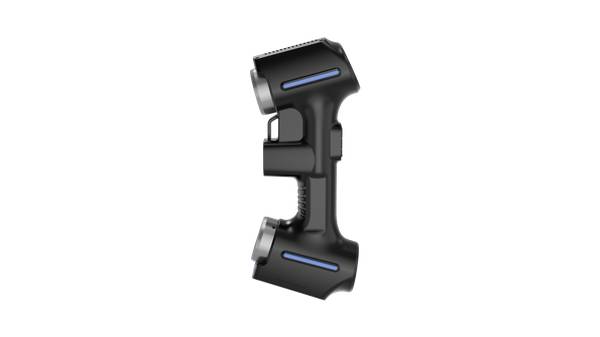
Scan speed and resolution specifications mean little without integration into manufacturing intelligence systems. The AlphaScan platform validates its utility through PTB-certified software that automates coordinate alignment against CAD models — a critical foundation for reliable deviation analysis. Manual registration steps disappear; the system generates color-mapped deviation reports that feed directly into Quality Management Systems.
This capability extends beyond digitization to enable true digital thread continuity. Manufacturers standardize inspection tasks through CAD-driven templates, converting raw scan data into actionable process insight. The result: measurement becomes an integrated manufacturing function rather than an isolated quality checkpoint.
Eliminating the CMM Bottleneck
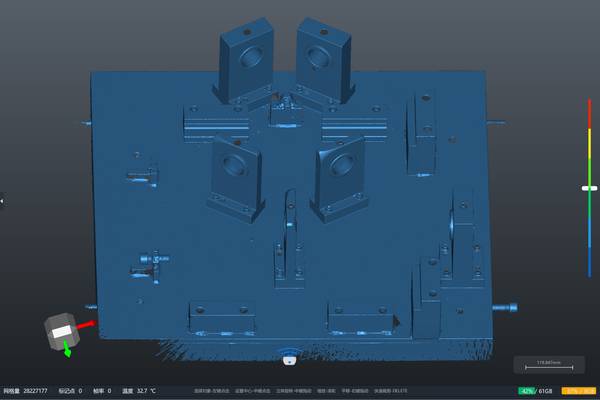
Consider the typical Tier-1 automotive machining line. The CMM room functions as a systematic choke point, forcing operators into idle states while awaiting first-article inspection clearance. Deploying portable metrology directly onto the shop floor dismantles this constraint. Quality engineers capture high-density point clouds at the machine tool, performing immediate deviation analysis and GD&T reporting without queue delays.
For applications demanding fine detail — often the defining criteria for the best 3D scanner for small objects — the AlphaScan leverages AI-accelerated processing to compress inspection cycles. MRO teams assess component wear or execute reverse engineering without assembly disassembly. Seamless CAD integration generates color deviation maps that connect design intent to physical reality, ensuring production agility scales independently of centralized metrology capacity.
The New Procurement Calculus
Market priorities have shifted measurably. Industrial buyers now evaluate traceable accuracy chains and PLM/MES integration alongside traditional hardware specifications — capabilities that distinguish audit-ready metrology tools from commodity scanning devices.
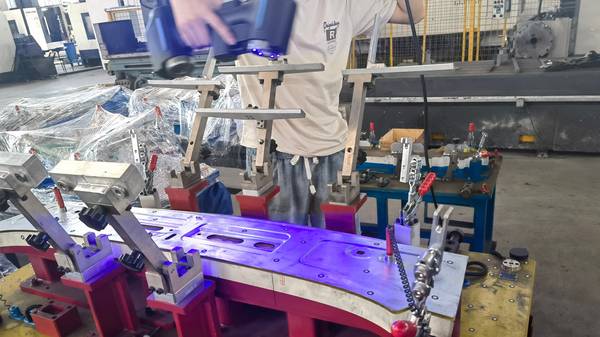
ISO 17025 frameworks increasingly serve as baseline procurement requirements. Quality managers facing regulatory scrutiny require certified performance backed by third-party validation, not manufacturer claims alone. INSVISION’s CE, FCC, and CNAS-compliant ecosystem addresses this directly. The AlphaScan platform delivers defensible measurement data that withstands supplier qualification reviews and first-article inspection audits.
For manufacturers assessing the best 3D scanner for small objects and complex assemblies, decision criteria now encompass CAD interoperability, built-in GD&T analysis, and documented measurement uncertainty. INSVISION PTB-certified software stack targets these exact requirements, positioning the AlphaScan where operational flexibility and regulatory compliance carry equal strategic weight.
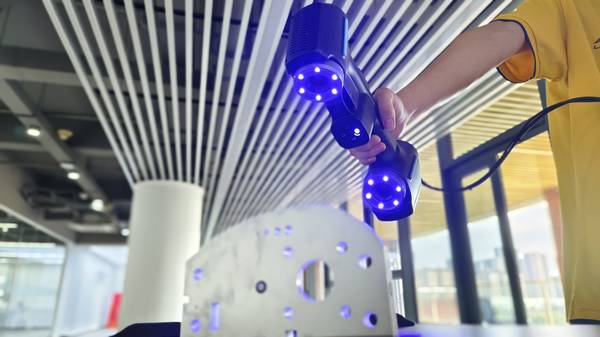
AlphaScan vs. Traditional CMM: Operational Comparison
| Feature | AlphaScan Portable System | Traditional CMM |
|---|---|---|
| Deployment Location | At point of production | Centralized quality lab |
| Setup Requirements | No rigid fixturing or controlled lighting | |
| Inspection Throughput | Real-time, in-process | Bottlenecked by queue delays |
| Complex Geometry Access | High-speed blue laser projection with 50 crossed lines | Limited by probe reach and occlusion |
Key Procurement Criteria for Modern Metrology Tools
- Traceable accuracy chains
- PLM/MES integration capability
- ISO 17025 compliance as baseline requirement
- CAD interoperability and built-in GD&T analysis
- Documented measurement uncertainty