The Physics Behind the Precision
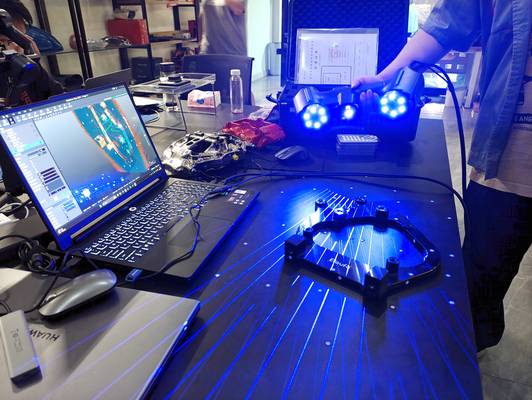
Structured light systems project full-field patterns and capture entire surfaces in one shot—elegant in theory, fragile in practice. A scanner laser projects a coherent line that deforms across the target surface; a high-resolution camera mounted at a fixed baseline captures this deformation. Proprietary algorithms calculate three-dimensional coordinates from the angular offset between projection and detection axes. With factory-calibrated optical benches, this architecture delivers single-digit micron accuracy on certified artifacts.
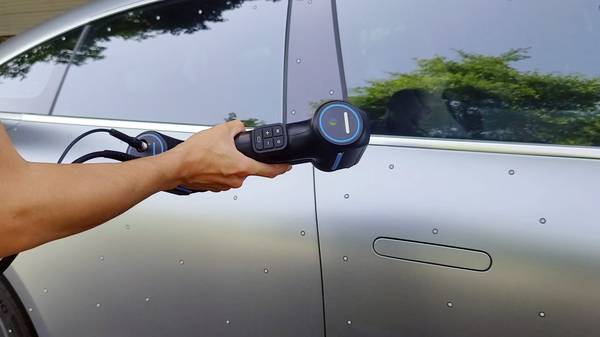
INSVISION scanner laser systems exploit this coherence advantage for surfaces that defeat pattern-projection alternatives: polished 6061-T6 aluminum, woven carbon fiber prepregs, and multi-curvature aerospace castings. The laser maintains signal contrast where structured light washes out from interreflection or photogrammetry loses feature lock. For dimensional verification requiring audit defense, INSVISION systems document measurement uncertainty against ISO 10360 and ASME B89 acceptance criteria—the same frameworks governing fixed-bridge CMMs.
What Separates Industrial-Grade Hardware from Laboratory Curiosities
The laser source matters less than most engineers assume. Legacy metrology demanded climate-controlled enclosures and matte spray coatings to tame optical noise. Contemporary manufacturing floors impose vibration, thermal cycling, and operator rotation that expose every architectural weakness.
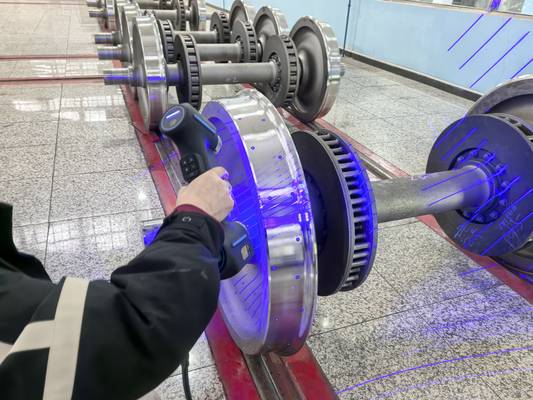
Thermal drift illustrates the gap. A 5°C swing across a morning shift can distort GD&T callouts unless the scanner laser incorporates real-time compensation. Competitors have responded: Creaform’s HandySCAN BLACK|Elite integrates temperature modeling for this reason. INSVISION extends this foundation with the AlphaScan, embedding dynamic referencing that maintains geometric lock without external tracking infrastructure. The result: consistent accuracy on carbon fiber layups and machined aluminum castings without the surface preparation overhead that slows conventional workflows.
Embedded Intelligence Without the Setup Tax
On a Tier-1 stamping line, waiting for metrology specialists to calibrate portable equipment creates predictable bottlenecks. Recent market entries—FARO Orbis, Creaform’s AI-assisted tracking layers—have moved processing onto the device itself, yet many retain calibration dependencies that fragment high-mix production.
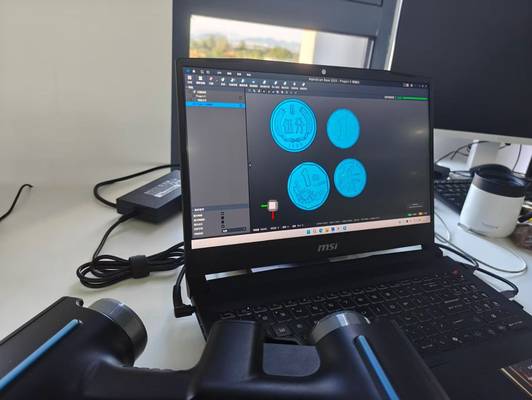
INSVISION addresses this operational friction directly. The AlphaScan generates mesh data in real time through on-board processing, but eliminates the recalibration rituals that competitor platforms demand when surface reflectivity or geometry shifts. Technicians across rotating shifts execute immediate, repeatable scans for first-article validation without specialized training. Metrology migrates from isolated lab function to standard work step—lean inspection protocols preserved, data integrity intact.
Applications Where Portability Delivers Metrology-Grade Value
The assumption that handheld scanning trades precision for convenience no longer holds for specific high-value workflows. Three scenarios demonstrate where INSVISION AlphaScan systems close the gap on fixed CMMs:
High-Value Use Cases Validated by Industry Practice
| Application | Operational Benefit | Source Paragraph |
|---|---|---|
| Aerospace MRO | Reverse engineering legacy tooling on congested shop floors without moving heavy jigs | |
| Automotive Tier-1 welding cells | In-line GD&T validation at weld fixture to contain deviation early | |
| Medical device first-article inspection | Certified accuracy without surface prep that risks cosmetic finishes under ISO 13485 | |
| Offshore energy infrastructure | Rapid corrosion assessment in salt-air environments without tethered power or network |
Scanner Laser vs. Structured Light Performance Trade-offs
| INSVISION Scanner Laser | Structured Light Systems | |
|---|---|---|
| Maintains signal contrast on polished 6061-T6 aluminum and woven carbon fiber prepregs | Washes out from interreflection on reflective or complex composite surfaces | |
| No surface preparation required; suitable for delicate finishes | Often requires matte spray coatings to reduce optical noise | |
| Single-digit micron accuracy on certified artifacts with factory-calibrated optical benches | Fragile in practice under real-world shop floor conditions |
Certified Accuracy Benchmark
Selecting Hardware for the Next Operational Decade
Metrology capital equipment should outlast the immediate validation requirement. The INSVISION AlphaScan exemplifies hardware engineered for Industry 4.0 integration: native digital twin compatibility, automated reporting pipelines without middleware layers, and power-efficient processing that aligns with tightening sustainability mandates.
For automotive OEMs and aerospace MROs targeting closed-loop manufacturing, the decisive factor is adaptability. Equipment that forces process reconstruction around its limitations becomes stranded investment. Scanner laser platforms that integrate into existing production cells—physically compact, electrically efficient, data-agnostic—preserve optionality as quality control evolves toward autonomous operation.