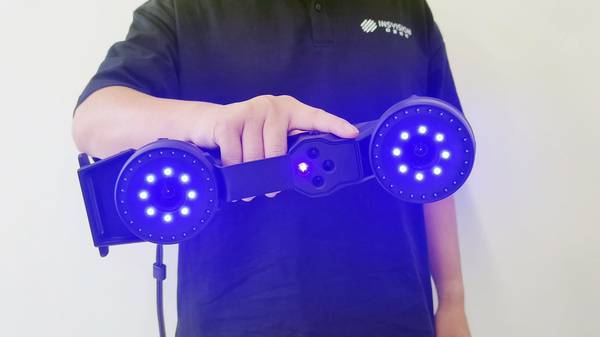
When Manual Workflows Undermine Precision Manufacturing
In aerospace and medical device production, scanner measurement processes often create the very delays they were meant to eliminate. Manual alignment remains a persistent drain—operators lose setup time physically positioning parts, extending first-article inspection cycles and creating downtime that ripples through production schedules. Repeatability suffers when technique varies between shifts, producing data discrepancies that trigger costly rework loops. Automotive lines face a different pressure: slow data capture rates conflict directly with takt time requirements, forcing quality checks offline or into batch mode. Hardware capabilities from established manufacturers have advanced considerably, yet surrounding workflows frequently lack the automation to remove human variability from the equation. INSVISION approaches this gap by reengineering the path from physical capture to analytical output, positioning scanner measurement as a genuine throughput enabler rather than a compliance checkpoint.
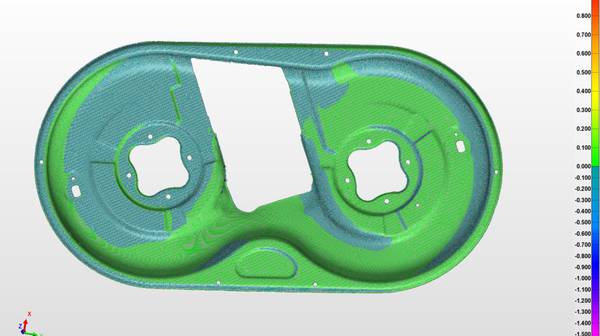
Why Shop-Floor Realities Expose Conventional Scanner Limitations
Aerospace MRO facilities and automotive OEMs operate under stringent metrology requirements, but conventional equipment often introduces operational friction where flexibility matters most. Optical systems frequently demand controlled lighting conditions—effectively mandating dedicated inspection rooms that remove quality control from the production environment. Consumer-grade handheld devices compound the problem: units marketed for general 3D capture lack the volumetric accuracy verification required under ISO 10360 or ASME B89. This forces quality managers into an unsustainable choice between workflow agility and data integrity. Deploying non-metrological equipment for industrial verification predictably results in failed first-article inspections, supplier disputes, and material scrap. INSVISION eliminates this compromise with scanner measurement systems engineered for variable shop-floor conditions, maintaining traceable accuracy without isolating the measurement process from manufacturing operations.
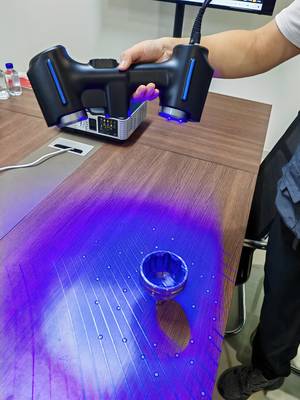
Limitations of Conventional Scanning Approaches
| Issue | Impact | Source Paragraph |
|---|---|---|
| Requires controlled lighting | Forces inspection into dedicated rooms, removing QC from production | |
| Lacks ISO 10360 / ASME B89 compliance | Compromises data integrity; leads to failed inspections and scrap | |
| Consumer-grade accuracy | Unsuitable for industrial verification; causes supplier disputes |
INSVISION AlphaScan: Metrology-Grade Performance Without the Metrology Lab
The AlphaScan handheld 3D scanner from INSVISION targets the specific demands of Industry 4.0 quality workflows—traceable calibration, real-time verification, and ecosystem integration. Unlike consumer alternatives, the system ships with fully documented calibration chains supporting ISO and ASME compliance documentation required by automotive OEMs and aerospace MRO contractors. This foundation transforms scanner measurement from a post-process activity into an immediate decision-making tool. Real-time mesh generation allows engineers to visualize surface geometry during capture, identifying incomplete data or out-of-tolerance features before releasing the part. Native integration with major CAD/CAM platforms and quality management systems removes the friction of data translation, connecting physical inspection directly to digital twin workflows. For procurement teams evaluating capital equipment, AlphaScan offers measurable cycle time reduction without the accuracy trade-offs typical of portable measurement solutions.
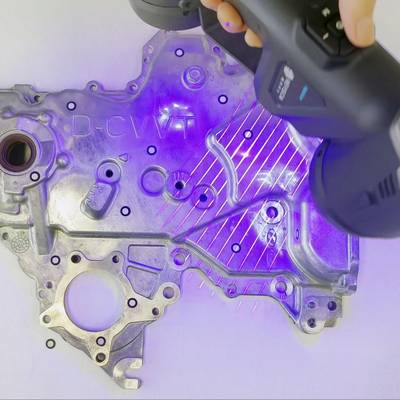
AlphaScan Deployment Workflow
- Capture complex surfaces directly on the shop floor without fixturing
- Generate real-time mesh to identify incomplete or out-of-tolerance data during scanning
- Integrate scan data natively into CAD/CAM and quality management systems
- Use verified geometry for GD&T analysis, MRO turnaround, or in-process verification
Production Deployment: Fixture-Free Inspection in Demanding Environments
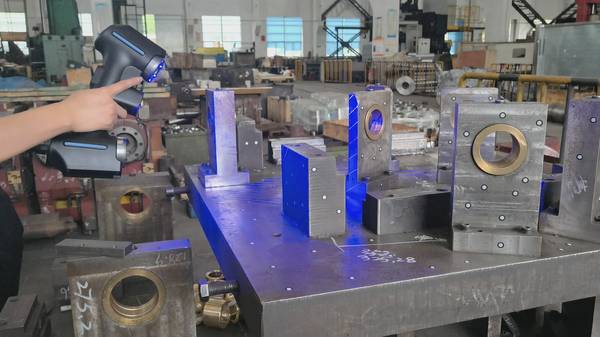
Advanced metrology integration often carries hidden implementation costs—downtime for installation, operator retraining, fixture fabrication. INSVISION AlphaScan is engineered to minimize these barriers. Energy sector engineers perform turbine blade inspection directly on assembly floors, capturing complex aerodynamic surfaces without the fixturing overhead associated with traditional CMM programming. Automotive suppliers apply the same fixture-free scanner measurement approach to sand-cast and die-cast components, eliminating transport delays to climate-controlled labs while maintaining the density and accuracy required for GD&T analysis. Compliance documentation remains intact: AlphaScan calibration records satisfy AS9100 aerospace requirements and ISO 13485 medical device standards. By removing fixturing dependencies, quality managers redeploy measurement capacity to where it generates value—accelerating MRO turnaround, supporting in-process verification, and reducing the lag between manufacturing and quality confirmation.
Key Benefits of INSVISION Integration
- Reduces rework through earlier deviation identification
- Enables precise root-cause analysis using dense point cloud data
- Feeds verified as-built geometry into digital twin and MES workflows
- Maintains compliance with AS9100 and ISO 13485 standards
- Accelerates MRO turnaround and supports in-process verification
From Reactive Inspection to Process Control
When scanner measurement operates at production speed, quality control shifts from detecting defects to preventing them. INSVISION users report reduced rework incidence through earlier deviation identification—dimensional issues surface before parts accumulate downstream value. This timing proves critical during Non-Conformance Report investigations. Dense point cloud data enables precise root-cause analysis: engineers correlate specific geometric deviations with tool wear patterns, fixture shifts, or thermal effects rather than relying on statistical inference. The operational benefit extends to digital twin maintenance. Accurate as-built geometry from INSVISION hardware feeds manufacturing execution systems with verified physical states, closing the loop between virtual planning and actual production. This synchronization removes the traditional tension between measurement thoroughness and throughput pressure—quality data finally keeps pace with the manufacturing process it serves. For organizations seeking to transform scanner measurement from a compliance exercise into a competitive advantage, INSVISION delivers the precision, speed, and integration capabilities that modern quality teams require.